By Staff Reporter
ISLAMABAD: Pakistan has told a gathering of Muslim-majority nations at the United Nations that India cannot simply walk away from its international obligations “when they become inconvenient”, reigniting a bitter dispute over a six-decade-old water-sharing treaty that has become the latest flashpoint between the nuclear-armed neighbours.
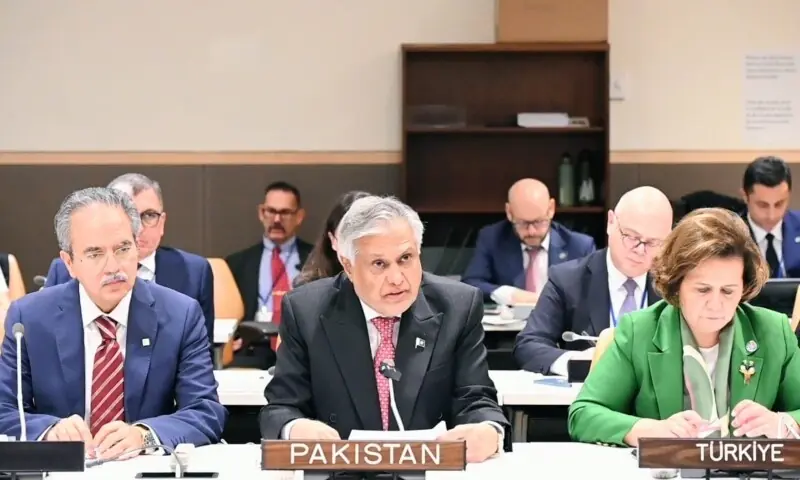
Ishaq Dar, Pakistan’s deputy prime minister and foreign minister, used an address to the Organisation of Islamic Cooperation’s Contact Group on Jammu and Kashmir in New York on Wednesday to insist that the Indus Waters Treaty remains legally binding on India, despite New Delhi’s refusal to accept a recent international arbitration ruling that went against it.
Speaking on the sidelines of the 81st session of the UN General Assembly, Dar told delegates that the treaty “contains no provision permitting its unilateral suspension”, and warned that India’s attempt to hold the accord in abeyance had introduced “another dangerous dimension” to relations between the two countries.
“International obligations cannot be set aside when they become inconvenient,” he said. “India cannot invoke domestic law to negate Security Council resolutions on Jammu and Kashmir, any more than it can resort to unilateral measures to evade its binding obligations under the Indus Waters Treaty.”
The comments come three weeks after the Permanent Court of Arbitration in The Hague delivered a unanimous ruling that the 1960 treaty “remains fully in force” and that India “must observe its obligations” under it, including rules governing hydropower projects on rivers flowing into Pakistan. The five-member panel found that no principle of international law allowed a state to unilaterally suspend a treaty of this kind, rejecting every argument New Delhi had advanced to justify its position.
But the ruling has done little to resolve the impasse. India has refused to recognise the court’s authority altogether, branding it an “illegally constituted” body whose pronouncements carry no weight. New Delhi did not take part in any of the arbitration hearings and has continued to insist, as recently as this week, that the tribunal has no jurisdiction over what it regards as sovereign decisions concerning its hydroelectric projects in the region.
The exchange escalated further on Tuesday, when India’s foreign ministry accused Pakistan of “misrepresenting facts and propagating falsehoods” after Islamabad circulated a letter to the president of the UN Security Council seeking to have the arbitration findings recognised. Ministry of External Affairs spokesperson Randhir Jaiswal told reporters in Delhi that Pakistan “needs to demonstrate action and firm commitment” and take “credible action against cross-border terrorism before the world believes it would do what it says”.
India moved to suspend the treaty in April last year following a militant attack in Pahalgam, in Indian-occupied Kashmir, in which 26 people were killed. New Delhi blamed Pakistan for the attack, a charge Islamabad has repeatedly denied, and said the water-sharing arrangement would remain suspended until Pakistan took “credible and irreversible” steps to end support for cross-border militancy.
The fallout from the Pahalgam attack pushed the two countries into a brief but intense military confrontation the following month, in what Dar described on Wednesday as a stark illustration of the dangers of leaving the Kashmir dispute unresolved after nearly eight decades.
“Two nuclear-armed states came into direct military conflict over a dispute that has remained unresolved for almost eight decades,” he told the OIC meeting, adding that Pakistan had acted only in self-defence, “in a measured and proportionate manner”, under Article 51 of the UN Charter, after what he called baseless allegations and military aggression from India.
“Whether in South Asia or the Middle East, military force cannot resolve longstanding political disputes,” he said. “Dialogue, diplomacy and just resolution of the root causes in accordance with international law remain the only sustainable way forward.”
Much of Dar’s address was devoted to the situation inside Indian-occupied Kashmir, where he accused New Delhi of pursuing a sustained campaign to alter the region’s demographic and cultural character since it revoked the territory’s semi-autonomous status in August 2019.
He told the OIC gathering that Kashmiri leaders, activists, journalists and young people continued to face arbitrary detention, torture and persecution under what he called “draconian laws”, including India’s Public Safety Act, while political organisations had been outlawed and dissent criminalised.
Dar said changes to domicile rules, land laws, electoral boundaries and voter registration, combined with property demolitions and measures affecting the region’s religious and cultural heritage, had been used to reshape “realities on the ground”. He also accused India of curtailing media freedom in the region, saying journalists faced intimidation and surveillance, that the Kashmir Press Club had been forcibly shut down, and that social media accounts had been blocked while international media and independent observers were denied access.
In support of these claims, the foreign minister pointed to a joint communication issued by United Nations special procedures in October last year, which he said had documented the detention of around 2,800 people, including journalists and human rights defenders, alongside home demolitions, the blocking of roughly 8,000 social media accounts, and incidents of hate speech and intimidation targeting Kashmiris and Muslims.
“These are not isolated violations,” he said. “Taken together, they reveal a sustained effort to silence a people, transform the identity of their homeland and foreclose their right to self-determination and their own future.”
Dar argued that Kashmir remained an “internationally recognised dispute” still on the UN Security Council’s agenda, and that no domestic law, court ruling, election or demographic shift could substitute for what he called the Kashmiri people’s “inalienable right to self-determination” — a reference to long-standing UN resolutions calling for a plebiscite in the region, which have never been implemented.
Pakistan pushes for coordinated diplomatic action
Dar used the address to press OIC member states to move beyond statements of support and toward what he called “sustained diplomatic action”. He asked the bloc to maintain a unified position at the UN and other international forums, to press India to reverse measures introduced since August 2019, and to call for the release of political prisoners and detainees in the region.
He also urged the OIC to demand unrestricted access to Indian-occupied Kashmir for its special envoy, for a fact-finding mission, for the Office of the UN High Commissioner for Human Rights, for UN special procedures, and for international media and independent observers — and to back calls for an updated report on the human rights situation there.
“The Kashmiri people are only asking the international community to deliver what was provided to them decades ago,” Dar said. “The right to self-determination is already recognised, and the mechanism for its exercise has already been prescribed by the [Security Council]. What remains is the fulfilment of the solemn international commitment.”
He thanked the OIC secretary-general and the bloc’s Independent Permanent Human Rights Commission for what he called their “steadfast and principled support” for Kashmiris, and reaffirmed Pakistan’s stated commitment to a peaceful settlement of the dispute in line with Security Council resolutions.
The meeting was expected to conclude with the Contact Group considering a joint communique on the issue, though the outcome of those deliberations had not been made public as of Wednesday evening.
Pakistan’s foreign minister is in New York for a packed schedule of engagements during the UN’s high-level week, which runs until Friday. Alongside the Kashmir meeting, Dar is also due to take part in discussions on Palestine, artificial intelligence and pandemic preparedness, and will chair a meeting of the Economic Cooperation Organisation’s council of ministers, as part of what the Pakistani foreign ministry has described as an “extensive and wide-ranging” diplomatic programme.
Copyright © 2021 Independent Pakistan | All rights reserved