By Staff Reporter
RAWLAKOT: At least seven civilians and four police officers were killed on Sunday in the deadliest violence to grip Azad Jammu and Kashmir in years, as clashes between security forces and supporters of the newly banned Joint Awami Action Committee tore through Rawlakot, leaving a territory already on edge now staring down a deepening political and security crisis.
Poonch Commissioner Sardar Waheed Khan confirmed the civilian death toll to Dawn newspaper on Monday, a day after the confrontation that also left 23 police officers wounded and resulted in 30 arrests by Sunday night. The commissioner and AJK Inspector General Liaqat Ali Malik provided the updated figures together — the first official accounting of civilian casualties after authorities had initially focused almost entirely on law-enforcement losses in their public statements.
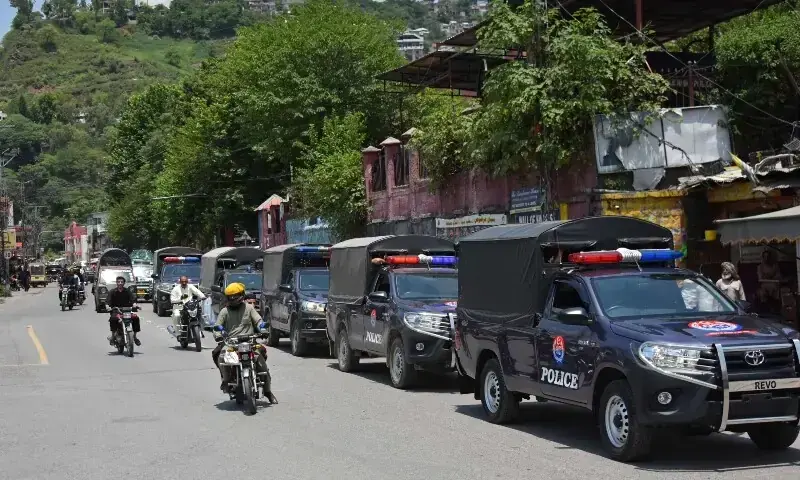
The revised toll of at least 11 dead underscored how swiftly a political standoff had collapsed into something far more dangerous. Federal paramilitary forces were being rushed into the territory to reinforce a police force that officials privately acknowledged was stretched thin. Mobile data services remained severed across Azad Kashmir, making independent verification of conditions on the ground all but impossible. And the territorial government issued an extraordinary advisory telling prospective visitors to postpone any travel to the region until June 20, citing security concerns ahead of protests that the JAAC had called for Monday.
The Confrontation
The events that produced Sunday’s bloodshed had been building for days — and, by some accounts, for months.
Tensions ignited on Friday night when a local trader was shot during a confrontation with law enforcement officers in Rawlakot, a city of roughly 50,000 in the Poonch district. His death set off an immediate chain of grief and fury. His family initially announced a Saturday funeral, then reversed course, returning the body to the Combined Military Hospital — known locally as CMH — apparently seeking a postmortem examination, and postponing burial until Sunday.
The postmortem was never conducted. Through Saturday night and into Sunday, scores of people kept vigil outside the hospital in a sit-in that, according to a senior administration official who spoke on condition of anonymity, increasingly disrupted access for patients, their families, and ordinary commuters. Police asked the crowd repeatedly to disperse. They refused.
When a police party arrived on Sunday to move the protesters, witnesses said a confrontation escalated rapidly. Officers deployed batons and fired tear gas. Demonstrators responded with stones. Then, according to police, gunfire erupted.
Inspector General Malik, in a statement released on Sunday night, said four of his officers had been shot and killed in what he characterised as a deliberate armed assault on the hospital itself. He accused JAAC’s leadership of orchestrating the attack under the cover of protest, calling it a “planned, armed and terrorist act” and pledging criminal prosecution for those responsible.
The family of the slain trader, meanwhile, refused to yield. They would not bury their son, a family member said, until the government rescinded the notification proscribing the JAAC. “Our son faces the allegation of being a terrorist,” the family member said. “We will not bury him until the notification branding JAAC as a terrorist group is withdrawn.”
A Crackdown Already Underway
Sunday’s violence did not arrive without warning. The AJK government had declared the JAAC a proscribed organisation on Friday, accusing it of being “engaged in terrorism” and of acting in a manner “prejudicial to peace and security” in the region. The timing was conspicuous: the JAAC had called a major protest for Monday, and the government moved against it days before demonstrators were set to gather.
On Saturday, authorities launched a broad crackdown, arresting scores of JAAC leaders and activists across the territory. By Sunday, police had sealed the group’s central office in Muzaffarabad, AJK’s capital, where officers recovered a submachine gun, a 12-bore rifle, and a pistol during a search of the premises. A large crowd stood outside during the raid but offered no resistance and raised no slogans — a detail that complicated the official portrait of an organisation on the verge of insurrection.
The 30 additional arrests confirmed on Monday brought the total detained since the crackdown began to a number that opposition figures and civil liberties observers said raised serious questions about the government’s methods.
Islamabad signalled its own alarm by dispatching federal paramilitary forces to reinforce AJK’s police, whose ranks had been badly strained by days of sustained unrest.
What the JAAC Wanted
The coalition at the center of the crisis had spent months occupying an unusual position in Azad Kashmir’s political landscape — a popular movement pressing an agenda that blended economic grievances with a loaded constitutional demand.
On the economic side, the group had called for lower energy prices and free healthcare for residents of a territory where household costs have climbed sharply in recent years. On the political side, it had demanded the abolition of 12 seats in the AJK Legislative Assembly reserved for Kashmiri refugees — descendants of those who fled Indian-administered Jammu and Kashmir during the conflicts of 1947 and 1965 and resettled across mainland Pakistan.
The JAAC argued that those seats had been systematically exploited by mainstream Pakistani political parties to tilt power in Muzaffarabad. Critics of the government said that however one viewed the demand, banning an organization for making it — particularly days before a scheduled protest — was a disproportionate and legally dubious response.
Pakistan Tehreek-e-Insaf was blunt on the point. “If JAAC was truly a terrorist organization,” the party said in a statement, “why did the government spend months negotiating with it, signing agreements with it, implementing its demands, holding meetings with its leadership and treating it as a legitimate stakeholder until yesterday?”
Minister for Parliamentary Affairs Tariq Fazal Chaudhry, appearing at a news conference on Sunday, waved away such questions. “Out of 38 demands, 35 have been addressed,” he said, calling the opposition’s criticism “negative and false propaganda.”
The Court Weighs In
Amid the violence, the Azad Kashmir Supreme Court released an advisory opinion responding to questions submitted by AJK President Chaudhry Latif Akbar about the constitutional status of the refugee seats and the government’s obligations regarding the upcoming elections.
Chief Justice Raja Saeed Akram Khan held that the refugee seats are guaranteed by Article 22 of the AJK Constitution, rooted in legislative history dating to 1960, and can only be altered through a formal constitutional amendment under Article 33 — a process requiring a sitting legislature with a full democratic mandate, deliberation, and broad consensus. No executive order, political agreement, or public pressure campaign could lawfully accomplish what the JAAC was demanding.
“The amendment of the constitution is a solemn constitutional act, not a concession to be wrested from a government under duress,” the chief justice wrote.
The court also addressed the limits of the right to protest with notable directness. Peaceful assembly, it affirmed, is a fundamental right — but not an unconditional one. Road blockades, forced business closures, and supply-route disruptions fall outside constitutional protection because they extinguish the rights of others. Attempts to secure constitutional change through coercive means, the court said, are “legally unenforceable” and incompatible with the rule of law.
The court directed the AJK Election Commission to proceed with general elections — set for July 27 — without delay. The constitutional obligation to hold timely elections, it held, “admits of no exception.”
A Territory on Edge
As of Monday morning, Azad Kashmir remained in a volatile and largely opaque condition. The information blackout imposed by the mobile data shutdown left residents, journalists, and outside observers without a clear picture of conditions across the territory. Officials in Muzaffarabad were controlling the narrative; the version being told by people on the ground in Rawlakot and other affected areas was largely inaccessible.
The government’s advisory warning visitors away until June 20 suggested authorities themselves were uncertain about what the coming days might bring. The JAAC’s planned protest for Monday had not been formally called off. Whether its supporters — some of whom had, by the government’s account, fired weapons at police the previous day — would attempt to gather regardless remained an open question.
The elections scheduled for July 27 cast a long shadow over everything. The AJK Supreme Court had said they must proceed. The Election Commission had said preparations were underway. But holding a credible vote in a territory where eleven people had died in a single day of unrest, where a major political organization had just been banned, and where federal paramilitary forces were now on the streets would require a degree of stability that nothing in recent days had done much to inspire.
Copyright © 2021 Independent Pakistan | All rights reserved