By Staff Reporter
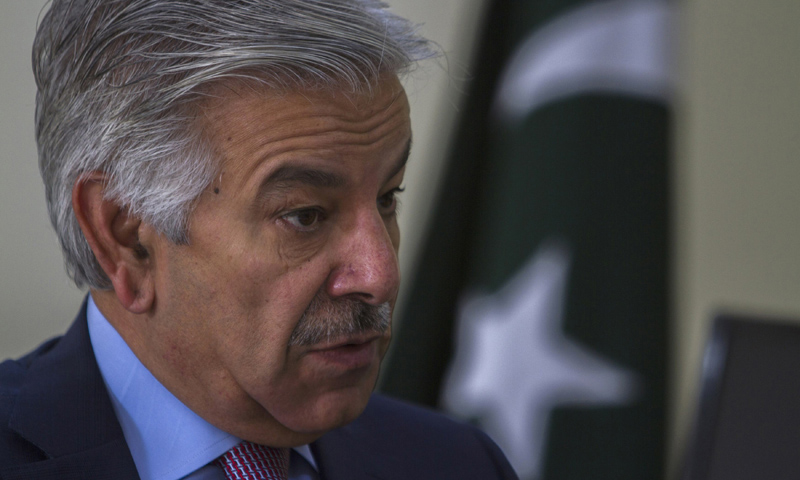
ISLAMABAD: Pakistan’s Defence Minister Khawaja Asif warned his Indian counterpart on Thursday that any armed conflict between the two nuclear-armed nations would be “inconceivable” and carry “drastic consequences,” delivering a pointed rebuke amid rising tensions over the anniversary of last year’s attack in Indian occupied Kashmir.
The comments, posted on the social media platform X, were a direct response to recent remarks by Indian Defence Minister Rajnath Singh. According to Indian media reports, Singh cautioned Pakistan against any “misadventure” while the world’s attention is focused on the ongoing war in the Middle East, promising an “unprecedented and decisive” response to any provocation.
Asif’s post, which tagged Singh but did not explicitly quote his statement, framed the Indian minister’s rhetoric as a sign of weakness rather than strength. “Repeated rhetoric reflects not strength, but visible strategic anxiety as the anniversary of the staged false flag operation in Pahalgam approaches — an episode that failed to withstand international scrutiny and exposed New Delhi’s reliance on manufactured crises,” Asif wrote. “Such threat-mongering is not new; it is part of a predictable pattern — externalising internal fragility, and attempting to provoke escalation under the garb of unsubstantiated allegations for vested political interests.”
The Pahalgam attack occurred on April 22, 2025, when tourists were killed in the scenic Himalayan town in occupied Kashmir. India immediately blamed Pakistan for orchestrating the assault, though it offered no public evidence to support the claim. Pakistan categorically denied any involvement and called for a neutral international investigation. The accusations triggered a brief but sharp military escalation between the two neighbors.
India responded with missile strikes inside Pakistani territory, which Islamabad said killed civilians and security personnel. Pakistan countered by downing seven Indian fighter jets — including three Rafale aircraft — along with dozens of drones and destroying an S-400 air defense system. The fighting, which Pakistan’s army described as its “Operation Bunyanum Marsoos,” lasted until May 10, when a ceasefire was brokered by the United States. Islamabad later officially named the entire period of conflict — from the Pahalgam attack through the May 10 ceasefire — “Marka-i-Haq,” or “Battle of Truth.”
In his X post Thursday, Asif invoked that episode as a cautionary tale. “History stands as a stark reminder that miscalculation has consequences,” he wrote. “Marka-i-Haq remains fresh in our minds. The next time our response will be even more forceful and decisive.” “Let there be no ambiguity: Pakistan remains committed to peace and regional stability, but its resolve to defend sovereignty is absolute, its preparedness complete, and its response will be swift, calibrated, and decisive.”
Asif closed with a direct address to Singh: “Let me remind Rajnath Singh that the illusion of space for war between two nuclear states is inconceivable and has drastic consequences. India would be better served by confronting the growing unease within its own strategic and diplomatic space.”
The exchange shows the persistent fragility of relations between India and Pakistan, which have fought three wars since 1947, two of them over the disputed Himalayan territory of Kashmir. Both countries claim the entire region but administer only portions of it. Pakistan has long accused India of suppressing dissent and human rights violations in the part of Kashmir under its control. India, for its part, maintains that Pakistan supports militant groups operating in occupied Kashmir, an allegation Islamabad denies.
Pakistan has repeatedly described past incidents in Kashmir as Indian “false flag” operations designed to justify crackdowns or divert attention from domestic problems. Thursday’s public exchange comes as the one-year anniversary of the Pahalgam attack nears, a period both sides have historically treated with heightened military alertness.
Copyright © 2021 Independent Pakistan | All rights reserved