By Staff Reporter
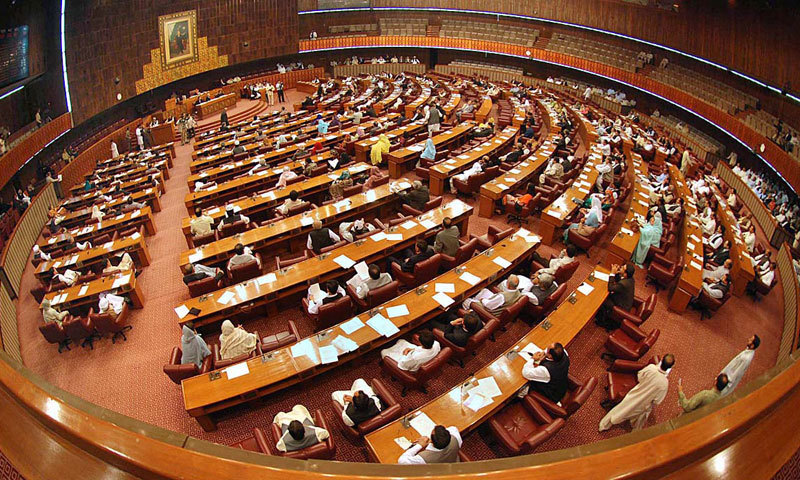
ISLAMABAD: Pakistan’s parliament has endorsed the imposition of emergency in Khyber Pakhtunkhwa, giving legal cover to the federal government’s removal of the opposition PTI party from power in the northwestern province.
The National Assembly passed the resolution by majority vote on Wednesday after a debate lasting more than four hours. The Senate followed within hours, with PTI senators staging a walkout. Opposition members were reported to have torn up copies of the resolution before leaving.
President Asif Ali Zardari proclaimed the emergency under Article 232 of the constitution on Sunday, on the federal cabinet’s recommendation. It came with governor’s rule under Article 234. The government says the provincial administration, led by Sohail Afridi, deliberately disengaged from the fight against terrorism. The PTI says the real target was its planned long march to Islamabad to demand the release of its founder, Imran Khan.
Article 232 requires both houses to approve a presidential emergency within 10 days. Governor’s rule, by contrast, goes to a joint sitting. It lapses after two months unless extended, and can never run beyond six months. A joint sitting has been summoned for 11.30am on Thursday to consider it. Party sources say the Pakistan People’s Party (PPP) will vote with the government.
Parliamentary Affairs Minister Tariq Fazal Chaudhry tabled the motions in both houses. In the Senate, Law Minister Azam Nazeer Tarar rejected opposition complaints about procedure, saying the seven-day notice rule did not apply to a resolution laid under constitutional necessity. “An attempt to bypass the constitutional procedure cannot succeed,” he said. Senate chairman Yousuf Raza Gilani told noisy opposition benches: “This is not a classroom.”
Opposition senators questioned both the motives and the legality of the move. Hamid Khan, a PTI-backed senator, described the Centre’s talks with the opposition as “a drama” held “only to deceive the people”. “Neither is there any Constitution nor any court in the country,” he said, adding that the 26th Amendment had stripped the judiciary of its independence. His colleague Humayun Mohmand alleged the decision had been taken months earlier and that terrorism was an excuse. Jamiat Ulema-i-Islam (F) senator Kamran Murtaza said the government had not supplied the material justifying the proclamation, leaving senators to find it on social media.
In the lower house, Tarar said the security situation in the province had become a threat to national security. He told members the cabinet examined material on terrorism on 11 October before advising Prime Minister Shehbaz Sharif to recommend the emergency. He said a special mechanism had been introduced for 12 districts. He put the number of terrorist incidents in Khyber Pakhtunkhwa at 2,911 between 2021 and 2024, and at 3,787 between 15 October 2025, when Mr Afridi’s government took office, and 9 October this year. The two periods differ in length, and the figures are the government’s own.
PPP chairman Bilawal Bhutto-Zardari, whose party backs the coalition, offered the sharpest defence of the move. “The PTI itself carried out a political suicide attack on its KP government,” he said. He called the emergency a “difficult decision” and “always a stopgap measure”, and urged the government to extend its hand for talks once more. He said negotiations on 3 October had come close to success, with the PTI willing to declare areas of surging militancy as “terrorist areas”, before collapsing. He also pointed to India’s role in militancy in Pakistan, an allegation Delhi has long denied.
PTI chairman Gohar Ali Khan said his party “rejected” the emergency. He asked what terrorism Imran Khan’s wife or sisters were accused of, and called for the production of party MPs he said were in custody. He said the government had put forward five reservations in the 3 October talks and that the PTI was prepared to align the provincial police act with those of Punjab and Sindh. He also welcomed Bilawal’s call for dialogue.
Defence Minister Khawaja Asif attacked the PTI’s record on militancy, citing the former government’s plans to resettle members of the banned Tehreek-i-Taliban Pakistan. “You do not have clean hands, you cannot demand equity,” he said. He claimed that Mr Afridi took directions from a person in Afghanistan, an allegation the PTI has not been reported to have answered in the debate. Farooq Sattar of the Muttahida Qaumi Movement-Pakistan said the decision had been “so unavoidable that you had no other option”. Opposition leader Mehmood Khan Achakzai questioned the government’s mandate after the February 2024 general election.
The debate was calmer than usual. Sharif attended part of the session and was photographed shaking hands with Achakzai. Speaker Ayaz Sadiq told PTI members that “your hands were tied” during the talks, and backed reviving the negotiating committees if needed.
Outside parliament, the legal fight has begun. Gohar filed a petition in the Peshawar High Court on Wednesday seeking to have governor’s rule set aside. The petition argues that the 18th Amendment requires a prior provincial assembly resolution to declare an emergency on grounds of internal disturbances, and asks for Mr Afridi and his cabinet to be reinstated. It also challenges the military deployment ordered under Article 245.
The PTI says Afridi and several cabinet members were abducted on Sunday. His brother has asked the court to trace his whereabouts. The party’s provincial media cell has alleged that police abducted Mr Afridi’s lawyer, Bashir Wazir, outside the high court. Neither claim has been independently verified, and the government has not publicly said where Mr Afridi is held.
In Peshawar, containers have been removed from roads, schools have reopened and traffic is returning to normal, though security remains tight in sensitive areas.
Copyright © 2021 Independent Pakistan | All rights reserved