By Staff Reporter
ISLAMABAD: Pakistan Peoples Party (PPP) chairman Bilawal Bhutto-Zardari has offered to personally ask Prime Minister Shehbaz Sharif to end emergency rule in Khyber-Pakhtunkhwa (K-P) if the Pakistan Tehreek-e-Insaf (PTI) agrees to talks that make the measure unnecessary.
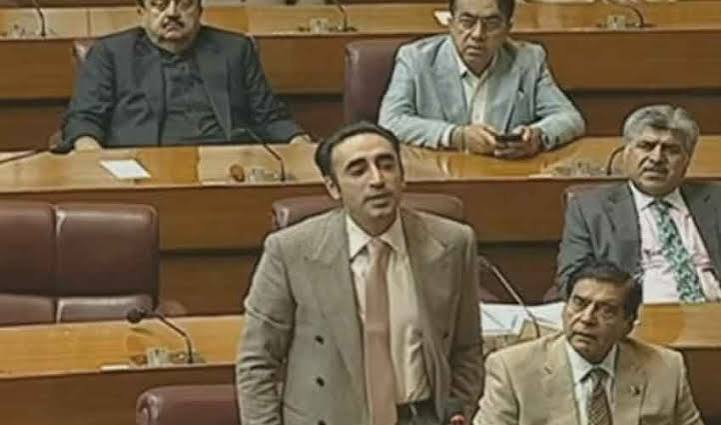
Speaking in the National Assembly on Wednesday, Bhutto-Zardari said the invitation to the PTI stood even now.
“Even today, I invite you to come and hold talks with the government and political parties and create conditions in which there will be no need for this emergency in K-P,” he said. “If you create these political conditions, I will personally stand in this House and request the prime minister that the time has come to end this emergency.”
The offer came from a party that backed the emergency and governor’s rule imposed on 11 October, which suspended the PTI-led provincial government of Chief Minister Sohail Afridi. Bhutto-Zardari said the federal government had made every possible political effort to engage the opposition before taking what he called a “constitutional atom bomb”. He accepted that the opposition had every right to speak against the decision, but argued that the PTI could not deny its own part in creating the circumstances that led to it.
He accused the party of carrying out a “political suicide attack” on its own government in K-P. Opposition leaders, he said, could blame the federal government or President Asif Ali Zardari for the loss of their provincial government, but the PTI’s provincial leadership had played a significant role. Responsible figures in the opposition understood this, he said, even if they were unwilling to say so publicly.
He said that when the proposal first reached the president and the PPP, their position was that the government should engage the PTI and the opposition first. The aim, he said, was to answer Islamabad’s allegation that the provincial government was not cooperating in the fight against terrorism, and so remove any legal, constitutional or political justification for the step.
Two PPP representatives, including the party’s parliamentary leader in the Senate, sat on the committee negotiating with the opposition, he said. He had been unsure whether the talks would succeed, but late one night he was told they were moving towards agreement.
Under the proposed understanding, the provincial government would declare the areas worst hit by terrorism as terrorist-affected. He said the opposition had also agreed in principle that the federal government, the provincial government and the chief minister would draw up an agreement on how to combat terrorism jointly. He had regarded this as a major political achievement, he said, believing the government, its allies and the opposition could work together on an issue of national importance.
Bhutto-Zardari criticised what he called the “non-functional” chief minister for taking an oath from supporters not to cooperate with federal counter-terrorism efforts. He asked whether such conduct amounted to political suicide. The PPP, whose leaders and workers had died in the fight against terrorism, had no justification for opposing measures to address the threat, he said.
He also referred to President Zardari’s role in restoring the 1973 Constitution and introducing the 18th Amendment. He argued that the opposition had failed to give the president any constitutional, legal or political reason to reject the step.
Even so, he stressed that the emergency was temporary and could not continue indefinitely. He said the decision had been necessary in the circumstances, but that an emergency alone could not provide a permanent solution to terrorism. Eliminating it “from Khyber to Khuzdar” required cooperation across the country, he said, and he urged the opposition to fulfil its responsibilities.
He said K-P was the province worst affected by terrorism, and that tensions with Afghanistan had added to the challenge. He called the present threat more complicated than in the past. He said India had not accepted the outcome of its recent military confrontation with Pakistan, in which he claimed Pakistan had shot down six aircraft. He alleged that India was sponsoring terrorism in Pakistan through the Tehreek-e-Taliban Pakistan and separatist groups, and that it had a role in developments in Afghanistan. He also claimed that “Zionist forces” were interfering in Pakistan’s internal affairs and backing militant groups in Balochistan and K-P.
The federal government did not want to fight on several fronts at once, he said, including India, the Baloch Liberation Army, the TTP and a political confrontation with the PTI. It wanted parties to work together instead. He said the PPP and other parties would not retreat from the fight against terrorism, even if some refused to take part.
Bhutto-Zardari also urged the PTI to treat parliament as the forum for resolving national issues, even if it did not accept other institutions or forums for negotiation. He proposed a parliamentary committee on terrorism and national security with members from both sides of the House, and said the PPP was ready to work with the opposition on such a mechanism. He recalled that the National Action Plan was agreed through consensus during Nawaz Sharif’s government, with both government and opposition taking part.
He acknowledged that the PPP and other parties shared responsibility for the shrinking of political space, but said the PTI could not deny its own role. Restricting one party’s political space inevitably affected other parties and ordinary citizens, he said. He urged the PTI not to undermine opportunities for dialogue through its own actions.
The constitutional decision on K-P had already been taken, he said, but efforts to defeat terrorism and give relief to the province’s people would continue. He said political negotiations remained necessary to create conditions in which the emergency could be withdrawn.
The PTI has called the emergency an attack on the province’s electoral mandate and has turned to the courts. Law Minister Azam Nazeer Tarar told the House that talks mediated with the help of Speaker Ayaz Sadiq broke down when the PTI delegation asked what facilities could be provided to its jailed founder, Imran Khan. That was a matter for the courts, he said. Senate opposition leader Allama Raja Nasir Abbas has alleged that the negotiations were a sham.
Copyright © 2021 Independent Pakistan | All rights reserved