By Staff Reporter
ISLAMABAD: The European Union’s top diplomat arrived in Pakistan’s capital Monday and offered Islamabad a striking public endorsement: that its behind-the-scenes diplomacy between Washington and Tehran had, on more than one occasion, helped pull the world back from the edge.
Kaja Kallas, who serves as vice president of the European Commission and the bloc’s high representative for foreign affairs and security policy, said Pakistan had earned recognition across Europe for its role as the principal mediator in a conflict that has throttled global energy supplies and raised the specter of a broader regional war.
“Pakistan has been the main mediator between the United States and Iran,” Kallas said at a joint news conference with Deputy Prime Minister and Foreign Minister Ishaq Dar after co-chairing the eighth EU-Pakistan Strategic Dialogue, the highest formal platform between the two sides. “Your diplomatic efforts have helped prevent a return to full-blown war on several occasions, and these efforts are much recognized and appreciated across Europe.”
The visit — the first by an EU foreign policy chief to Pakistan in seven years — came at a moment of unusual diplomatic turbulence. Hostilities between the United States and Iran broke out on Feb. 28 following American and Israeli strikes on Iranian targets, triggering retaliatory strikes from Tehran and the near-closure of the Strait of Hormuz, the narrow waterway through which roughly a fifth of the world’s oil and gas supplies flow. Islamabad brokered a two-week ceasefire on April 8 and then hosted direct talks between American and Iranian representatives on April 11 and 12. Those talks ended without a permanent agreement, but Pakistan has continued backchannel efforts to narrow the distance between Washington and Tehran.
Kallas said Pakistan’s efforts had created a “tenuous diplomatic opening” to extend the fragile ceasefire and reopen the strait — though she was careful to frame the moment as a beginning, not an end. “Any temporary understanding between the US and Iran must be followed by deeper talks about Tehran’s nuclear stockpile and other critical issues,” she said. “Lasting stability will require more encompassing solutions.”
She added that the EU saw itself as a useful player in any eventual arrangement, citing the bloc’s economic influence, institutional experience with nuclear negotiations, and longstanding ties across the Gulf region. “I see a concrete role for the EU in helping to make any eventual agreement durable,” Kallas said, “whether through maritime operations, economic incentives that support long-term stability, or other issues.”
The diplomatic flattery, however, came paired with pointed language about conditions attached to Pakistan’s most valuable economic lifeline with Europe. Pakistan is the world’s largest beneficiary of the EU’s Generalized Scheme of Preferences Plus, a trade arrangement that grants developing countries duty-free or sharply reduced tariff access to European markets in exchange for commitments on human rights, labor standards, environmental protection, and governance. The EU is Pakistan’s single largest export destination — a market that Kallas noted is larger than the United States and China combined — and bilateral trade stands at roughly 12 billion euros annually.
Since 2014, when Pakistan was first granted GSP+ status, the country’s exports to the EU have more than doubled, with garments, textiles, sporting goods, and surgical instruments among the primary beneficiaries.
“GSP+ has clear conditions,” Kallas said, her tone shifting. “Continued preferential access to the EU market depends on progress in implementing the international conventions underpinning the scheme. This includes good governance, environmental protection and, particularly, labor and human rights. We look to Pakistan to demonstrate tangible progress on these issues.”
The warning echoed remarks from the EU’s ambassador to Pakistan last November, who said Islamabad needed to “do better” on blasphemy laws, enforced disappearances, and minority rights. In December, the EU acknowledged certain steps Pakistan had taken while reiterating the need for further reforms over the medium and long term.
Kallas also praised the scale of academic engagement between the two sides — noting that Pakistan has topped the EU’s global Erasmus Mundus scholarship rankings for the fifth consecutive year — and said both sides were deepening ties in climate resilience, digital infrastructure, clean energy, migration, and labor mobility.
On Afghanistan, she took a notably harder line than the carefully diplomatic language that typically surrounds the issue. Pakistan has been “locked in a conflict with Afghanistan,” she said, and the fighting in recent weeks has had “grave humanitarian consequences” while risking further instability and radicalization across the region. She called on both sides to exercise restraint and acknowledged Pakistan’s right to defend itself under international law — but added that “dialogue, not airstrikes, are the best option in this situation.”
Dar, standing alongside Kallas, welcomed the EU’s recognition of Pakistan’s Iran diplomacy and framed the visit itself as a marker of how much the bilateral relationship had accelerated. He noted that the gap between this strategic dialogue and the one held in November 2025 was, by his reckoning, the shortest interval between any two such sessions in the relationship’s history, and that Kallas’s presence in Islamabad was itself a signal of momentum.
“We have been constantly in touch during last year’s India-Pakistan war, and so are we in touch during the regional conflict between the US and Iran,” Dar said. “We believe that the EU as an institution embodies the universal ideals of peace, diplomacy, democracy, and commitment to human rights.”
Dar also used the occasion to raise the dispute over the Indus Waters Treaty, saying a May 15 supplemental award by the Permanent Court of Arbitration had vindicated Pakistan’s position that the treaty places substantive limits on India’s ability to control water flows on western rivers. He briefed Kallas on Pakistan’s stance on Indian-administered Kashmir, urging a resolution consistent with UN Security Council resolutions and what he described as the wishes of the Kashmiri people.
On counterterrorism, Dar said both sides discussed the threat emanating from Afghan soil, identifying the militant groups Fitna al-Khawarij and Fitna al-Hindustan as top concerns.
Both governments agreed to hold the ninth round of the Strategic Dialogue next year in Brussels. Kallas is also scheduled to meet President Asif Ali Zardari, Prime Minister Shehbaz Sharif, and Army Chief Field Marshal Asim Munir during her stay, as well as representatives from Pakistani think tanks and academic institutions.
Dar said he hoped the visits would multiply. “I’m optimistic,” he told reporters, “that this will be one of many.”
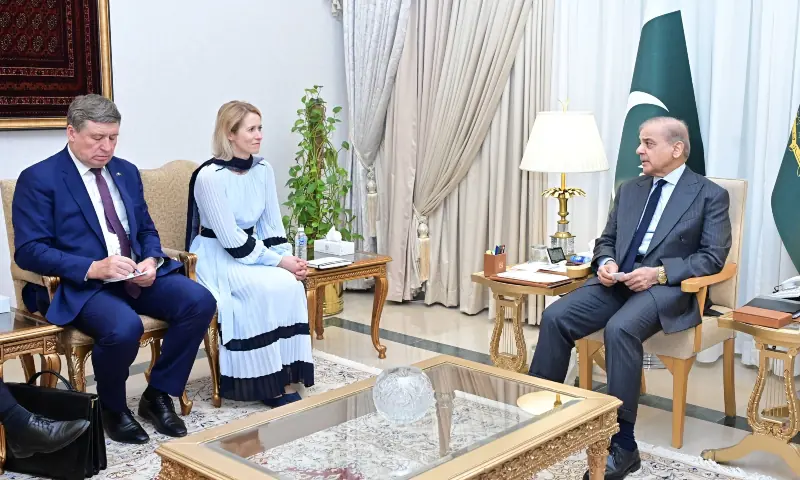
Later on Monday, Kallas moved from the Foreign Ministry to Prime Minister’s House, where Shehbaz Sharif received her in a meeting that reinforced the day’s central themes while adding a personal dimension to the diplomatic outreach.
Sharif thanked the EU leadership for what he called its “strong support” for Pakistan’s peace efforts in the Gulf, singling out Dar and Army Chief Field Marshal Asim Munir as playing a “crucial role” in the ongoing mediation between Washington and Tehran. The framing was notable — a rare public acknowledgment by the prime minister of the military’s direct hand in sensitive diplomatic affairs.
The prime minister said Pakistan was eager to deepen its partnership with the EU across trade and investment, climate, security, migration, and connectivity, and he pointed to GSP+ as a cornerstone of that economic relationship. He also shared Pakistan’s perspectives on South Asia and Afghanistan, according to a statement from the Prime Minister’s Office.
Sharif used the occasion to renew standing invitations to EU Council President António Costa and European Commission President Ursula von der Leyen to visit Pakistan, conveying what the PMO described as his personal best wishes to both leaders. The push for higher-level European engagement has become a recurring refrain in Islamabad’s diplomatic messaging — Dar made a similar appeal to Kallas earlier in the day.
Kallas, for her part, told the prime minister that the EU had a strong interest in deepening strategic engagement with Pakistan and reiterated the bloc’s appreciation for Islamabad’s regional mediation efforts.
Copyright © 2021 Independent Pakistan | All rights reserved