By Staff Reporter
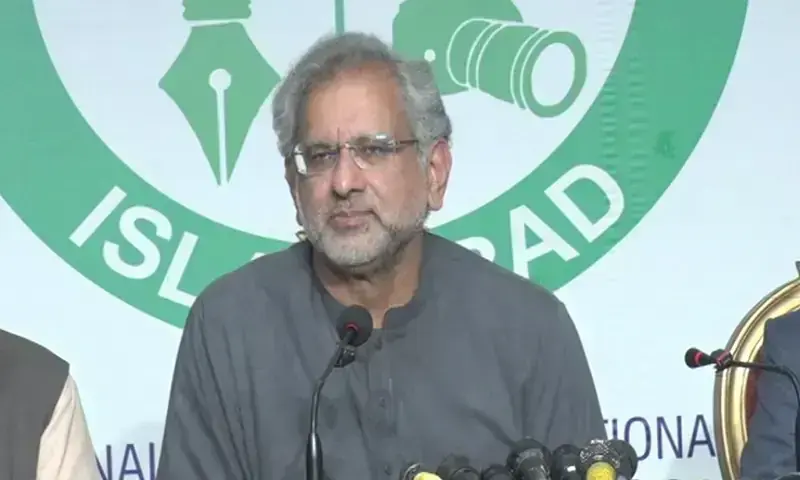
ISLAMABAD: Former Prime Minister Shahid Khaqan Abbasi on Saturday pressed the government to immediately deregulate petroleum product prices and accelerate the adoption of electric vehicles, saying the steps are the only viable response to the sharp rise in global oil costs triggered by the US-Israel war on Iran.
Abbasi, who now leads the Awaam Pakistan party, made the remarks at a press conference in the capital as fuel prices in Pakistan reached all-time highs. Since the US and Israeli strikes on Iran on Feb. 28 ignited the conflict and sent crude markets higher, Pakistani pump prices have surged in two major adjustments. Petrol has climbed from 266.17 rupees a liter to 378 rupees after a partial rollback of the latest increase. High-speed diesel has jumped from 280.86 rupees to 520.35 rupees.
“I would like to say two things: deregulate the petroleum prices — the government is not capable of handling it — and pay attention to electric vehicles (EVs), especially on motorcycles,” Abbasi said. “This amount keeps on increasing […] your system will function only if you incentivise EVs.”
He pointed to China’s successful EV policies as a model Pakistan should follow. Without such incentives, he warned, the mounting subsidy burden will overwhelm the fiscal system. Abbasi also questioned recent provincial decisions to make public transport free and disburse funds to selected groups, arguing that corruption would render the measures largely ineffective. “Not even Rs20 billion out of the Rs200bn announced would reach” the public because of graft in government departments, he said.
The former premier criticised the government for adopting “five different policies” over the past month alone to determine oil prices. He said full deregulation, with prices left to the market, is the only sustainable path. “This is the path Pakistan should take. There is no other way,” Abbasi said, recalling that the government itself had approved deregulation of petroleum products in 2018.
Countering hoarding and ensuring supply, he added, is the government’s responsibility. “You are the government. You can counter hoarding; it is your responsibility. It does not mean hiking the prices in an untimely manner.” Abbasi called on policymakers to acknowledge the country’s structural weaknesses and craft responses that account for the war’s long-term impact. He noted that Pakistan experienced a “solar revolution” without government intervention, yet has struggled with electricity policy. “We always try to find whose fault it is,” he said.
First independent power producers were blamed for the power crisis, then net-metering became the target. The government changed the net-metering policy four times — scrapping it and then bringing it back. “Why can’t you formulate a permanent policy? This is called elite capture,” Abbasi said. His comments follow the government’s announcement on Thursday of an unprecedented increase — 43% for petrol and 55% for high-speed diesel — aimed at cushioning the impact of global oil price shocks from the Middle East conflict. The move drew immediate backlash from the opposition Pakistan Tehreek-e-Insaf party. Jamaat-i-Islami warned of a nationwide protest movement if the hikes were not withdrawn.
Late Friday night, Prime Minister Shehbaz Sharif announced that the government would cut the petrol levy by 80 rupees a liter. The adjustment brought the retail price to 378 rupees instead of the 458 rupees that would have taken effect after the earlier increase.
Copyright © 2021 Independent Pakistan | All rights reserved