By Staff Reporter
ISLAMABAD: Finance Minister Muhammad Aurangzeb on Wednesday called for a gradual rebalancing of the country’s financial system, urging capital markets to take on a bigger role alongside banks in funding economic growth while pressing lenders to prepare for potential fallout from escalating Middle East tensions.
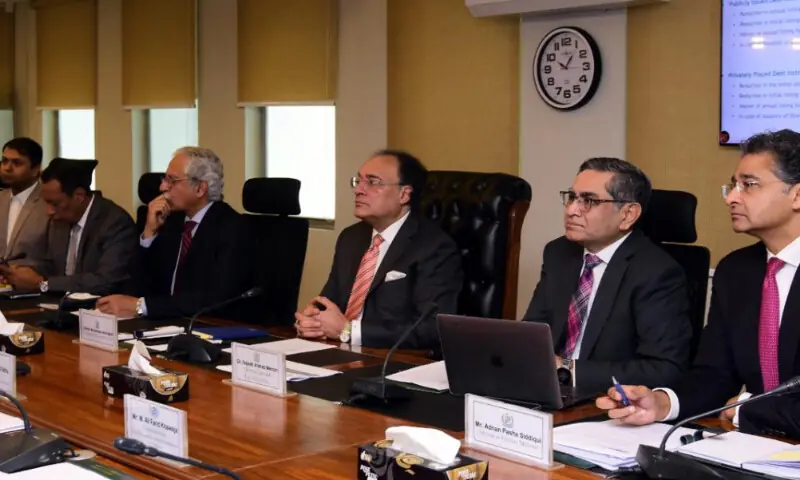
Chairing a meeting of the Capital Market Development Council, Aurangzeb stressed that a “strong and well-functioning capital market” is essential for sustainable development, enabling companies to tap long-term financing and giving investors — both institutional and retail — diversified options. The government wants to reduce the economy’s heavy dependence on bank lending by developing a deeper corporate-bond market that can mobilize domestic savings and support private-sector investment, according to a finance ministry press release.
The session reviewed progress on reforms aimed at strengthening capital markets, with a particular focus on corporate debt issuance and expanding markets’ contribution to overall financing needs. Aurangzeb directed officials to pursue “practical and time-bound reforms” that tackle bottlenecks across the value chain — from issuance and regulatory approvals to market infrastructure and secondary-market liquidity.
He emphasized creating an environment where companies can raise capital efficiently through market-based instruments while investors gain from greater transparency, liquidity and confidence. To that end, the minister instructed the Securities and Exchange Commission of Pakistan to step up outreach on recent regulatory changes that have simplified prospectus requirements, streamlined documentation, cut fees and digitized the issuance process.
Aurangzeb also called for lessons from regional peers, asking institutions to study best practices in neighboring markets that could be adapted locally. Improving secondary-market liquidity — especially through effective market-making mechanisms for corporate debt — will be critical to building investor confidence, he said.
Participants, including representatives from the Pakistan Stock Exchange, State Bank of Pakistan, Central Depository Company, National Clearing Company, Pakistan Banks Association and Pakistan Business Council, briefed the council on steps already taken and structural hurdles still ahead. Those include approval delays, coordination gaps and low awareness among potential issuers. The discussion highlighted the need for stronger participation by banks and brokerages to boost trading activity and price discovery in corporate bonds.
The council is advancing a broader reform agenda that includes expanding financial instruments, bolstering investor protection, raising corporate-governance standards and encouraging greater institutional and retail participation. Specialized working groups will now be set up — covering tax policy, debt-issuance frameworks, market infrastructure and investor safeguards — to accelerate implementation and improve coordination among regulators, infrastructure providers and the private sector.
On the tax front, the ministry’s Tax Policy Office has begun consultations to rationalize the framework for capital-market participants and explore incentives that could draw more issuers and investors. Aurangzeb reiterated the government’s commitment to building “a deeper and more efficient capital market” as a pillar for mobilizing investment, strengthening financial stability and supporting private-sector-led growth.
Separately on Wednesday, Aurangzeb held a virtual meeting with senior Pakistan Banks’ Association officials to assess risks to the economy from rising Middle East tensions involving the United States, Israel and Iran. The talks came amid volatility in global oil and financial markets that has already pushed up fuel prices and raised concerns about supply disruptions for an import-dependent nation like Pakistan.
The minister told bankers that Islamabad has established a high-level coordination mechanism across economic ministries and institutions to monitor global developments, particularly in energy and supply chains. Authorities are running regular scenario analyses on possible effects on inflation, the external accounts and overall stability, while working to ensure continuity of essential supplies and engagement with international partners.
Aurangzeb stressed the need for coordinated decision-making and operational resilience in the financial sector during periods of uncertainty, urging banks to keep supporting businesses and customers while maintaining prudent risk management. Pakistan Banks’ Association Chairman Zafar Masud updated the minister on the industry’s internal preparedness, including a coordination framework for information sharing to keep payment systems and financial services running smoothly. Banks will stay closely aligned with the State Bank of Pakistan and continue industry-wide monitoring, Masud said.
Copyright © 2021 Independent Pakistan | All rights reserved