By Staff Reporter
ISLAMABAD: Pakistan will stand with Saudi Arabia in any crisis, no matter the timing or circumstances, the government’s chief spokesman for foreign media said on Wednesday, as the conflict set off by US-Israeli strikes on Iran threatens to draw in more countries across the region.
Mosharraf Zaidi, speaking on Bloomberg Television, was asked directly whether Pakistan would offer military or other help to Riyadh. He replied without hesitation. “The question is not whether Pakistan might come to Saudi Arabia’s aid,” Zaidi said. “Both countries, even before the strategic mutual defence agreement, have operated on a principle of being there for the other before they need the other. So, there is no question that we might; we will. No matter what, no matter when.”
The more pressing matter, he continued, is what Pakistan is doing to keep the situation from reaching a point where its closest partners get pulled deeper into fighting that could damage stability and prosperity across the region and inside Pakistan itself.
Zaidi recalled the recent trip by Field Marshal Asim Munir, who serves as both chief of defence forces and chief of army staff, to Saudi Arabia. He said Pakistani officials have stayed in regular contact with leaders in both Riyadh and Tehran. “Our prime minister and field marshal have a great relationship with US leadership,” he added.
Zaidi said one thing Pakistan respects is the way Saudi Arabia and the other Gulf states have refused to be drawn into the conflict so far, despite what he described as repeated calls from some voices in the United States and elsewhere urging the GCC countries to take a more active role. “That is part of what Pakistan wants to see,” he said.
When the interviewer pressed him on how near Pakistan might be to actually supplying military aid, Zaidi called any such discussion “speculative and irresponsible.” He repeated the core position: Pakistan will be there for Saudi Arabia before any request is even made, and Saudi Arabia would do the same.
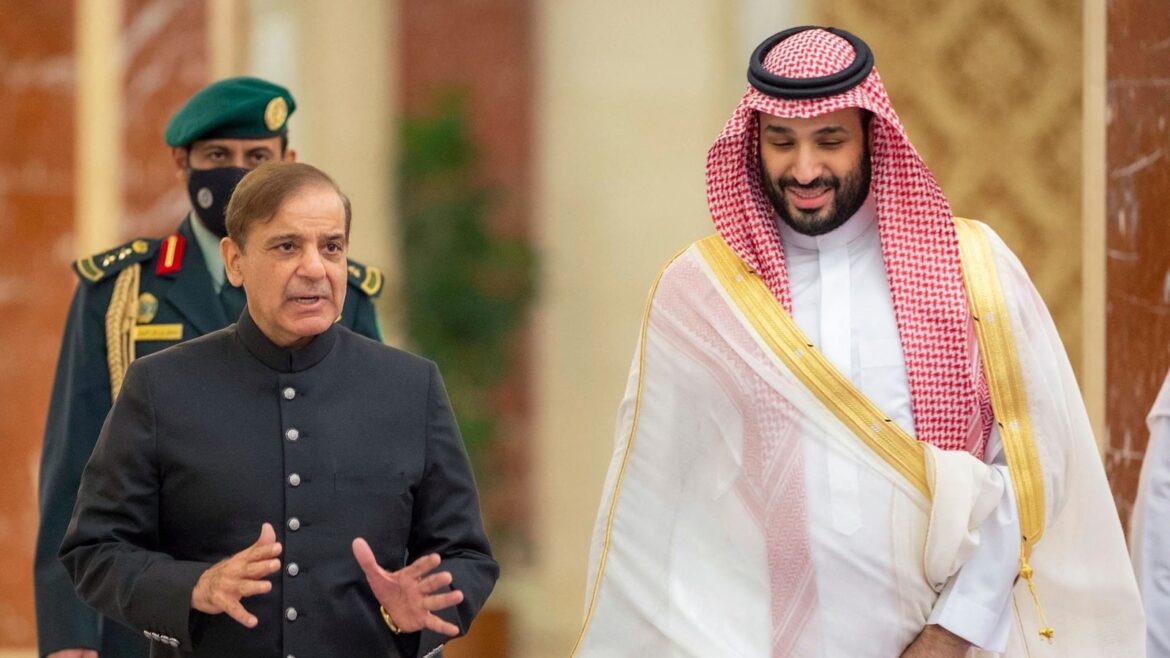
The relationship between the two countries runs deep. It rests on decades of military cooperation, economic support and shared Islamic traditions. Saudi Arabia has long been one of Pakistan’s most important sources of financial help and oil shipments. Last September, Prime Minister Shehbaz Sharif and Saudi Crown Prince Mohammed bin Salman signed a Strategic Mutual Defence Agreement in Riyadh. The pact states that any attack on one country will be treated as an attack on both.
Only last week, Deputy Prime Minister and Foreign Minister Ishaq Dar said Pakistani diplomatic work had helped prevent what would have been much heavier Iranian strikes against Saudi targets. Field Marshal Munir met Saudi Defence Minister Khalid bin Salman Al Saud around the same time to talk through the current fighting.
Zaidi made clear that Pakistan is also talking regularly with Iran. He said the government sees itself as having a responsibility to all its friends in the region and does not want to see any of them drawn into open quarrels. He noted that Dar has spoken several times in the past two weeks with Iranian Foreign Minister Abbas Araghchi. Those calls, and others, have helped produce what Zaidi called Iran’s more conciliatory approach toward the Gulf states.“ We don’t like our friends getting into quarrels with each other, and we certainly don’t like innocent people dying needlessly.”
Zaidi said dialogue always offers a way forward. “We don’t believe there is ever a time, especially in this context, where Iran should be attacking the Gulf countries and where the people of Iran should have to endure the cruel bombing campaign that they are enduring currently,” he said.
On the economic fallout at home, Zaidi said Pakistan’s fuel situation remains “stable to good” despite the turmoil that has shaken global oil markets. He acknowledged that the recent rise of Rs55 per liter in petrol and diesel prices has been painful for ordinary Pakistanis. The government’s goal, he said, is to make sure that no matter how high prices go, the country never faces a serious shortage. Pakistan acted early, he explained, raising fuel prices ahead of most other nations once it became clear that supplies could be disrupted.
The decision drew heavy criticism, but it gave oil marketing companies the buffer they needed to line up alternative shipping routes. Those routes can take 18, 19 or even 20 days instead of the normal five or six, he noted, creating a gap that the extra stocks are meant to cover. Zaidi pointed to other steps the government has taken: moving to a four-day work week in many offices, encouraging more work from home, and cutting government car usage sharply. “Every crisis is an opportunity for change,” he said.
Saudi Arabia, for its part, has already moved to help Pakistan keep its supply lines steady for oil, diesel and crude, Zaidi said. He ruled out any immediate Pakistani role in escorting commercial tankers through the Strait of Hormuz, the narrow waterway that carries about one-fifth of the world’s crude and has been thrown into chaos by the fighting. “First and foremost, Pakistan is responsible for its own territory, and that includes our maritime naval domain,” he said.
The Pakistan Navy is already escorting ships through waters under Pakistani control, he added, but any move into the Strait of Hormuz would require a broader multilateral arrangement that has not been discussed. “The Strait of Hormuz is tricky, and we are nowhere near making any sort of support missions for such escorts at this time,” Zaidi said.
Copyright © 2021 Independent Pakistan | All rights reserved