By Staff Reporter
ISLAMABAD: The parliamentary finance committee on Monday approved the Finance Bill 2026 with approximately 30 amendments that introduce mandatory digital production monitoring for manufacturers, restructure electric vehicle import duties by price tier and authorise a centralised banking data repository — sweeping changes to the country’s tax architecture as the government intensifies its campaign against evasion before a final legislative vote expected this week.
The National Assembly Standing Committee on Finance finalised its report after a day of deliberations, clearing the way for the full house to vote on the bill clause by clause. The Senate had submitted 123 separate recommendations on the legislation, which will require independent consideration.
The amendments cut across income tax, sales tax, customs and federal excise regimes, reflecting competing pressures on the government to widen the tax net and rein in evasion while meeting demands from business groups for rate reductions and greater procedural fairness.
Digital enforcement
Among the most structurally significant changes, manufacturers will be barred from moving or selling taxable goods unless items carry tax stamps or barcodes, or their production lines are integrated with digital monitoring systems, including video-based analytics. The committee also approved faceless tax assessments and an algorithm-based dispute settlement mechanism designed to resolve disagreements without direct contact between taxpayers and tax officials — a change the government frames as a safeguard against arbitrary enforcement.
Electric vehicles and automobiles
On electric vehicle imports in completely built-up form, the committee proposed a tiered duty structure based on declared vehicle value. Those priced at up to $75,000 would face zero federal excise duty. Vehicles in the $75,000 to $110,000 bracket would attract a 30 percent rate, while those above $110,000 would be subject to 40 percent.
Revised rates were also proposed for conventional imported vehicles. The committee recommended an 86 percent federal excise duty on cars and sport utility vehicles with engine displacement between 2,000cc and 3,000cc, rising to 92 percent for vehicles above 3,000cc.
Pakistani-registered airlines were separately approved for an exemption from duties on imported aircraft and spare parts, effective July 1.
Mobile phones and the steel sector
The committee approved an instalment-based facility allowing buyers of imported mobile phones to pay the applicable sales tax through the Pakistan Telecommunication Authority’s device identification system, with full settlement required within the financial year of import.
For steel manufacturers, the committee proposed tying sales tax collection to per-unit electricity consumption, including power drawn from captive generation plants. The levy would remain adjustable, with provisions for reduced rates for compliant producers intended to prevent excessive refund accumulation.
Income tax: small businesses, super tax and social media
Businesses with annual turnover of up to 200 million rupees were granted the right to opt out of the final tax regime from tax year 2027, providing relief to smaller enterprises currently subject to flat-rate levies regardless of actual profit margins.
Export-oriented companies deriving more than 80 percent of revenue from exports were recommended for exclusion from the super tax. A 5 percent withholding tax was proposed on income earned from social media platforms, with tax deducted on payments to non-resident social media recipients made adjustable. Legal definitions in the income tax statute were revised, several time limits shortened and rules governing inheritance and property transfer updated.
The minimum tax rate was cut to 0.5 percent for 14 categories of distributors covering pharmaceuticals, fertilisers, sugar, cigarettes, locally manufactured mobile phones, packaged food, beverages, dairy products and general consumer goods.
Penalty provisions were tightened, with fines in some categories linked to turnover and higher penalties imposed on repeat violations. Taxpayers gained the right to challenge the appointment of auditors.
Banking data repository
In a significant structural change, the State Bank of Pakistan would be authorised to establish a centralised digital repository of banking data for tax purposes, enabling the Federal Board of Revenue to access financial transaction records through unique identifiers — a measure intended to give authorities a broader view of income and capital flows through the formal banking system.
Customs reforms
The committee introduced tighter administrative controls in customs law, requiring board-level decisions to obtain ministerial approval and mandating competitive procurement under public procurement rules. The limitation period for customs cases was cut from 10 years to five.
Affected parties must now be heard before orders are issued, except in urgent situations involving risk of asset dissipation, and must also be given the opportunity to present their case before any assets are confiscated. Chartered accountants were approved as non-voting members in customs and tax proceedings. Confiscated goods must be auctioned, including through electronic platforms, under public procurement rules.
Exemptions and other measures
The exemption list was expanded to include provincial social security institutions, the Workers Welfare Fund, Make A Wish Foundation and the Quaid-i-Azam Mazar Management Board. Private equity and venture capital funds were recommended for exemption subject to distributing at least 90 percent of income annually.
A 3 percent value-added tax was proposed on imported goods sold without processing, while coal imports used by independent power producers would be taxed at a reduced 1 percent rate. Special concessions were recommended for footwear businesses integrated with digital point-of-sale systems.
Several measures considered during deliberations were ultimately dropped, including changes linked to the petroleum levy.
The committee’s report was accompanied by dissenting notes from members Javed Hanif Khan and Sharmila Faruqi.
Budget allocations passed; 587 cut motions defeated
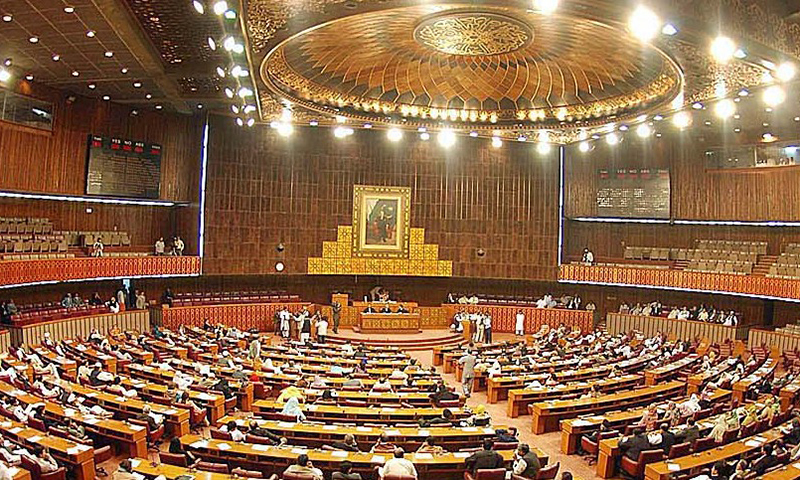
Separately on Monday, the National Assembly completed approval of 135 demands for grants covering federal ministries and allied departments for fiscal year 2026-27, concluding a two-day examination of government spending plans.
The opposition filed 587 cut motions against the allocations — 380 on Monday alone — all of which were defeated by majority vote. The house is expected to turn to the finance bill and related fiscal measures before the budget is formally passed.
National Assembly television and its social media channels continued to broadcast opposition speeches during the session, though in censored form, with audio muted during segments in which lawmakers referenced the jailed former prime minister Imran Khan or criticised state institutions.
Interior ministry draws sharpest fire
The opposition directed its most sustained criticism at the interior ministry, tabling 123 cut motions against it. Lawmakers targeted the performance of the ministry’s attached departments, including the Federal Investigation Agency, the Anti-Narcotics Force and the National Cybercrime Investigation Agency.
Pakistan Tehreek-e-Insaf lawmaker Shandana Gulzar said the deteriorating law and order environment was deterring investment while online hate speech was deepening ethnic and religious divisions across the country.
“The failure of just one ministry has not only destroyed the economy of the country but also divided the society,” she told the house. She said citizens were being killed by terrorists, criminals and law enforcement personnel alike.
Gulzar also challenged the use of cybercrime legislation against individuals engaging in political commentary. “Mr Speaker, we acknowledge that criticising the state is not correct, but Maryam Nawaz is not the state; she is the political head of a province,” she said, referring to the Punjab chief minister and ruling party leader.
Hameed Hussain, a lawmaker from Parachinar affiliated with Majlis Wahdat-i-Muslimeen, said security conditions in his constituency remained critical. The main road into Parachinar, which has been the site of persistent sectarian violence, was open for just two hours daily, he said.
Food ministry and agricultural grievances
The food ministry drew 112 cut motions. Speakers called for reductions in fertiliser prices, the introduction of crop insurance schemes and other measures to ease input costs for farmers.
PTI Chief Whip Amir Dogar said the agricultural market was failing producers and consumers alike. “A strange part of the story is that farmers decry low rates of their produce, while the buyers, mainly the urban consumers, complain about high prices of agricultural products,” he said.
Several lawmakers praised Pakistan’s civil and military leadership for what they described as a role in facilitating the end of the conflict involving Iran, and called for revival of the long-stalled Iran-Pakistan gas pipeline project.
Copyright © 2021 Independent Pakistan | All rights reserved