By Staff Reporter
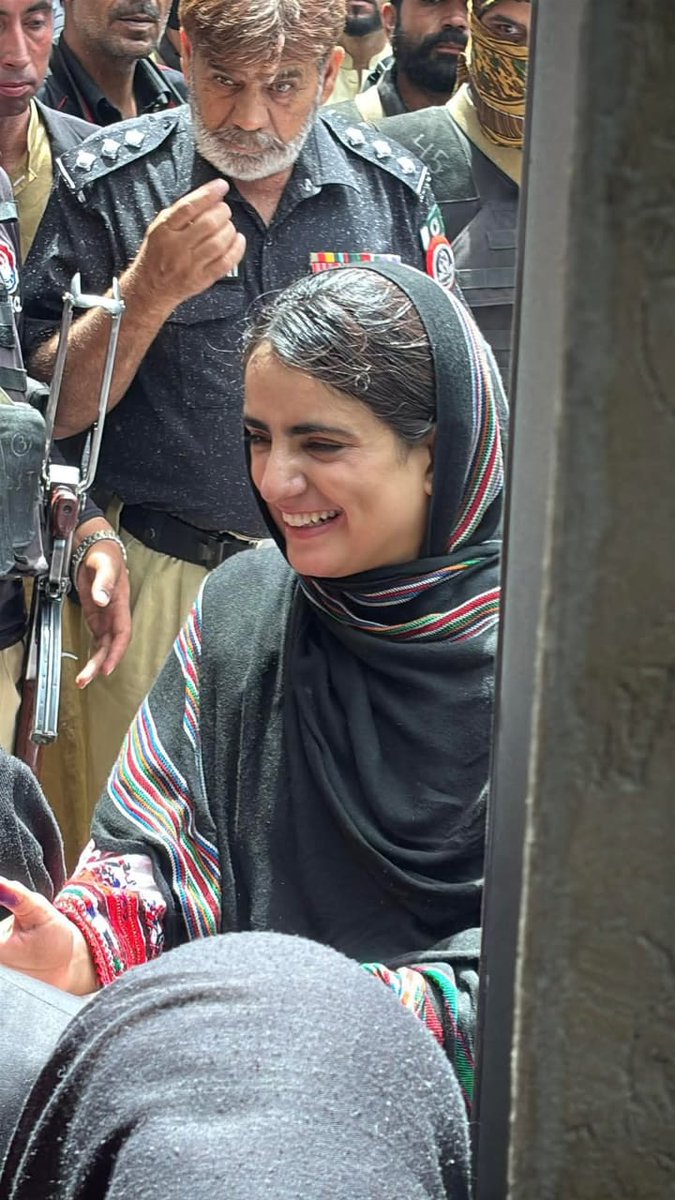
QUETTA: An anti-terrorism court on Monday sentenced prominent Baloch rights activist Dr. Mahrang Baloch to life imprisonment after convicting her of inciting a mob that killed a paramilitary soldier during a protest in the southwestern port city of Gwadar nearly two years ago, in a case her lawyers condemned as a travesty of justice.
The verdict by the Anti-Terrorism Court (ATC) in Quetta also handed a life sentence to Sibghatullah Shahji, a fellow leader of the Baloch Yakjehti Committee (BYC), the civil rights group Baloch heads. Both were found guilty under sections of the Pakistan Penal Code covering murder, unlawful assembly, and rioting in connection with the death of Frontier Corps sepoy Shabir Ahmed during clashes in Gwadar on July 29, 2024.
The court ordered each convict to pay 200,000 rupees in compensation to the deceased’s family. A written judgment had not been formally released as of Monday.
“The judge of the ATC Quetta has awarded a life term to Mahrang Baloch and Sibghatullah Shahji in the murder case of the FC personnel,” Baloch’s lawyer Israr Jattak told reporters after the verdict was announced.
The ruling drew immediate condemnation from Baloch’s family and legal team, who said the proceedings had been conducted in secret and denied the defendants a fair hearing.
“Dr. Mahrang’s case was shifted from an open court to a jail trial, then from the jail it was shifted to a faceless trial,” said Nadia Baloch, the activist’s sister and a member of her legal team. “We do not know where the judge is sitting and running the case from, we do not know where the prosecutor is, we do not know who the witnesses are or who is giving testimony.”
“Our entire legal team has refused to accept this decision. If you are to give us a trial, then grant us a fair trial,” she said.
Nadia Baloch said the family would appeal the conviction in superior courts.
A Polarising Figure
Mahrang Baloch, 33 and a trainee surgeon, has become one of the most recognisable faces of Baloch civil activism in Pakistan in recent years. Time Magazine named her among its 100 rising leaders in 2024, and the BBC included her on its list of 100 most inspiring women the same year.
The BYC, which she leads, organised a large civil rights demonstration in Gwadar in late July 2024 to protest what it described as enforced disappearances, extrajudicial killings, and the exploitation of the region’s natural resources. The two-week-long gathering, billed as the Baloch Rajee Muchi, or Baloch National Gathering, drew thousands and ended in violent clashes with security forces that left three people dead and at least ten wounded.
According to the court’s judgment, Baloch delivered a speech at the Gwadar gathering on July 29 in which she urged participants to attack an FC vehicle near the demonstration. Both she and Sibghatullah “were active participants of the unlawful assembly of the Baloch Yakjehti Committee and shared a common objective of committing the murder of deceased FC official Shabir Ahmed,” the judgment stated.
The court noted that the accused had been given repeated opportunities to participate in the trial but had deliberately boycotted proceedings.
Extended Detention
Baloch was first taken into administrative detention on March 22, 2025, while leading a sit-in on Quetta’s Saryab Road, held under the Balochistan Maintenance of Public Order (MPO) ordinance for an initial 30-day period that was subsequently extended twice. Before the third extension expired, she was taken into custody in connection with the murder case. Sibghatullah has also been held for approximately two years across multiple cases.
The United Nations expressed concern over Baloch’s detention following her arrest last year, citing her profile as a medical professional and human rights advocate.
Separate cases under the Anti-Terrorism Act and the Pakistan Penal Code were registered against Baloch and other BYC leaders following the initial administrative detentions. Constitutional petitions seeking her release were rejected by the Balochistan High Court in May 2025 and were subsequently challenged before the Supreme Court.
Although the BYC is not listed among banned organisations by Pakistan’s National Counter Terrorism Authority (Nacta), Baloch herself is included on its list of proscribed individuals.
A Province Under Strain
Balochistan has for decades been the site of a low-level but persistent insurgency in which separatist militant groups routinely attack security forces, government officials, and civilians from other provinces. The insurgency has intensified in recent years, with armed factions accusing Islamabad of economic exploitation and systematic human rights abuses, including the enforced disappearances of thousands of men.
Pakistani authorities deny those allegations and say they are investing in the province’s development. Rights groups, however, have long argued that civilian activists who organise peacefully are increasingly prosecuted under anti-terrorism statutes, blurring the line between militancy and dissent.
The conviction of Mahrang Baloch is likely to deepen those concerns and draw fresh international scrutiny to Pakistan’s handling of civil society in the province.
Copyright © 2021 Independent Pakistan | All rights reserved