By Staff Reporter
ISLAMABAD: Pakistan’s weather agency issued a stark warning on Tuesday about glacial lake outburst floods (GLOFs) threatening Gilgit-Baltistan and Khyber Pakhtunkhwa, where torrential rains have already claimed five lives and left dozens missing.
Rescue crews pulled more than 200 tourists to safety in Gilgit-Baltistan’s Diamer district amid widespread flooding fueled by monsoon downpours and melting glaciers, highlighting the increasingly visible toll of climate change on Pakistan’s vulnerable northern territories.
The floods, exacerbated by heavy monsoon rains and melting glaciers, have wreaked havoc across Gilgit-Baltistan, a region famed for its breathtaking landscapes but increasingly imperiled by natural disasters.
On Monday, four people were killed and 15 others reported missing in Diamer’s Babusar area after a cloudburst triggered flash floods. By Tuesday, the death toll had risen to five, according to Diamer District Commissioner Attaullah Kakar, who confirmed that four of the deceased had been identified.
The Pakistan Meteorological Department’s (PMD) alert, issued on Tuesday, warned that the prevailing weather conditions have heightened the risk of GLOFs, flash floods, and landslides in the glaciated areas of Gilgit-Baltistan and Khyber Pakhtunkhwa. “The wet spell is likely to continue,” the PMD stated, forecasting scattered rain and thunderstorms with isolated heavy falls in both regions throughout the week. The agency urged residents and tourists to exercise caution, particularly in vulnerable areas.
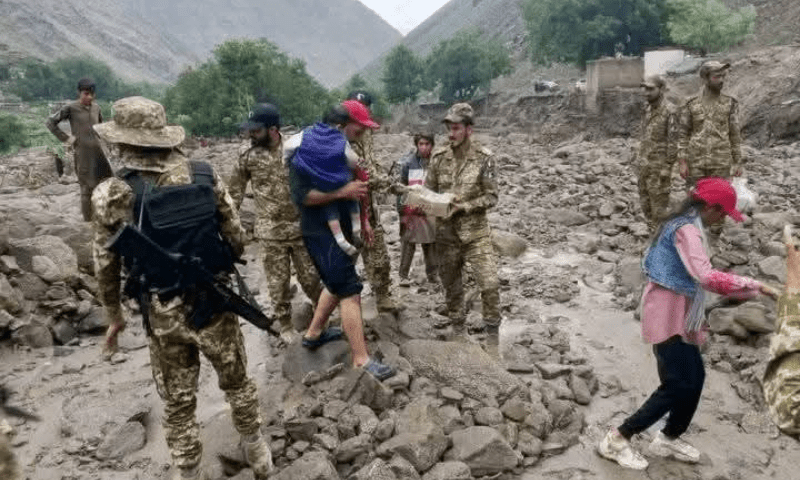
In a dramatic rescue operation, more than 200 tourists stranded in the Babusar area were evacuated to safety in Chilas, where they were provided shelter in hotels and guest houses. “More than 200 rescued tourists have been shifted to Chilas and provided shelter in hotels and guest houses,” said Gilgit-Baltistan government spokesperson Faizullah Faraq. He added that the tourists were now able to contact their families after being stranded for hours.
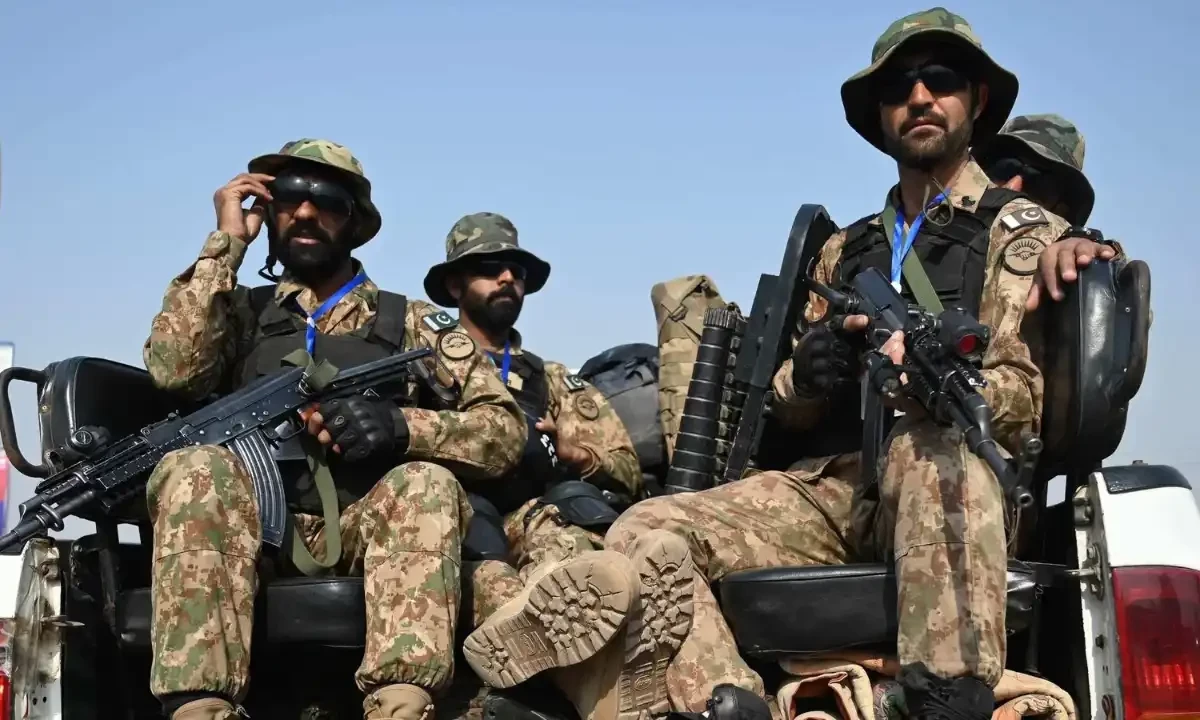
Diamer District Commissioner Kakar confirmed that rescue efforts are ongoing, with the Pakistan Army’s Force Command Northern Areas (FCNA) playing a critical role. “Rescue operations are still underway to look for missing tourists,” Kakar said, noting that “the FCNA has been providing medical assistance and food to stranded tourists on Babusar via helicopters.”
Senior Superintendent of Police Abdul Hameed estimated that 20 to 30 tourists from across Pakistan may still be unaccounted for. The Diamer administration has declared a state of emergency along the Thack-Babusar Road, suspending all tourist movement between Zero Point and Babusar Top until further notice. A notification issued by District Magistrate Ataur Rehman ordered that all travelers “should be stopped at both ends” of the road and “evacuate to designated safe zones immediately and to avoid any travel on Babusar Road until its complete rehabilitation.”
Rehman also directed six companies to dispatch at least two excavators each to assist in road rehabilitation and potential body retrieval. Local residents have stepped in to aid the effort. Muhammad Ali, a social worker from the area, reported that “thirty vehicles were swept away by the floods, and most people have been rescued by the locals.”
Shahabuddin, a resident of Chilas, said the local people provided food and accommodation to some stranded tourists in Babusar’s Thak area and were assisting the rescue operation. The floods have inflicted severe damage on the region’s infrastructure. “In Babusar, a wheat depot, a girls’ school, a police checkpoint, a tourism police shelter and four bridges have been washed away, while two mosques and a windmill have also been damaged,” Faraq said. Across Gilgit-Baltistan, “more than 100 houses had been fully damaged in the recent torrential rains,” according to Kakar.
In Skardu, flash floods in Barge Nullah, Dhagyol Nullah, and Shagri Bala Nullah on the city’s outskirts have “entered homes and caused severe damage to public infrastructure and crops,” said Ghulam Muhammad, spokesperson for the Baltistan Division Police Department. The Karakoram Highway (KKH), a vital artery connecting Pakistan to China, has been severely affected. “Several points from Thalichi to Chilas have been cleared,” state-run Radio Pakistan reported, though “Babusar road was still blocked due to heavy mud on the road.”
The Pakistan Army, Frontier Works Organisation, National Highway Authority, and Gilgit-Baltistan administration are working to restore access, with heavy machinery dispatched to Tatta Pani, Jalipur, and three points at Gandola Nullah. Traffic has been restored on the Jaglot-Skardu road, and construction has begun on damaged portions of highways and connecting roads. In Skardu’s Deosai area, 413 tourist vehicles were stranded on the Sadpara-Deosai Road after floods closed it at ten different points. “The stranded people were rescued by the police and shifted to Skardu in the morning after the damaged roads were restored overnight,” said Ghulam Muhammad. Elsewhere, three people were injured in Sadpara village, and the Kharmang district has also been hit hard, according to Skardu Rescue 1122.
The disaster in the north is part of a broader crisis gripping Pakistan, where monsoon rains have killed 234 people and injured 596 since June 26, according to the National Disaster Management Authority (NDMA). Punjab has recorded the highest toll, with 135 deaths and 470 injuries, followed by Khyber Pakhtunkhwa with 56 fatalities. In a separate incident in Rawalpindi, retired Colonel Ishaq Qazi, aged 62–64, and his 25-year-old daughter were swept away by floodwaters in the Defence Housing Authority (DHA) Phase 5. “Due to heavy rainwater accumulation on a nearby road, their vehicle stalled,” said a statement from Islamabad’s Sihala police station. A search operation involving police, Rescue 1122, DHA staff, and divers is underway, though only a car bumper has been recovered.
The NDMA has warned of potential landslides in Gilgit, Skardu, Hunza, Astore, Diamer, and Ghanche in Gilgit-Baltistan; Muzaffarabad, Neelum, Haveli, Bagh, and Poonch in Azad Jammu and Kashmir; and Chitral, Dir, and Kohistan in Khyber Pakhtunkhwa. Roads such as Kohistan Road, Jaglot-Skardu Road, and Hunza Road are identified as particularly prone to disruption. The agency advised citizens to avoid mountainous areas and directed authorities to remain on alert.
President Asif Ali Zardari and Prime Minister Shehbaz Sharif have expressed “deep grief and sorrow over the loss of precious lives due to rains” and directed authorities to “provide every possible assistance and rehabilitation facilities to the flood-affected people across the country,” Radio Pakistan reported.
In Khyber Pakhtunkhwa, the tourism department established a flood emergency response unit with a helpline (1422), according to a notification from Secretary Abdul Samad. The Pakistan Telecommunication Authority (PTA) has also directed telecom operators to “ensure uninterrupted services and maintain contingency plans for emergencies,” activating its National Emergency Telecommunication Coordination Centre to monitor the situation.
The NDMA noted that over 61 percent of nationwide deaths were caused by house collapses, with 826 homes damaged and 203 livestock lost. A spokeswoman for the agency told Agence France-Presse that “such death tolls are usually seen in August, but this year the impact has been markedly different,” reflecting the unusually early intensity of this year’s monsoon.
Monsoon season brings South Asia 70 to 80 percent of its annual rainfall, arriving in early June in India and late June in Pakistan, and lasting through until September.
However, Pakistan is ranked consistently among countries most affected by climate change impacts. Pakistan has witnessed irregular weather patterns in recent years, which include heavy rains, droughts and soaring temperatures.
In 2022, record-breaking monsoon rains combined with glacial melt submerged nearly a third of Pakistan, killing more than 1,700 people and displacing over 8 million. In May, at least 32 people were killed in severe storms, including strong hailstorms.
Copyright © 2021 Independent Pakistan | All rights reserved