By Staff Reporter
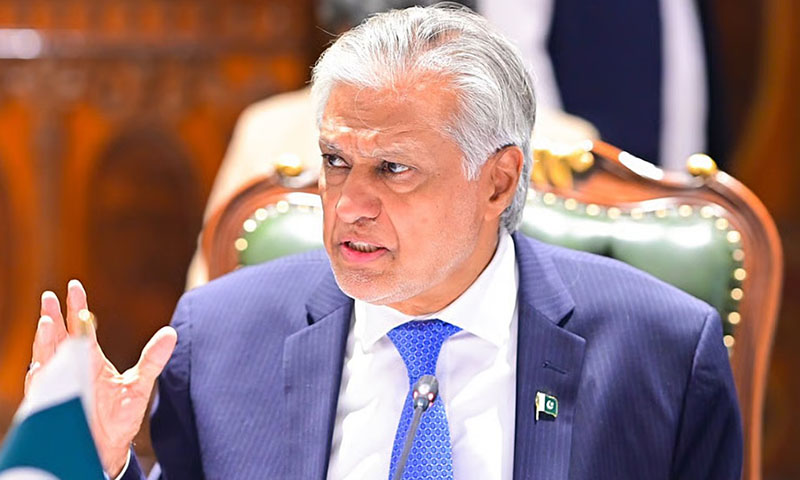
ISLAMABAD: The deputy prime minister and foreign minister, Ishaq Dar, will leave Tuesday for an official visit to China even though he suffered a hairline fracture in his shoulder the day before, the Foreign Office said Monday, a move that officials described as a measure of how seriously Islamabad takes its deepening role in trying to end the fighting between the United States and Iran.
The trip, at the invitation of Chinese Foreign Minister Wang Yi, comes less than 48 hours after Dar chaired a rare four-nation meeting in Islamabad that brought together the foreign ministers of Saudi Arabia, Turkey and Egypt. At the end of those talks, Dar publicly offered Pakistan as a venue for direct negotiations between Washington and Tehran — an overture that would mark a sharp escalation in Islamabad’s mediation efforts.
The Foreign Office statement said Dar had chosen to go ahead with China visit despite medical advice to rest after the injury. It said the Pakistan-China relationship as an “all-weather strategic cooperative partnership” built on “close coordination and regular consultations” about regional and international issues. The upcoming meetings in Beijing, the statement said, would allow both sides to discuss the latest developments in the Middle East, as well as other bilateral and global matters of mutual concern.
Dar injured his shoulder Sunday evening after slipping while greeting Egypt’s foreign minister during a four-nation meeting in Islamabad focused on the Iran crisis. His son, Ali Dar, said in a post on X late Sunday that his father had powered through a full day of high-level talks on painkillers before seeking medical attention at the family’s insistence.“His X-rays are overall fine,” Ali Dar wrote. “There is a hairline fracture in the shoulder. In the coming few days, his pain will be managed through medications and other precautionary measures.”
The injury occurred on the same day that the four foreign ministers reviewed the month-old conflict that began with U.S. and Israeli strikes on Iran on Feb. 28 and has since drawn in retaliatory actions from Tehran across the region. In a joint assessment, the ministers expressed deep concern over the “devastating impact on lives and livelihood” and agreed that the war “is not in favour of anyone and would only lead to death and destruction,” according to remarks Dar made afterward. They called for an immediate halt to the fighting, emphasized the need for unity among Muslim countries and backed efforts to set the stage for structured talks between Washington and Tehran.
Prime Minister Shehbaz Sharif used social media early Monday to thank the visiting ministers. In separate posts, he expressed gratitude to Saudi Foreign Minister Prince Faisal bin Farhan, Turkish Foreign Minister Hakan Fidan and Egyptian Foreign Minister Badr Abdelatty. Sharif said he had reaffirmed Pakistan’s “unwavering solidarity” with Saudi Arabia and appreciated the kingdom’s “remarkable restraint in these challenging times.” He also stressed the importance of collective action to stop the hostilities, which he said had inflicted heavy losses “not only in Iran, but across several brotherly Muslim countries.”
The quadrilateral meeting had originally been scheduled for Turkey but was moved to Islamabad at the last minute because of Dar’s central involvement in the mediation process. A Foreign Office statement issued after midnight confirmed that the three visiting ministers had left the Pakistani capital.
Dar’s trip to Beijing follows a telephone conversation he held with Wang on Friday. According to an account released by the Chinese side, Wang told Dar that starting peace talks over Iran would be “no easy task” but that such efforts would help restore normal shipping through the Strait of Hormuz. The two ministers agreed to work together to push for a cease-fire, an end to hostilities and the resumption of negotiations, while protecting civilian sites and vital sea lanes.
China has voiced support for Pakistan’s mediation role on several occasions. During an earlier call on March 10, Wang praised Islamabad’s “constructive role” in trying to calm the situation in the Middle East. Dar said afterward that the Chinese minister had welcomed Pakistan’s continued work as a mediator and that both countries had committed to pursuing the resolution of disputes through dialogue.
Pakistan has spent recent weeks quietly relaying messages between Washington and Tehran in coordination with Saudi Arabia, Turkey and Egypt. Officials describe the exchanges as indirect, structured relays rather than face-to-face contacts. A diplomatic source familiar with the discussions said indirect talks could be held in Islamabad as soon as Tuesday, possibly involving U.S. Secretary of State Marco Rubio and Iranian Foreign Minister Abbas Araghchi.
Another diplomat tracking the process said some parties expected Washington to announce a cease-fire to coincide with the opening of any dialogue — a step Tehran has demanded as a confidence-building measure. Both sources cautioned that nothing was settled and that events could shift rapidly in the next two days. German Foreign Minister Johann Wadephul said Friday that a direct U.S.-Iran meeting would take place in Pakistan “very soon.”
At the close of Sunday’s meeting in Islamabad, Dar made Pakistan’s offer explicit. “Pakistan will be honoured to host and facilitate meaningful talks between the two sides in the coming days, for a comprehensive and lasting settlement of the ongoing conflict,” he said. The diplomatic activity reflects Islamabad’s determination to carve out a role for itself in a crisis that has raised fears of wider regional instability and threats to global energy supplies. Pakistani officials have framed their efforts as an attempt to open channels for negotiation where none existed before, reaching out not only to Gulf capitals but also directly to Washington and other Muslim nations.
Copyright © 2021 Independent Pakistan | All rights reserved