By Staff Reporter
ISLAMABAD: Pakistan’s Deputy Prime Minister and Foreign Minister Ishaq Dar said on Friday that a trade deal with the United States could be finalised within days, a move he framed as a cornerstone of improving relations between the two nations.
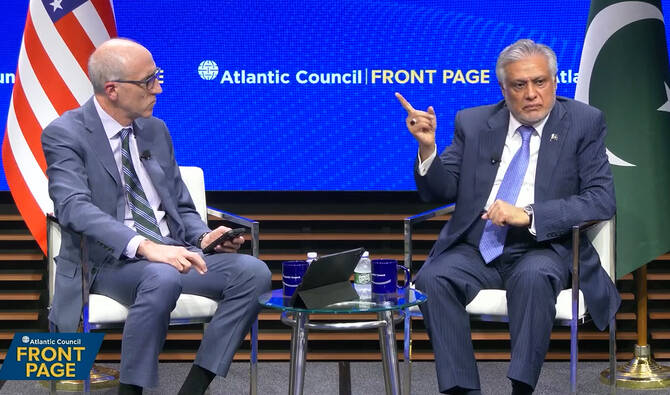
Speaking at a Washington think tank event after meeting U.S. Secretary of State Marco Rubio, Dar struck an optimistic note, though U.S. officials offered no timeline for the agreement.
“I think we are very close to finalising a deal with the US,” Dar said. “Our teams have been here in Washington, discussing, having virtual meetings, and a committee has been tasked by the prime minister to fine-tune now. It’s not going to be months, not even weeks, I would say (just) days.”
Pakistan and the United States have recently concluded a critical round of trade negotiations, reaching an understanding on an agreement that could prevent the re-imposition of a 29 percent tariff on Pakistani exports.
Finance Minister Muhammad Aurangzeb was in the United States last week to negotiate Washington’s demands as part of trade talks ahead of an August deadline.
Aurangzeb’s visit follows an earlier Pakistani delegation being presented with an exhaustive list of demands from the US to reduce tariff and non-tariff barriers as preconditions for a trade deal. Islamabad had initially anticipated concluding the agreement by early July, but the pace of negotiations has been slower than expected.
The Ministry of Finance stated last week that trade negotiations have made encouraging progress. Pakistan is particularly keen to secure relief from the 29% tariff currently imposed on its exports and has offered to increase imports of American cotton and soybeans. Media reports estimate the tariffs could slice $500 million to $700 million from Pakistan’s export revenues if reinstated.
The US accounted for 18 percent of Pakistan’s total exports in the latest fiscal year, with textiles making up nearly 90 percent of shipments. In contrast, the US represents just 4.5 percent of Pakistan’s imports, highlighting a stark trade asymmetry.
In 2024, the US imported $5.44 billion in Pakistani goods, while exports to the US climbed 10 percent year-over-year to $4 billion in the first eight months of the current fiscal year, amplifying the urgency of the talks.
Under the proposed deal, Pakistan could ramp up imports of US goods, particularly crude oil, while opening the door to American investment in its mining, energy, and infrastructure sectors. The Reko Diq copper and gold mine project emerged as a key focus, alongside potential financing from the US Export-Import Bank.
The deputy prime minister’s optimism comes amid a broader warming of relations between Islamabad and Washington, which have been strained in recent years. “Ties between Pakistan and the US are getting better, and both sides have agreed to work on building a strong, long-term partnership,” he told the audience.
The thaw in relations became more evident last month when US President Donald Trump hosted Field Marshal Asim Munir at the White House, signaling a shift from the diplomatic freeze that has long characterised US-Pakistan ties.
Dar noted that his 40-minute discussion with Rubio covered a wide range of issues, including trade, investment, technology, artificial intelligence, and counter-terrorism, as well as regional and global matters.
He thanked the Trump administration for its role in easing tensions between Pakistan and India and reaffirmed Pakistan’s commitment to cooperation on global platforms, such as the United Nations Security Council. Dar also stressed the importance of dialogue in resolving the Iran-Israel conflict.
On economic relations, Dar was clear about Pakistan’s priorities. “Pakistan wants trade, not aid,” he said, outlining plans to grant greater access to American products in Pakistani markets and encouraging US investors to explore opportunities in the country’s mining sector.
A significant portion of Dar’s remarks focused on the fraught relationship between Pakistan and India, particularly over the disputed region of Kashmir. He urged both nations to “stop pointing fingers and start building trust” if they are to move forward.
Addressing India’s allegations regarding the Pahalgam attack, Dar denied any Pakistani involvement, stating, “India hasn’t given any proof that Pakistan was involved.” He accused India of using terrorism as a pretext to shift focus from the core issue of Kashmir, which he described as “the main bone of contention” between the two neighbors.
Dar also charged India with attempting to alter the demographics of Kashmir during its “more than 70 years of illegal occupation.” Recalling the events leading to a ceasefire in May, he said Pakistan had ended its military operation in defence of its sovereignty.
When Rubio asked if Pakistan was prepared for a ceasefire, Dar replied, “We weren’t ready to start a war in the first place.” The deputy prime minister revealed that the US had promised to facilitate talks between Pakistan and India at a neutral location. “Pakistan is ready to talk about everything, from Kashmir to terrorism,” he said, but emphasised that dialogue must be reciprocal. “Pakistan can’t sit down alone and expect results.”
In a broader appeal for regional stability, Dar declared, “Pakistan wants no conflict with its neighbors. We seek lasting peace in South Asia, built on trade and partnerships, not hostility.”
On the issue of terrorism, Dar took a firm stance. “Pakistan is already taking action and doesn’t need to be told what to do,” he said. He addressed the U.S. decision to designate The Resistance Front (TRF) as a terrorist organization, noting that Pakistan had no issue with the move but strongly disagreed with linking TRF to Lashkar-e-Taiba.
“That group was broken up years ago, its members were arrested and jailed, and TRF has nothing to do with it,” he insisted. Dar also called for the U.S. to move beyond a transactional relationship with Pakistan and work toward a more strategic and stable partnership.
He dismissed concerns about Pakistan’s defence deals with China, explaining that such decisions are based on which country offers the better terms and would not affect U.S.-Pakistan relations.
During the discussion, Dar faced questions about Pakistan’s internal political situation, particularly regarding former Prime Minister Imran Khan. He revealed that Khan used to meet him regularly and that he had personally donated to Khan’s hospital.
However, Dar sharply criticised Khan’s 2014 sit-in protests for halting economic progress, noting that he had tried to broker a “domestic ceasefire” at the time. He also accused Khan of inciting violence against the state, specifically referencing the May 9 incident. “No one has the right to attack military installations,” Dar said. “That’s not politics — that’s treason.”
Commenting on the US imprisonment of Dr. Aafia Siddiqui, Dar said he had no objection if it was lawful, but drew a parallel to attacks on Pakistani installations, arguing that such acts must also be dealt with under the law.
He praised former Prime Minister Nawaz Sharif for taking tough steps against militancy but lambasted the subsequent PTI government for undoing that progress. Dar claimed the Imran Khan-led regime had released over 100 militants, opened borders, and allowed 30,000 to 40,000 Taliban fighters to regroup inside Pakistan. “That one cup of tea brought armed rebellion back to life in Pakistan,” he said, in a pointed critique of the previous administration’s policies.
Copyright © 2021 Independent Pakistan | All rights reserved