By Staff Reporter
ISLAMABAD: In a blistering attack that cuts to the heart of Prime Minister Narendra Modi’s leadership, India’s main opposition party, the Indian National Congress, on Tuesday ripped into the government’s new trade agreement with the United States, portraying it as a desperate cave-in to President Donald Trump that sells out Indian farmers and industries while undermining the country’s hard-won economic independence.
The deal, unveiled by Trump himself on Monday, slashes American tariffs on Indian goods but at a steep price: New Delhi must fling open its markets to US products, abandon cheap Russian oil imports, and potentially pivot to pricier supplies from America or Venezuela — a move that critics say reeks of subservience and highlights Modi’s faltering grip on international affairs.
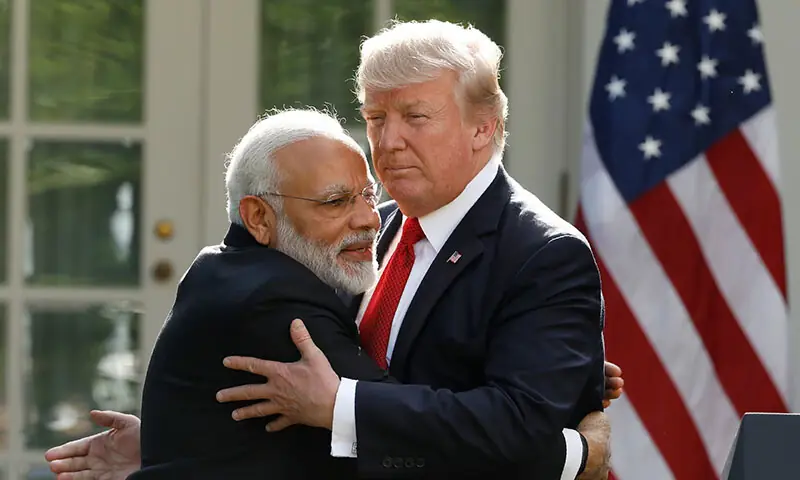
This isn’t just another spat in India’s fractious politics; it’s a damning indictment of Modi’s decade-plus in power, where his vaunted personal charisma and “hug diplomacy” — those bear-hug greetings with world leaders — have increasingly failed to deliver tangible wins. Modi, who swept into office in 2014 promising to make India a manufacturing powerhouse through his “Make in India” campaign, now stands accused of prioritising his rapport with Trump over domestic priorities.
The opposition’s fury underscores a broader vulnerability: Modi’s foreign policy, once hailed for its assertiveness, appears brittle when tested by a mercurial ally like Trump, whose “America First” agenda has repeatedly strong-armed partners into lopsided concessions. The pact’s details, as sketched by Trump in his announcement, lay bare the imbalance. US tariffs on Indian exports drop from a crippling 50 percent — hiked last August in retaliation for India’s Russian oil purchases — to 18 percent. In return, India agrees to zero out its own tariff and non-tariff barriers for American goods, including in the sensitive agriculture sector. Trump crowed about the windfall for US farmers, while his agriculture secretary, Brooke Rollins, celebrated the prospect of flooding India’s vast market with American produce, predicting higher prices and a cash infusion for rural America.
Modi’s response? A effusive thank-you on X. “Big thanks to President Trump on behalf of the 1.4 billion people of India for this wonderful announcement.” He made no mention of the oil pledge, leaving observers to wonder if New Delhi is truly committed — or if it’s another promise Modi might quietly sidestep. External Affairs Minister S. Jaishankar tried to put a positive spin on it, posting on X that the deal would generate jobs, fuel growth, and invigorate innovation on both sides. “It will strengthen ‘Make in India’ endeavors and encourage trusted technology ties,” he wrote, insisting the economic potential was “truly vast.”
But such boilerplate optimism rings hollow against the opposition’s pointed questions. How does importing more US goods square with building India’s own industries? And what safeguards exist for Indian farmers, already reeling from volatile markets and past protests against agricultural reforms? Congress leaders didn’t mince words. In a scathing X post, the party demanded full transparency, arguing that Modi must brief Parliament and the nation on the fine print. “It seems India has agreed to completely open our market for America,” the post read. “This will impact Indian industry, traders and farmers.” They zeroed in on the agriculture angle, questioning whether the government had bartered away protections for local growers in exchange for tariff relief.
Spokesperson Supriya Shrinate highlighted Rollins’ gloating statement as “deeply worrying,” asking: “Modi had promised that he won’t compromise the interests of Indian farmers. But America says there will be a massive surge in export of American agricultural products to India — how can India allow this?” The rhetoric escalated from there. Congress General Secretary Jairam Ramesh, a sharp-elbowed critic of Modi’s foreign maneuvers, drew a direct line to last year’s humiliating ceasefire with Pakistan, also orchestrated by Trump on May 10, 2025. That halt to Operation Sindoor — India’s military pushback against Pakistani strikes — was seen at home as a climbdown, allowing Islamabad to cozy up to Washington and its military chief, Asim Munir.
Ramesh recalled Modi’s early White House visit after Trump’s January 2025 inauguration, where the prime minister’s “trademark huglomacy was on full display” and relations seemed poised for a golden era. But, he argued, everything soured once Trump meddled in South Asian conflicts and embraced Pakistan. “From the information President Trump has provided, it is abundantly clear that Prime Minister Modi has — like he did on May 10, 2025 — completely surrendered,” Ramesh said. “He has most definitely appeased President Trump. India stands diminished by this unfortunate sequence of events.”
Even the party’s Kerala unit piled on with unvarnished bluntness: “Simply put, we will be an American colony,” it tweeted, noting the tariff asymmetry — 18 percent on Indian goods entering the US, zero the other way. “Resign and get lost,” it told Modi. Another post branded the deal “the lowest moment” for India, claiming Modi had “surrendered India’s sovereignty to the US to keep his friend and himself out of jail” — a barbed allusion to tycoon Mukesh Ambani, whose Reliance Industries has deep ties to the government and faces occasional whispers of favoritism.
These barbs sting because they tap into a deeper unease about Modi’s stewardship. For years, he’s positioned India as a rising counterweight to China, courting the West while maintaining strategic autonomy — including discounted Russian oil that ballooned to 36 percent of India’s imports in 2024, averaging 1.8 million barrels daily. That lifeline, vital amid Western sanctions on Moscow over Ukraine, helped keep energy costs down and buffered India’s economy. But Trump’s pressure, including October claims that Modi had vowed to quit Russian crude (which never materialized), exposed the limits of that balancing act. After US tariffs bit, Indian imports from Russia dropped 38 percent monthly. The Kremlin, for its part, said Tuesday it hadn’t heard a peep from New Delhi about stopping buys, with spokesman Dmitry Peskov telling reporters: “So far, we haven’t heard any statements from New Delhi on this matter.”
Ramesh called for both the US and a separate EU trade deal to be debated in Parliament, emphasising the need to scrutinise agricultural liberalisation. The opposition’s push for accountability isn’t just theater; it reflects genuine fears that Modi’s personalisation of diplomacy — betting on bromances with leaders like Trump — leaves India exposed when those relationships fray. Trade talks collapsed last year amid these very oil disputes, and Trump’s doubling of tariffs to 50 percent, the world’s highest, hammered Indian exporters. Now, with this pact, Modi risks alienating his rural base, where farmers’ unrest has toppled policies before.
At its core, this episode reveals Modi’s foreign policy as more reactive than visionary. His early White House jaunt in 2025 promised much, but Trump’s pivot to Pakistan and relentless trade demands have left India scrambling. By bending to US pressure on Russia — a longtime ally whose President Vladimir Putin visited New Delhi late last year to pledge steady oil flows — Modi invites charges of abandoning multipolarity for a unipolar deference to Washington. Ukraine and its backers, eager to starve Russia’s war machine, will cheer the shift, but in India, it fuels perceptions of a leader who talks tough at home but wilts abroad. As Modi navigates these choppy waters, the deal could either stabilize ties or deepen domestic divisions. For now, the opposition’s onslaught serves as a stark reminder: In global politics, hugs only go so far. What India needs, critics argue, is a strategy that puts national interests first, not personal alliances.
Copyright © 2021 Independent Pakistan | All rights reserved