By Staff Reporter
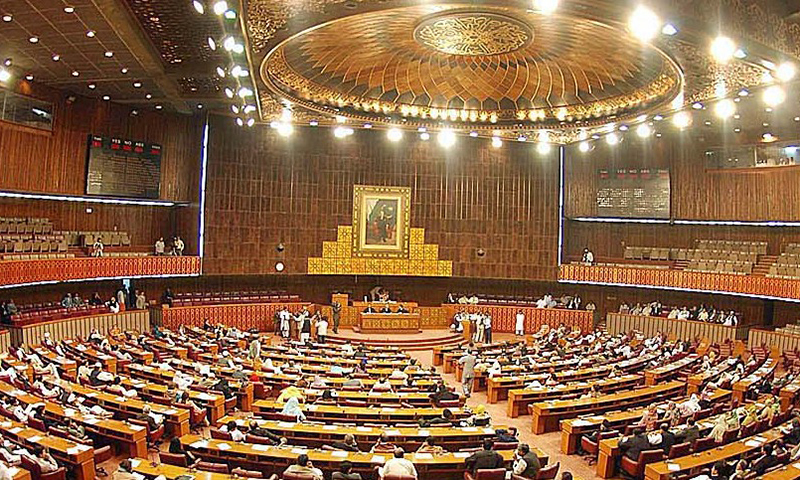
ISLAMABAD: The National Assembly unanimously passed a resolution on Tuesday condemning a wave of deadly militant attacks in Balochistan and demanding an “immediate, aggressive” national response against what it described as external sponsors and internal facilitators of terrorism, with lawmakers pointing to evidence of Indian involvement.
The lower house of parliament continued its debate on the security situation in the restive southwestern province following coordinated assaults on Saturday that targeted security forces, civilians and infrastructure across multiple districts, killing dozens and prompting a fierce military counter-operation.
“This House condemns in the strongest terms the recent terrorist incidents in Balochistan, in which not only innocent civilians were targeted but also heinous and inhumane tactics such as using women as weapons were adopted,” the resolution, tabled by Parliamentary Affairs Minister Dr Tariq Fazal Chaudhry, stated. It called for a “coordinated and effective national response” uniting political, diplomatic, military, intelligence, legal and rhetorical efforts against funding, smuggling and propaganda networks linked to the violence.
The document highlighted that “in several cases, evidence available points to external sponsorship, [and] particularly there are serious concerns over the role of India.” It added that terrorism was “being supported in some neighbouring countries through logistical and operational facilitation, financial support, training, treatment, movement and propaganda networks.”
The resolution expressed “deep sorrow and concern” over militant networks exploiting women “through exploitation, coercion and blackmail,” describing such tactics as contrary to Islamic, Pakistani and Baloch values. It praised the “timely and effective measures” by security forces, law enforcement, the Balochistan provincial government and civil administration, while expressing solidarity with the martyrs and injured. The assembly asserted that attacks on civilians, women and children were “unforgivable crimes” and vowed “decisive action” on a “zero tolerance” basis.
Pakistan’s military said militants from “Fitna-al-Hindustan” – a term used to denote groups allegedly backed by India – carried out the large-scale attacks on Saturday. Security forces killed 92 terrorists in initial clashes, with the toll rising to 177 by Monday after further operations. The attacks claimed the lives of at least 18 civilians, including women, children, elderly people and labourers, particularly in Gwadar and Kharan, along with 15 security personnel. Interior Minister Mohsin Naqvi earlier blamed India as the “main country” behind the terrorism, accusing it of providing financial, planning and strategic support.
Lawmakers from across parties voiced alarm over the surge in violence. Opposition Leader Mehmood Khan Achakzai proposed acknowledging the “first right” of provincial children to local resources, which Speaker Ayaz Sadiq noted was constitutionally protected. PTI’s Asad Qaiser called for talks with Afghanistan on cross-border concerns, full implementation of the National Action Plan and stronger policies to avoid isolation. JUI-F’s Aliya Kamran questioned delayed security responses and normalisation delays in areas like Nushki, urging answers on escaped terrorists and reasons for women becoming suicide bombers.
Defence Minister Khawaja Asif had noted women were involved in at least two of the 12 targeted cities. “For God’s sake, save these children,” she said, advocating dialogue with Balochistan’s people. Fellow JUI-F member Usman Badini described the province as “on fire,” questioning the state’s writ during attacks and highlighting issues like one-hour electricity supply and denial of rights. “Dialogue must be held with all those who accept the flag of Pakistan; otherwise, the problem will not be resolved,” he said.
PPP’s Sehar Kamran linked the attacks to a “nexus” between the banned Tehreek-i-Taliban Pakistan and India, saying the aim was to destabilise Pakistan. “To attack nine to 12 places in a coordinated manner requires tactical and logistic support. I think it is clear that there is external involvement,” she said. PML-Zia’s Ejazul Haq noted empty government benches during the debate and endorsed Achakzai’s points on gas deprivation in Balochistan despite Sui supplies.
A day earlier, Asif rejected justifying violence as a freedom struggle, calling it organised crime and affirming the state’s “bottom line” against such rationalisations. The attacks struck Quetta, Mastung, Nushki, Dalbandin, Kharan, Panjgur, Tump, Gwadar and Pasni. Assailants targeted police stations, banks, jails and government offices, torching records, freeing prisoners and killing officials.
Balochistan, Pakistan’s largest province by area, holds vast mineral and hydrocarbon reserves and hosts the China-Pakistan Economic Corridor, part of China’s Belt and Road Initiative. Separatists accuse Islamabad of exploitation; the government rejects this, citing investments. China condemned the attacks on Tuesday. Foreign Ministry spokesperson Lin Jian said: “We mourn for the lives lost, and our hearts go out to the injured and those who lost their loved ones.” He added China “firmly opposes any form of terrorism” and supports Pakistan’s anti-terror efforts. The Chinese embassy earlier mourned the victims. The United States, European Union, Iran and others also condemned the violence.
Copyright © 2021 Independent Pakistan | All rights reserved