By Staff Reporter
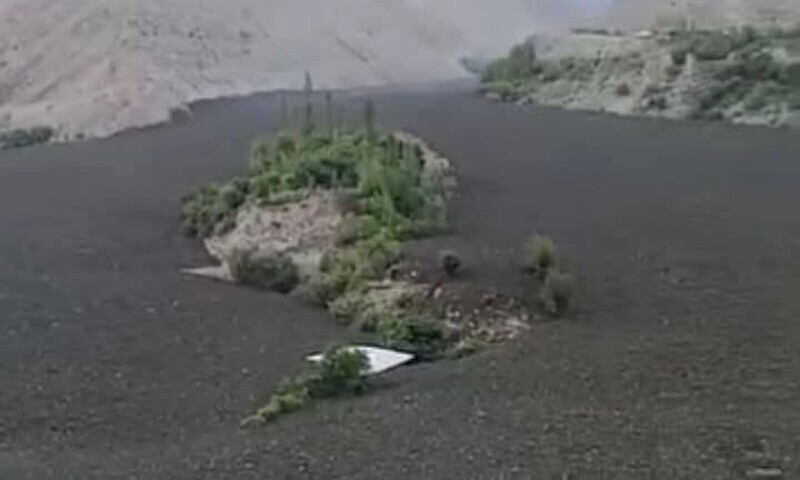
ISLAMABAD: A glacial lake outburst flood (GLOF) in Pakistan’s northern Gilgit-Baltistan region has damaged more than 100 houses and blocked the Ghizer River, prompting large-scale rescue operations, officials said on Friday.
The disaster struck around in the Rowshan and Talidas areas of Ghizer district, a region nestled among thousands of glaciers and some of the world’s highest peaks. The sudden release of water from a glacial lake, triggered by rising temperatures, swept through downstream villages, causing widespread destruction.
“One kilometer of road stretch was damaged in the flooding and the main road of Ghizer is closed,” Faizullah Faraq, a spokesperson for the Gilgit-Baltistan government, told media. “Over 100 houses were damaged and huge financial losses occurred, but local population was rescued by volunteers with the help of GB government and Pakistan Army.”
Rescue 1122, a national emergency service, said around 200 people have been rescued from flood-affected areas and have been shifted to Ghizer’s Yangal and Samal areas. “Several people have been traumatised after [their] houses were destroyed. Medical assistance is being provided to the affected people.”
The flooding was caused by a glacier burst in the Gupis valley’s Tildas and Rawshan villages late Thursday night, Rescue 1122 reported. “A terrible incident of glacier outburst has taken place, causing widespread destruction in the downstream,” it said, noting that the Ghizer River had been blocked for several hours, raising fears of high-level flooding downstream.
Pakistan, home to over 13,032 glaciers, the largest reservoir outside polar regions, faces increasing risks from glacial lake outbursts due to climate change. Experts warn that around 10,000 glaciers in Chitral and Gilgit-Baltistan are receding due to rising temperatures.
Local resident Abdul Wahid said shepherds near the glacier alerted downstream communities via mobile phones, urging immediate evacuation. “Some shepherds, who were living near the glacier, had informed people living in the downstream areas through mobile communication about the flood,” he said.
GB Secretary Fida Hussain confirmed no casualties were reported, with all affected individuals accounted for. “The flood swept away everything in the downstream areas in Talidas and Rawshan villages,” he said, adding that 40 stranded people were rescued, initially by local volunteers and later supported by Pakistan Army helicopters.
“The high temperature caused a burst of the lake, and ultimately high flooding occurred in the Sado nullah on Wednesday night,” Hussain said.
GB Minister for Law, Parliamentary Affairs and Tourism Ghulam Muhammad said the flood destroyed 70 houses, with standing water spreading three to four kilometres due to debris blocking the river. “If the flow of the river water is not restored, hundreds of large houses will be submerged,” he warned, noting that flooding began around 10pm Thursday and continued into Friday.
The Gilgit-Baltistan Disaster Management Authority (GBDMA) reported that helicopters were deployed to evacuate stranded individuals, while alerts were issued for downstream areas up to Biarchi, connecting Ghizer with Gilgit district. “All downstream 63 schools have been safely evacuated,” the GBDMA said, adding that drinking water supplies and relief items, including tents, were being dispatched.
The disaster follows a series of climate-related calamities in Pakistan this year. Earlier this month, a GLOF from the Shishper Glacier damaged parts of the Karakoram Highway, while a glacier burst in Bagrot Valley on August 1 killed one person and injured another, according to regional authorities.
Pakistan, one of the world’s most climate-vulnerable nations despite contributing less than one percent of global greenhouse gas emissions, has faced severe monsoon-related flooding and landslides in recent years. Since June 26, the National Disaster Management Authority reported 771 deaths nationwide, with Khyber Pakhtunkhwa accounting for 465 fatalities.
Meanwhile, Prime Minister Shehbaz Sharif, addressing a federal cabinet meeting on Friday, announced plans for a nationwide meeting to address illegal constructions along rivers, which exacerbate flooding risks. “There is no room for man-made disasters,” he said, criticising structures like hotels and houses built on riverbanks. He also praised the armed forces’ role in rescue operations, noting: “Pakistan Army reached the distant and difficult areas to rescue the people. For this purpose, helicopters were also used.”
The United Kingdom announced £1.33 million in humanitarian aid to support Pakistan’s flood response, targeting over 223,000 people across seven districts in Punjab, Gilgit-Baltistan, and Khyber Pakhtunkhwa. British High Commissioner Jane Marriott said: “Through UK-funded programmes, vital assistance is reaching communities affected by flooding and landslides.” The aid includes food rations, medical camps, and rehabilitation of water and irrigation systems.
Copyright © 2021 Independent Pakistan | All rights reserved