By Staff Reporter
ISLAMABAD: Pakistan has shot down an Afghan Taliban drone that crossed into its airspace on Friday, hours after Kabul claimed its air force had struck Islamic State hideouts inside Pakistani territory — claims Islamabad dismissed as deliberate disinformation from a regime it accuses of sheltering the very groups it claims to be targeting.
The Ministry of Information and Broadcasting, posting on its official fact-check account on X, said the Taliban administration had been circulating claims — through what it described as “various propaganda mouthpieces and official statements” — that Afghan forces had struck alleged Daesh camps in the border regions of Khyber Pakhtunkhwa and Balochistan using rudimentary drones. “The claims are false as usual,” the ministry stated flatly.
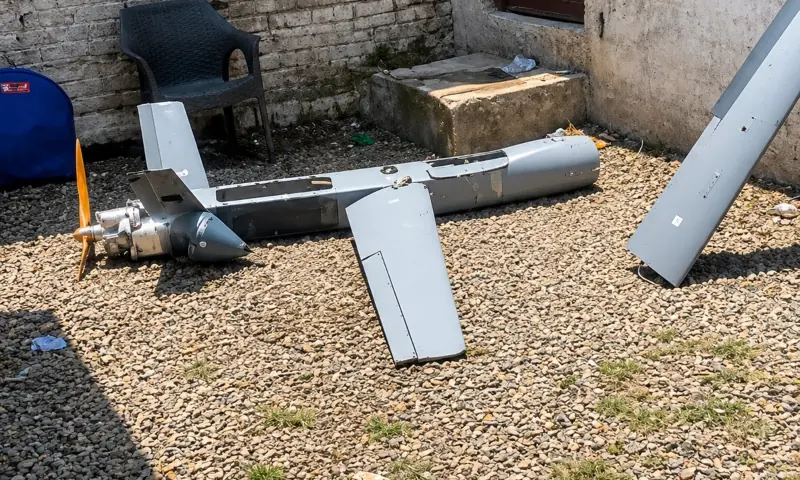
The rebuttal was accompanied by a photograph of the drone itself. According to the ministry, the drone had crossed into Pakistani airspace near Shinko in the Khyber district of KP, where it was “immediately identified and neutralised” by the Pakistan Air Force’s air defence system.
The ministry went further, turning the Taliban’s own narrative on its head. Terrorist camps — including those of Daesh and more than two dozen other militant organisations — were not located inside Pakistan, it said, but were “factually located, run and patronised from inside the territories under control of the Afghan Taliban regime.” Kabul’s statements, the ministry added, were a habitual attempt to obscure its own role in sponsoring cross-border militancy, including through groups Islamabad designates as Fitna Al Khawarij — its official term for the banned Tehreek-i-Taliban Pakistan and its affiliates — and Fitna Al Hindustan, a label applied to outfits Pakistan accuses India of funding to carry out attacks on Pakistani soil.
The Afghan Taliban’s defence ministry had posted on X claiming its air force had struck militant hideouts in Balochistan and KP overnight on Thursday. It offered no independent verification of the strikes, and Pakistan’s rebuttal appeared within hours.
The episode is the latest flare-up in a relationship that has deteriorated sharply since the Taliban’s return to power in Kabul in 2021, which Pakistani officials correlate directly with a steep rise in militant attacks in KP and Balochistan. Islamabad has repeatedly pressed the Taliban administration to dismantle sanctuaries used by the TTP and allied groups operating from Afghan territory. Those appeals, Pakistani officials say, have gone unanswered.
The frustration boiled over in February, when Pakistan launched Operation Ghazab lil-Haq following an unprovoked cross-border firing by Afghan Taliban forces. Border clashes last October had already left more than 200 Taliban fighters and allied militants dead, alongside 23 Pakistani soldiers killed in what the government described as defensive operations.
On 9 June, Pakistan carried out fresh strikes on terrorist positions along the Afghan frontier. Information Minister Attaullah Tarar said 26 militants were killed. China had attempted to broker a de-escalation between Islamabad and Kabul, facilitating talks in Urumqi in April that produced a period of relative calm — a calm that the June strikes appear to have broken.
Pakistan’s ambassador to the United Nations, Asim Iftikhar Ahmad, told the Security Council earlier this month that Afghanistan’s rulers were obliged to take “verifiable and non-reversible action” against militant groups operating from their territory. “Regrettably,” he said, “this demand remains unmet.”
The Foreign Office has made clear that any normalisation of ties with Afghanistan is contingent on credible counter-terrorism commitments from Kabul — specifically, a binding assurance that Afghan soil will not be used to plan or launch attacks against Pakistan. The Taliban government has consistently rejected such framing, insisting that militancy inside Pakistan is an internal Pakistani problem.
Copyright © 2021 Independent Pakistan | All rights reserved