By Staff Reporter
ISLAMABAD: An international arbitration panel has delivered a fresh technical blow to India’s hydroelectric ambitions in occupied Kashmir, issuing a supplemental award that Pakistani officials say sharply restricts New Delhi’s ability to store and control water on the rivers the 1960 Indus Waters Treaty reserves largely for Pakistan.
The Permanent Court of Arbitration in The Hague ruled May 15 that maximum “pondage” — the volume of water a run-of-river plant can hold in its reservoir — must be grounded in real hydrology, actual power needs and strict treaty criteria, not inflated assumptions or later promises of operational restraint. Pakistan, which hailed the still-unpublished decision on Sunday as a major validation of its position, said the ruling makes clear that the treaty’s limits are substantive and apply at the design stage, not merely during operation.
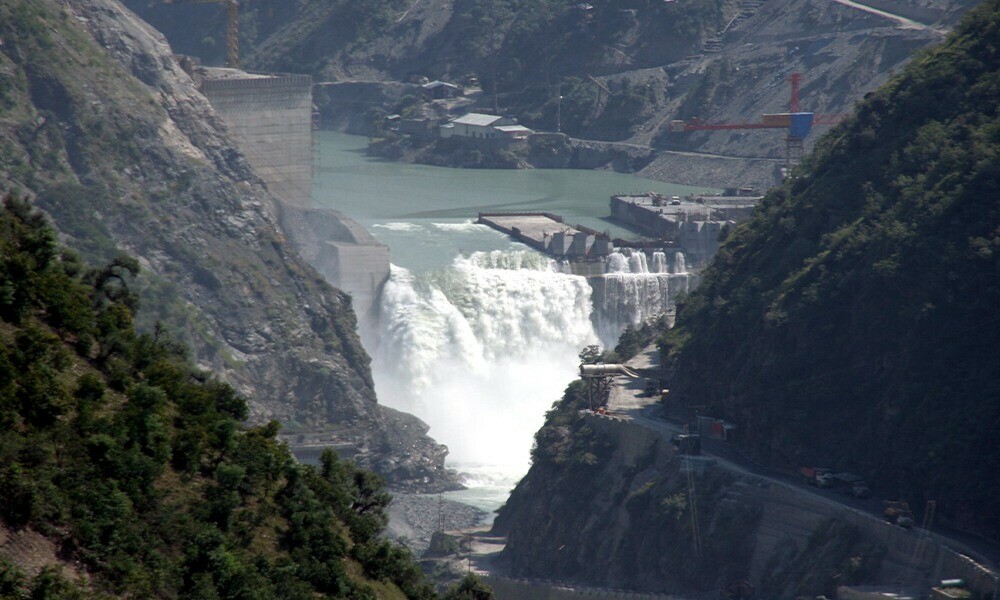
The award stems from long-running disputes over two Indian projects — the Ratle plant on the Chenab River and the Kishenganga project on the Jhelum — both in Indian-occupied Kashmir. It builds directly on the tribunal’s August 2025 interpretation of the treaty, which required India to let the western rivers flow for Pakistan’s “unrestricted use” and insisted that any hydroelectric exceptions conform precisely to the pact’s technical rules rather than to Indian notions of best engineering practice.
Pakistan first took the dispute to arbitration in 2016. India has refused to participate, calling the court illegally constituted, and last year announced it was suspending its obligations under the treaty after a tourist attack in Pahalgam that killed 26 people. New Delhi blamed Pakistan for the assault but has offered no public evidence linking Islamabad to it.
The 1960 treaty, brokered by the World Bank after years of negotiations following Partition, was designed to survive the two nations’ bitter rivalry. It gave Pakistan primary rights to the western rivers — Indus, Jhelum and Chenab — and India the eastern ones — Ravi, Beas and Sutlej. For more than six decades it has channeled technical disagreements away from the larger political conflict. But India’s unilateral suspension, coupled with its rejection of the arbitration process, has pushed the water-sharing arrangement into uncharted and dangerous territory.
In its statement on Sunday, the Pakistani government said the new award “affirmed Islamabad’s central position that the treaty places substantive limits on India’s water-control capability on the western rivers.” Those limits, it stressed, “are not formalities.” Pondage must be justified by site-specific hydrology, hydraulic conditions, realistic power-system requirements and the detailed information India is obliged to provide under the treaty.
The court, Pakistan says, rejected any attempt to justify larger reservoirs through “imagined capacity, artificial load curves, unrealistic peaking assumptions, or bare assertions of compliance” with operational release rules.
The ruling also clarified that Paragraph 15 of the treaty — which sets minimum flow requirements — is an operational constraint but does not substitute for evidence-based justification of pondage. It reinforced Pakistan’s right to demand sufficient data from India to assess compliance and placed the burden squarely on New Delhi to prove that any proposed design meets the treaty’s standards under Annexure D. The tribunal further ruled that any minimum-flow obligations must be factored into calculations of “firm power” and that Paragraph 15 releases do not automatically satisfy them.
Pakistan noted that the court had already declared its awards final and binding, with controlling legal effect for future treaty proceedings. Islamabad said it would carry these interpretations forward to the neutral expert mechanism, respecting confidentiality rules.
Indian Ministry of External Affairs spokesperson Randhir Jaiswal dismissed the entire arbitration process as “null and void,” repeating New Delhi’s position that it does not recognize the court and that its suspension of the treaty remains in force. The Pakistani statement described the award as “a strategic consolidation” of its treaty rights: maximum pondage must be realistic, evidence-based, hydrologically grounded and incapable of inflation through artificial assumptions. Despite the sharp language, Islamabad reiterated its commitment to the treaty and its dispute-resolution procedures, saying it would continue to pursue “every lawful and diplomatic means” to ensure Indian projects on the western rivers stay within treaty limits.
Political analysts in Pakistan reacted with pointed criticism of India’s stance. Former ambassador Manzoorul Haq told the Associated Press of Pakistan that New Delhi’s rejection of the ruling reflected “the fascist Modi government’s disregard for international legal institutions.” He noted that India had similarly brushed aside UN Security Council resolutions on Kashmir and now the arbitration court’s decisions, undermining the World Bank’s guarantee of the treaty. Such actions, Haq warned, threatened the sanctity of international agreements and risked destabilizing the subcontinent — a particularly perilous prospect between two nuclear-armed neighbors locked in a dispute over a resource as vital as water.
Copyright © 2021 Independent Pakistan | All rights reserved