By Staff Reporter
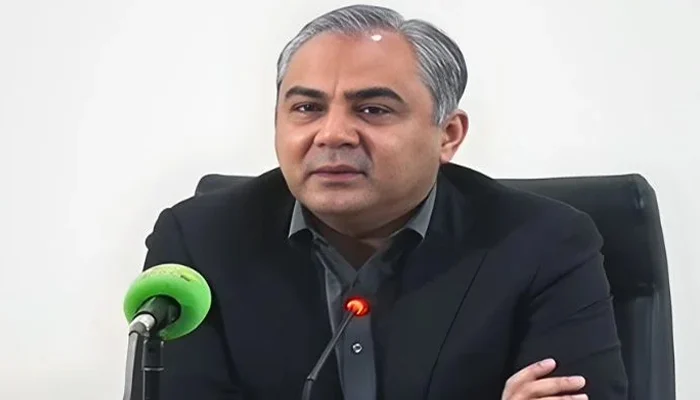
LAHORE: The interior minister announced on Monday a sweeping campaign against the spread of false information on social media, warning that the government would no longer tolerate unsubstantiated claims that sow panic or undermine national stability.
The minister, Mohsin Naqvi, said during a news conference that the information ministry, working with the newly formed National Cyber Crime Investigation Agency, would take action “on a massive scale” to curb what he described as an epidemic of misinformation. He estimated that “since the past few days, past few weeks, 90 percent news on social media is fake.” Naqvi was quick to emphasise that the measures were not intended to infringe on legitimate journalism or free speech. “I believe in the freedom of expression and liberty to criticise,” he said.
The announcement comes amid heightened government efforts this year to regulate online content. In April, Pakistan established the National Cybercrime Investigation Agency to probe and prosecute digital offencses nationwide. Earlier, in January, amendments to the Prevention of Electronic Crimes Act were enacted, with officials saying the changes targeted hacking, online harassment and data breaches.
But opposition parties, journalists and human rights organisations have charged that such laws are being wielded to suppress dissent and muzzle critics. Media outlets have reported instances of harassment and intimidation by authorities, allegations that the government has denied.
In his remarks, Naqvi drew a sharp distinction between traditional media and unregulated online platforms. He noted that if false information appeared in mainstream outlets, complaints could be filed with the Pakistan Electronic Media Regulatory Authority, and reporters would be held accountable by their news directors or bureau chiefs. “But, on social media one can post any photo, make news as per their wish and post it.”
Naqvi said he had discussed the issue with the information minister that morning, declaring, “we will not allow this.” “If you have evidence, you can report any story,” Naqvi continued. “But it cannot be allowed that you say whatever you want on social media, make any allegation against anyone, [declare] any living person dead and [declare] a dead person alive. This cannot happen.”
The crackdown, he said, would focus on preventing the dissemination of fake news “across the country and create panic […] in the garb of journalism.” Naqvi elaborated on the government’s view of who qualifies as a journalist. “Journalists are responsible, those who are part of the national media. They work as part of a system. Every institution has a system of check-and-balance and an editorial board.” Those operating within such frameworks, he said, “are journalists for us.”
“By contrast, purveyors of false information “are not journalists for us. We are very clear on this,” he stated. “Whether you produce vlogs or a podcast, […] run news responsibly.”
Reiterating the government’s respect for press freedom, Naqvi insisted that the initiative targeted only misinformation. When asked if a new regulatory body would oversee the effort, he replied: “I think one is already being established.” Clarifying the scope, Naqvi described the planned actions by the information ministry and the cyber agency as “not an operation or a crackdown, but simply an action against anyone spreading fake news without any evidence.”
The minister also addressed broader political tensions, including what he called “a political party running a campaign from India”, an apparent allusion to recent interviews given to Indian media outlets by the sisters of Imran Khan, the imprisoned founder of the Pakistan Tehreek-e-Insaf party. “I want people to get exposed,” Naqvi said. “Others should know who can go to what extent. The country’s integrity is a boundary that you don’t cross and join the enemy. Let it happen.”
Responding to questions about criticism of Gen. Asim Munir, the chief of army staff, Naqvi said the state is clear, “we will not spare them. The other day someone was saying in London that there was a dispute within the institutions, someone else says something about our journalists. This will have to stop.”
Without naming individuals, he added: “Those sitting out there, let me tell you, you are also coming back soon. And if you think you will get protection here, that is not possible. We will soon bring you back, and you will be answerable.”
At the start of the news conference, Naqvi turned to the issue of Afghan migrants, saying authorities were encountering resistance in the northwestern province of Khyber Pakhtunkhwa to repatriating refugees to Afghanistan. He contrasted this with smoother operations in the country’s other three provinces. Afghan migrants, he claimed, were being “protected in KP.” The federal government had closed refugee camps, he said, but several remained active in the province.
Citing security concerns, Naqvi pointed to the involvement of Afghans in recent terrorist acts, including an attack on the Frontier Constabulary headquarters in Peshawar on Nov. 24, which he said was carried out by Afghans. He announced that local police station house officers would now be tasked with identifying “illegal Afghans” in their jurisdictions for deportation.
Directives had been sent to provincial inspector generals to compile data through these officers. “Our message to the KP government is also that it is important at this time to prioritise your country over politics,” Naqvi said, urging compliance with federal policy. “We cannot afford any more bomb blasts.” To undocumented Afghans, he delivered a stark warning: “My message to illegal Afghans is to leave yourself respectfully. Because if you get caught now, we will not just send you back.”
He declined to elaborate but added that any who returned after deportation would face arrest. Questioned on whether the federal government might take legal action against Khyber Pakhtunkhwa for noncompliance, Naqvi said various options were under consideration. “When it comes to national security, it cannot happen that a province makes it own policy,” he said. “We will not allow this.”
Naqvi dismissed speculation on social media about a delayed official notification of the appointment of a chief of defence forces, a new role created by a constitutional amendment. Observers have called the delay baffling, suggesting it could signal strains in civil-military relations. “Let them do it,” Naqvi said of the rumors. “A new institution is being established after an amendment in the Constitution. They want things to happen at the press of a button, but things don’t work that way. A system has to be established, and it takes days, hours. It’s not that you press a button and it will become a part of the Constitution.”
Copyright © 2021 Independent Pakistan | All rights reserved