By Staff Reporter
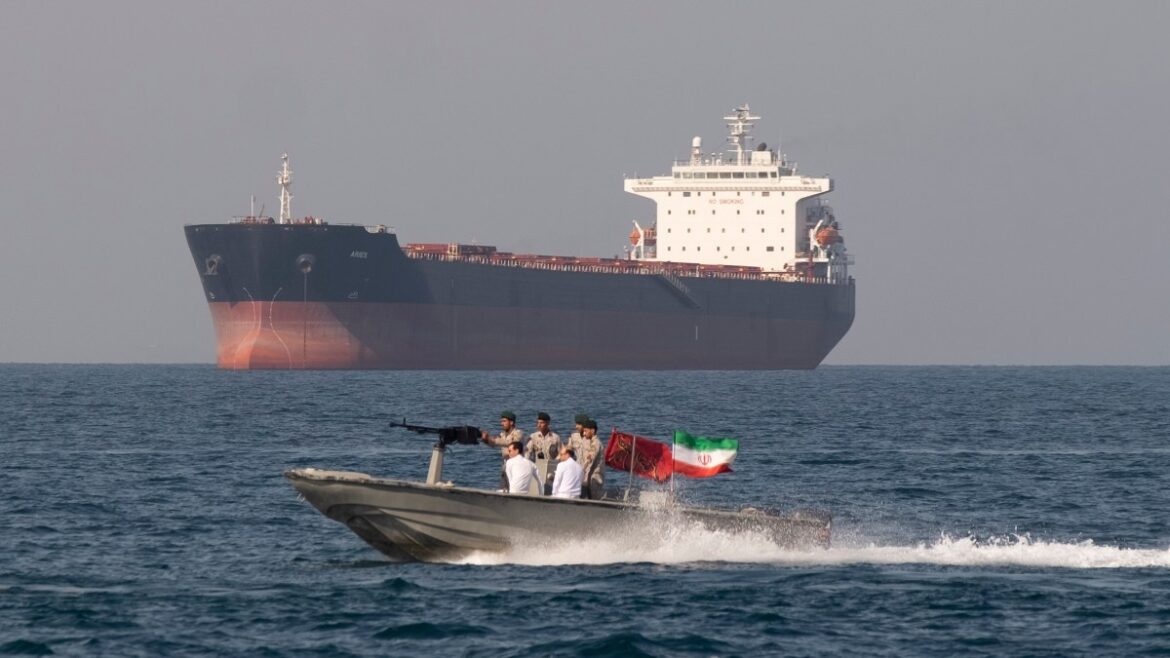
ISLAMABAD: Iranian gunboats opened fire on a tanker and a container ship was struck by an unknown projectile in the Strait of Hormuz on Saturday, hours after Tehran’s navy broadcast a radio warning that it was once again sealing the strategic waterway to all commercial traffic in retaliation for what it described as US violations of a fragile ceasefire.
The abrupt reversal — less than 24 hours after Iran had declared the vital chokepoint open — plunged one of the world’s most critical oil arteries back into crisis, triggered new reports of armed incidents at sea and cast fresh doubt on President Donald Trump’s insistence that a long-term deal to end the US-Israeli war with Iran was “very close.”
With only four days left before the two-week truce expires, the developments showed how quickly the diplomacy could collapse. “Attention all ships, regarding the failure of the US government to fulfil its commitment in the negotiation, Iran declares the Strait of Hormuz completely closed again. No vessel of any type or nationality is allowed to pass through the Strait of Hormuz,” the VHF radio message stated, according to vessels that received it and reports relayed by Reuters.
The announcement from Iran’s military central command, aired on state television late on Saturday, said control of the strait had “returned to its previous status” and was now “under strict management and control of the armed forces.” The move came in direct response to Washington’s continued naval blockade of Iranian ports, which the United States has insisted would remain in place “until such time as our transaction with Iran is 100 percent complete.”
The to-and-fro over the strait — one of the world’s most critical arteries for global oil and gas shipments — underscored the razor-thin margins of the diplomacy that has unfolded since the war erupted on Feb. 28. A handful of oil and gas tankers had managed to cross the waterway early Saturday during the brief reopening Iran announced on Friday afternoon, tracking data from the firm Kpler showed. But within hours, several more crude carriers approached the passage only to turn back near Iran’s Larak Island, a key checkpoint under Iranian oversight, according to the ship-tracking platform MarineTraffic.
A screengrab from the site taken around 3 pm Pakistan time illustrated the sudden reversal. At least eight tankers had successfully transited by 10:30 am GMT, some hugging Iranian territorial waters as instructed by Tehran and broadcasting their identities as Indian or Chinese vessels in what appeared to be an effort to signal neutrality. At least three of those exiting vessels were under US sanctions, according to public listings.
Iranian Revolutionary Guard Corps gunboats fired on a tanker northeast of Oman, the UK Maritime Trade Operations Centre (UKMTO) reported in an online statement. “Tanker and crew are reported safe,” the UKMTO said. “Authorities are investigating.” A short time later, the same British monitoring service received a report of a container ship in the same area “being hit by an unknown projectile which caused damage to some of the containers” but no fire or injuries.
The incidents occurred as Iran reversed its Friday pledge to reopen the strait following a US-brokered ceasefire in Lebanon that had halted Israel’s offensive there. Tehran had framed the temporary opening as a goodwill gesture tied to the truce. But Iranian officials quickly accused Washington of violating the terms by maintaining its blockade. Iran’s parliamentary speaker, Mohammad Bagher Ghalibaf, posted on X that “with the continuation of the blockade, the Strait of Hormuz will not remain open.” Passage, he added, would require explicit Iranian authorisation. Foreign Ministry spokesman Esmaeil Baqaei called the US naval presence “a violation of the ceasefire” and warned of an “appropriate response.”
Iran’s Supreme National Security Council, meanwhile, said new US peace proposals were under review, according to state-run broadcaster PressTV.
Shipping industry on edge
The renewed closure trapped hundreds of vessels inside the Persian Gulf and sent ripples through global energy markets and shipping costs. Shipping analysis firm AXSMarine estimated that between 108 million and 116 million barrels of crude oil were currently stored aboard tankers at sea in the Gulf. Under a full reopening, that volume could transit the strait within six to eight days — but reaching key Asian markets would still take weeks.
The industry had already reacted with caution to Friday’s announcement of a temporary opening. Jakob Larsen, chief security officer for the major shipping association BIMCO, said in a statement that “the status of mine threats in Iran’s maritime traffic separation scheme is unclear” and urged companies to consider avoiding the area. A notable exception was the cruise ship Celestyal Discovery, which became the first passenger vessel to transit the strait since the conflict began.
MarineTraffic reported the ship, carrying no passengers, sailed close to the Omani coast on Friday afternoon after being docked for 47 days in the United Arab Emirates. At least two other passenger ships were tracked making the same cautious passage near Oman on Saturday.
Trump’s mixed signals from Air Force One
Aboard Air Force One on Saturday, returning from Phoenix, Trump told reporters he might not extend the ceasefire beyond its Wednesday expiration unless a permanent deal is reached. “Maybe I won’t extend it, but the blockade on Iranian ports is going to remain,” he said. “So you have a blockade, and unfortunately, we have to start dropping bombs again.” Yet the president also expressed optimism. “I think it’s going to happen,” he said of a final agreement.
He ruled out any Iranian-imposed “tolls” on ships passing through the strait — a demand Tehran had floated in earlier proposals — and insisted that enriched uranium stockpiles in Iran would be transferred jointly to the United States as part of any deal. Trump separately posted on Truth Social that Chinese President Xi Jinping was “very happy” about the brief reopening of the chokepoint. “Our meeting in China will be a special one and, potentially, Historic,” he wrote, referring to a planned summit in Beijing in May.
He also alluded obliquely to a mysterious visitor arriving at the White House for what he called “a form of a news conference” around 9 am on Saturday, describing the guest as “very good, very smart, very caring” but declining to name them or confirm any direct link to the Iran talks.
Diplomatic scramble intensifies
No date has been set for the next round of direct US-Iran negotiations, Iran’s deputy foreign minister, Saeed Khatibzadeh, told reporters on the sidelines of the Antalya Diplomacy Forum in southern Turkey. “We are now focusing on finalising the framework of understanding between the two sides,” he said. “We don’t want to enter into any negotiation or meeting which is doomed to fail and which can be a pretext for another round of escalation.”
Khatibzadeh accused Washington of a “maximalist approach” that sought to place Iran outside international law, particularly on the nuclear file. “I have to be very crystal clear that Iran would not accept being an exception from international law,” he said. “Anything that we are going to be committed to will be within the international regulations and international law.”
He dismissed US threats of renewed military action as inconsistent. “The American side tweets a lot, talks a lot. Sometimes confusing, sometimes, you know, contradictory,” Khatibzadeh said, a clear reference to Trump’s frequent social media activity. Iran, he vowed, would “defend heroically and patriotically our country … as the oldest civilisation on earth.”
Russia’s state nuclear energy company, Rosatom, signaled its readiness to assist with the removal of enriched uranium from Iran if a deal is reached, its director general, Alexei Likhachev, told Reuters. The company is closely monitoring the US-Iran talks.
The Strait of Hormuz, which connects the Persian Gulf to the Gulf of Oman and the Arabian Sea, normally carries about one-fifth of the world’s traded oil and liquefied natural gas. Its repeated closure has already driven up oil prices and shipping insurance premiums, forcing some captains to reroute around Africa at enormous extra cost. Iran had initially sealed the strait in early March in response to US-Israeli strikes. Friday’s brief reopening followed the Lebanon ceasefire and appeared calibrated to build momentum for broader talks. But the US insistence that its blockade would remain until a comprehensive deal was finalised prompted Tehran’s swift reversal.
Khatibzadeh rejected accusations that Iran was endangering freedom of navigation. “Americans cannot impose their will to do a siege over Iran while Iran, with good intentions, is trying to facilitate safe passage through the Strait of Hormuz,” he said. Tehran had offered safe passage for commercial vessels during the Israel-Lebanon truce, he added, but only with prior coordination — terms Washington, in Iran’s view, had sought to undermine.
Copyright © 2021 Independent Pakistan | All rights reserved