By Staff Reporter
ISLAMABAD: Iranian President Masoud Pezeshkian called on Tuesday for Muslim nations to forge a “united front” against common enemies and offered Iran’s “hand of friendship” to build a new regional security architecture, using a high-profile state visit to Islamabad to signal a diplomatic pivot following last month’s devastating US-Iran conflict.
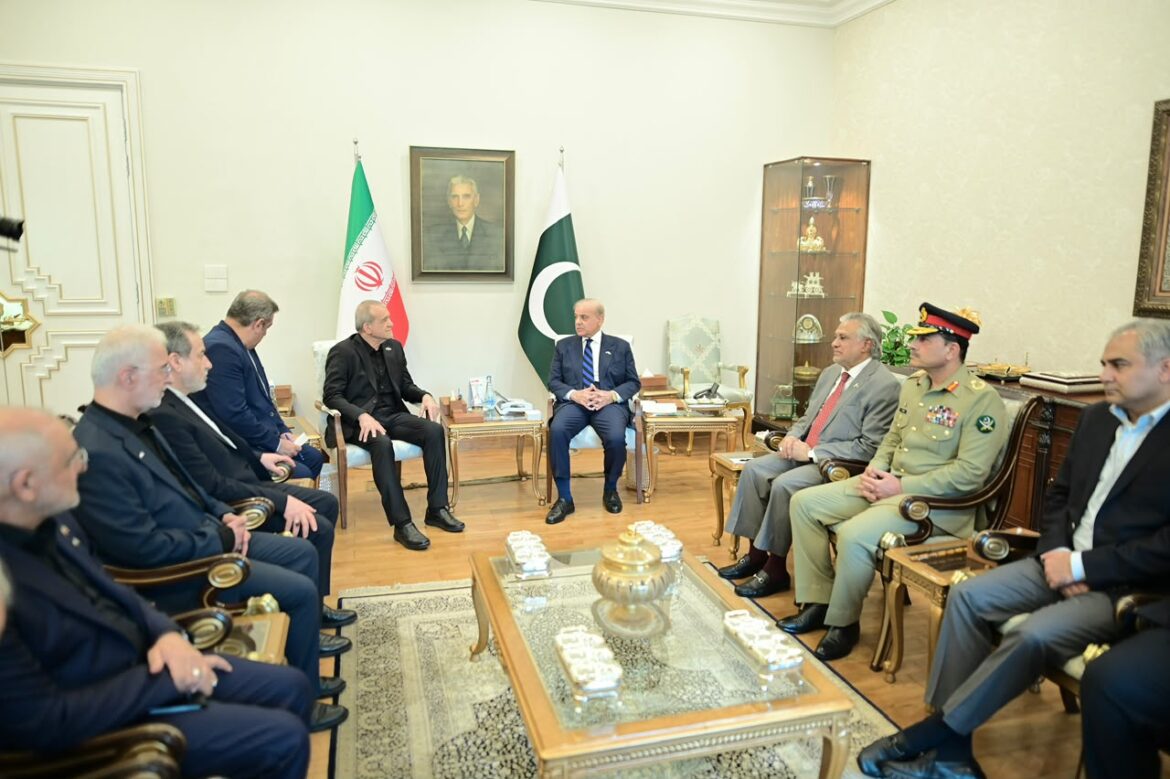
Pezeshkian, flanked by Prime Minister Shehbaz Sharif at a joint press conference, said peace and stability across West Asia and the Persian Gulf could only be guaranteed through intra-regional cooperation grounded in mutual respect — and that Tehran was ready to help build it.
“Based on this fact, we stretch our hands of friendship to establish a common understanding and build a new security structure for the countries in the region,” the Iranian president said.
“I believe Muslims shall form a united front against their enemies,” he added.
The visit — Pezeshkian’s second to Pakistan as president and his first since hostilities erupted on February 28 following US-Israeli strikes on Tehran — came days after Pakistan and Qatar brokered the landmark Islamabad Memorandum of Understanding between Washington and Tehran, a 14-point accord setting out a framework to end the war, reopen the Strait of Hormuz and resolve key disputes within 60 days.
The MoU was followed last weekend by direct US-Iran talks at the Swiss resort of Burgenstock — dubbed the Lake Lucerne Summit — at which Pakistan’s Shehbaz and Chief of Defence Forces Field Marshal Asim Munir represented Islamabad’s mediation effort alongside Qatari envoys.
A NEW CHAPTER
Pezeshkian opened his remarks at the press conference by reciting verses by the revered poet and philosopher Allama Iqbal, a nod to shared intellectual heritage that he said continued to inspire Muslim unity. He cast the Pakistan-Iran relationship not merely as bilateral but civilisational.
“Pakistan for us is not merely a neighbouring country; it is a brotherly and friendly country,” he said. “These bonds have brought our nations closer.”
The two sides, he said, were “adamant to use the positive existing atmosphere to usher in a new era and open a new chapter in bilateral relations” — drawing “new horizons and new opportunities of cooperation based on shared interests.”
He said discussions during the visit had covered the “latest developments in the region and the world”, as well as measures to operationalise agreements reached during a previous visit to Islamabad, including the removal of technical hurdles obstructing economic and trade cooperation.
Pezeshkian praised Pakistan’s role in the months of diplomatic groundwork that preceded the ceasefire, calling Islamabad’s mediation a “reflection of the ancient and age-old trust that the Iranian nation has towards the nation, the government and the authorities of Pakistan.”
SHEHBAZ: ‘IRAN’S LOSS IS OUR LOSS’
In remarks that were conspicuously personal in tone, Shehbaz described the meeting as akin to a “family reunion” and saluted Pezeshkian — a trained cardiac surgeon before entering politics — as a “visionary and sagacious leader” who is “calm, wise and patient.”
“Iran’s success is our success. Iran’s loss is our loss,” Shehbaz declared, inserting a Persian phrase into his address before adding: “This sentiment reflects deeply the feeling of the people of Pakistan.”
He described the US-Iran ceasefire as “a matter of great happiness” that had halted a conflict he warned “could have engulfed the entire region and beyond,” and offered Pakistan’s deepest condolences over the thousands of Iranian civilian deaths, including that of Supreme Leader Ayatollah Ali Khamenei, who was killed in the initial US-Israeli strikes.
Pakistan, he said, would participate in Khamenei’s funeral, and he announced he would travel to Tehran next week to pay his personal respects and “reaffirm and reassure Pakistan’s solidarity with our brotherly people of Iran.”
Shehbaz also praised the “wisdom and sagacity” of Iran’s new supreme leader, Ayatollah Mojtaba Khamenei, for guiding Iran through “these very difficult and challenging times,” and commended Field Marshal Munir by name as instrumental in building the diplomatic consensus that led to the breakthrough.
“Even during the dark days, he never wavered,” the prime minister said of Munir.
He also thanked Qatar’s emir, Saudi Crown Prince Mohammad bin Salman, Turkish President Recep Tayyip Erdogan and Egyptian President Abdel Fattah El-Sisi for what he described as decisive support during the negotiations. He additionally credited Deputy Prime Minister and Foreign Minister Ishaq Dar, Interior Minister Mohsin Naqvi and Iran’s Foreign Minister Abbas Araghchi — who attended the visit — for their shuttle diplomacy.
ZARDARI, MUNIR MEETINGS
Before the press conference, Pezeshkian held separate meetings with President Asif Ali Zardari at Aiwan-i-Sadr and with Munir, in addition to formal bilateral and delegation-level talks with the prime minister at PM House, where he was received with a guard of honour.
Zardari reaffirmed Pakistan’s “principled support for Iran’s peace, stability, national unity, sovereignty and territorial integrity” and expressed hope that ongoing technical-level negotiations would yield “permanent peace in the region.” He also requested that Pezeshkian convey warm regards to Iran’s new supreme leader.
In a statement, the Inter-Services Public Relations directorate said Munir and Pezeshkian had exchanged views on “regional developments and peace initiatives,” with the Iranian president acknowledging Pakistan’s “constructive and responsible role in promoting dialogue, de-escalation and regional stability.”
Munir had been present alongside Shehbaz at the Lake Lucerne Summit over the weekend.
LAKE LUCERNE FRAMEWORK
The Swiss talks created a mechanism for further technical negotiations continuing this week, established communication lines to end fighting in Lebanon, and set up procedures to keep the Strait of Hormuz open.
“Encouraging progress has been made,” the mediators said in a joint statement, adding that a contact channel had been set up to “avoid incidents and miscommunication” in the strategically vital waterway. A “de-confliction cell” involving the parties and Lebanese authorities was also agreed upon.
Iran’s Foreign Minister Araghchi, who attended the Burgenstock talks and arrived in Islamabad on a separate flight from Oman, joined Pezeshkian throughout the visit. Araghchi had also held talks with both President Zardari and Prime Minister Shehbaz in the hours before Pezeshkian landed.
The Iranian delegation also included Interior Minister Eskandar Momeni and other senior presidential office officials.
SECURITY LOCKDOWN
Islamabad was placed under a tight security cordon for the visit, with the Red Zone sealed and access restricted to authorised officials. All bus terminals in the capital were shuttered from Monday night and remained closed pending Pezeshkian’s departure.
The Islamabad High Court and the Federal Constitutional Court both cancelled their cause lists for the day, directing staff to work from home. The federal government issued a similar work-from-home order for ministries and divisions located within the Red Zone, though essential institutions and banks were exempted.
Pezeshkian was accorded a 21-gun salute on arrival at Nur Khan airbase in Rawalpindi, with fighter jets conducting a flypast in his honour.
Copyright © 2021 Independent Pakistan | All rights reserved