By Staff Reporter
ISLAMABAD: Islamabad is bracing for its biggest security operation in years, with tens of thousands of police officers, hundreds of shipping containers and a arsenal of riot equipment being mobilised across the federal capital and neighbouring Punjab ahead of a planned opposition march that the government has vowed, in the words of one insider, to “fix… for good”.
Pakistan Tehreek-e-Insaf, the party founded by jailed former prime minister Imran Khan, intends to march on the capital on 27 September to demand his release from Adiala jail in Rawalpindi, where he has been held since August 2023. But sources close to the party say the government has made clear, through backchannel contacts, that the demonstration will not be permitted to proceed — and that preparations are already in place to confront marchers with overwhelming force should they try.
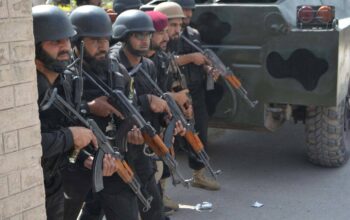
The scale of the security build-up is extraordinary even by the standards of a country accustomed to political upheaval. More than 43,000 police personnel are being deployed across the districts ringing Islamabad and Rawalpindi alone, while the capital’s police force has requisitioned some 110,000 tear gas shells, 200,000 sandbags and roughly 1,300 launchers capable of firing them — with 500 more on order. Officers have also, for the first time, been issued net launchers designed to physically entangle and detain protesters.
Mobile phone and internet services are expected to be suspended or slowdown across Islamabad, Rawalpindi and parts of Attock on 26 and 27 September, a measure Pakistani authorities have used before to hamper the coordination of large protests.
A capital sealed shut
The clampdown was formalised on Wednesday when Islamabad’s Additional District Magistrate, Dr Anam Fatima, signed an order invoking Section 144 of the criminal procedure code — a colonial-era provision that bans public gatherings — across the entire capital territory for two months. The order prohibits any assembly of five or more people, as well as processions, rallies and demonstrations, in any public space, including the high-security Red Zone that houses parliament, the Supreme Court and foreign missions.
The order warns that the demonstrations being planned “were likely to threaten public peace, cause annoyance and injury, endanger human life and safety, threaten public property and could lead to a riot”. Violators face up to three years in prison under Pakistan’s Peaceful Assembly and Public Order Act 2024, the district administration said, urging residents to “cooperate with security agencies and demonstrate responsibility”.
A parallel order has imposed the same restrictions across the whole of Punjab province for thirteen days, and the provincial government has formally asked Islamabad to deploy paramilitary Rangers to four districts — Rawalpindi, Attock, Jhelum and Mianwali — from 22 September to 5 October to reinforce police. It follows the federal government’s decision in August to station three companies of the Pakistan Army in Rawalpindi for six months on what officials described as “sensitive security duties”.
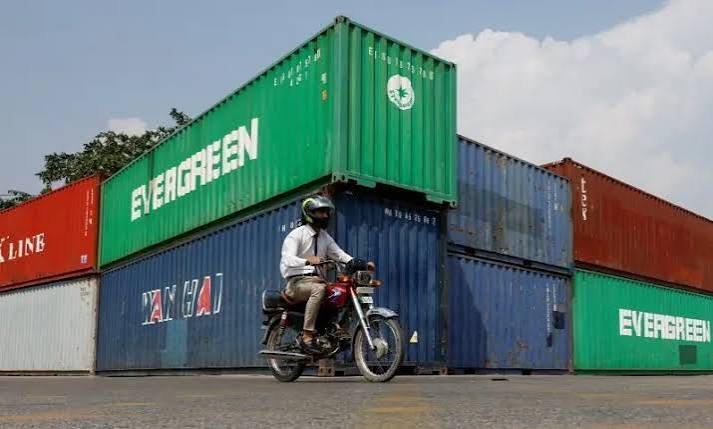
On the ground, the physical fortification of the city is already well advanced. Roughly 210 shipping containers — enough to seal virtually every major road into the capital — have been distributed to intersections across Islamabad, with sand-filled trailers brought in to weigh them down so they cannot easily be dragged aside. Three routes into the Red Zone have already been welded shut. Twenty-two cranes are on standby, ready either to reposition containers or, if past demonstrations are any guide, to be withheld from the opposition entirely: PTI insiders say several transport and machinery firms have already declined to supply the party with the cranes and heavy vehicles it has relied on in previous marches to clear barricades, after government warnings that any firm assisting protesters “would face the music”.
In Rawalpindi division alone, more than 43,000 officers are being stationed at motorway interchanges, bridges and checkpoints along the M-1, N-5, N-80 and the China-Pakistan Economic Corridor’s M-14 route — the principal arteries by which PTI convoys would need to travel from Khyber Pakhtunkhwa toward the capital. Roughly 30,000 of those personnel are earmarked for Attock district alone, the last major crossing point before Punjab gives way to the federal territory. Police have also surveyed dozens of petrol stations and hotels along the Grand Trunk Road and motorway corridors, in what security officials describe as contingency planning should the standoff run for an extended period.
The Punjab Police, in a formal request to their federal counterparts, have asked for reinforcements that read like a quartermaster’s inventory of a coming confrontation: thousands more rubber bullets, tear gas shells and grenades, riot helmets and bulletproof jackets, water cannon, armoured personnel carriers and a dozen surveillance drones with operators. Officials say the current strategy is to keep Rawalpindi and Islamabad functioning normally in the meantime, monitoring the march’s progress under what one official described as a “wait and see” approach, before committing forces if and when convoys breach barriers in Punjab.
Carrot and stick
Behind the show of force, however, local media reported that quieter contacts have continued between the party and figures close to the state. According to PTI insiders, the government has floated a series of confidence-building measures in an apparent effort to defuse the crisis without a march taking place at all — chief among them, an offer to transfer Khan from Adiala jail to the Pakistan Institute of Medical Sciences hospital in Islamabad, and his wife, Bushra Bibi, to house arrest at the couple’s residence in Banigala on the capital’s outskirts, rather than her current place of detention.
Party sources say government representatives have also indicated that Khan’s family could be permitted to visit him in hospital — but pointedly not before 27 September, on the reasoning that any softening of the government’s position ahead of the planned protest might be read as a concession extracted under pressure.
Separately, PTI’s interim chairman, Barrister Gohar Ali Khan, and the Leader of the Opposition in the Senate, Raja Nasir Abbas, have both publicly confirmed holding contacts with the government, including a meeting Senator Abbas held with Interior Minister Mohsin Naqvi. But those talks appear to have stalled after the detention earlier this month of all three of Khan’s sisters — Aleema Khan, arrested on 20 September, and Uzma Khan and Noreen Niazi, all held under Punjab’s public order legislation for preventive purposes.
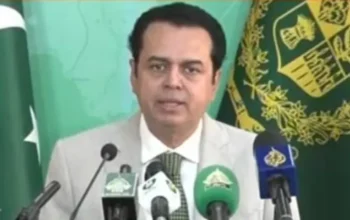
Asked directly about the alleged confidence-building measures, the Minister of State for Interior, Tallal Chaudhry, flatly denied that any such offer had been made. “Had the government offered any confidence-building measures, there would have been no long march,” he said, characterising the party’s account as one more in a pattern of “one-sided claims” that he said had proven baseless before. “They are claiming too much. We are not even prepared to offer them less,” Mr Chaudhry said, adding that he believed civilian police were more than capable of managing any threat posed by the march, and that there was no need to call in the armed forces.
That confidence sits uneasily alongside the government’s own build-up of military-grade riot equipment and the deployment of army units to Rawalpindi — a contradiction that has not gone unnoticed by PTI figures, who argue the scale of the security response speaks louder than any denial.
A party still finding its feet
For all its defiance, PTI’s own preparations appear, by the account of its own senior figures, to be running behind schedule and in some disarray. One senior party leader told local media that, as late as this week, workers and leadership in Punjab, Sindh and Balochistan had “no clue” what the strategy for the march actually was, with detailed plans expected to rest largely with Khyber Pakhtunkhwa’s chief minister, Sohail Afridi.
That uncertainty was addressed only in the past few days. Afridi, who leads the PTI-run provincial government in Khyber Pakhtunkhwa, said publicly on 21 September that a full plan for the demonstration would be disclosed on 25 September, and has since confirmed the march will proceed “under all circumstances”, insisting the party seeks no confrontation and intends to operate strictly “within the bounds of the Constitution and the law”. Afridi has organised a central convoy from Khyber Pakhtunkhwa, with additional caravans expected to converge from other provinces en route to the capital.
Party veterans have been recalling the mechanics of PTI’s previous marches on Islamabad for comparison. In earlier demonstrations, three convoys typically set out from Khyber Pakhtunkhwa — one led by former chief minister Ali Amin Gandapur travelling via the Hazara Motorway, a second under Omar Ayub following a parallel route, and a third, led by Umar Amin Gandapur, travelling the CPEC corridor. This time, party sources say as many as twelve separate caravans are being planned to leave the province — a considerably more ambitious, and logistically complex, undertaking.
Some within the party are sceptical the caravans will get far. One leader voiced concern that marchers could be intercepted before they even leave Khyber Pakhtunkhwa, pointing to the federal government’s growing influence over the province’s police force. The party noted a legal quirk in that relationship: under Imran Khan’s earlier stewardship of the province, the Khyber Pakhtunkhwa police had been granted wide-ranging operational independence from the provincial government. Ali Amin Gandapur, as chief minister, had moved to curtail some of those powers — but the force successfully challenged the restrictions at the Peshawar High Court and regained its autonomy, a ruling the current provincial government did not appeal. Sources say the federal government is now weighing whether to press ahead with fresh efforts to rein in the force’s independence, after three senior police officers reportedly declined a summons from Khyber Pakhtunkhwa officials on Tuesday night.
Meanwhile, a wave of arrests and pre-emptive detentions has swept the party’s ranks nationwide in recent days, PTI figures say, with the homes of ministers raided and members of the National Assembly, provincial assemblies and even local union councils taken into custody. One party leader said a prominent Khyber Pakhtunkhwa minister had been sheltering inside the Chief Minister’s House for four consecutive nights to avoid arrest. A leader from Punjab, meanwhile, observed a striking reversal: where the party had previously faced criticism for its comparatively weak organisation in that province, it now appeared Khyber Pakhtunkhwa — traditionally PTI’s stronghold — was struggling with the same mobilisation problems.
Copyright © 2021 Independent Pakistan | All rights reserved