By Staff Reporter
ISLAMABAD: Jamaat-i-Islami has vowed to march on Islamabad in mid-November unless the government announces major relief over the petroleum levy, shortly after its leader met Prime Minister Shehbaz Sharif without securing a promise to abolish the charge.
Hafiz Naeemur Rehman, the party’s emir, told a press conference in the capital that the demonstration would not be delayed again. “It will now take place in mid-November, and it certainly will take place,” he said.
He called on ministers to announce a package and “devise a mechanism to abolish this extortionate levy” before then. “If they do not do so, we might have to sit on the road to talk,” he said. “We are prepared for anything.”
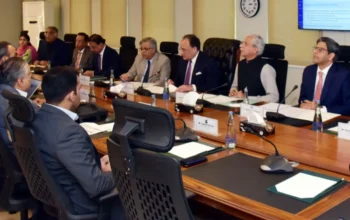
The meeting at PM House had been offered by Sharif when he urged the party to postpone its earlier march. Rehman, who arrived with deputy emir Liaquat Baloch, deputy secretary general Syed Farasat Shah and Islamabad emir Nasrullah Randhawa, declined to describe the talks as inconclusive.
He said both sides agreed that the scope of relief should be widened, but differed on “modalities” and “procedure”. “We say eliminate the levy; they say we can move towards it phase by phase,” he said.
Planning Minister Ahsan Iqbal, speaking at a separate press conference, said the two leaders had agreed to set up a joint committee of three government and three JI members. The government side will be made up of Iqbal, Deputy Prime Minister Ishaq Dar and the prime minister’s political adviser Rana Sanaullah. Rehman said his party’s representatives would be Baloch, Shah and Randhawa.
The panel is to give “final shape” to two sets of proposals: how to extend the government’s fuel relief scheme to more “deserving people”, and how to phase out levies in the next budget. Iqbal said the scheme already benefits more than ten million people.
“The prime minister and JI emir agreed that they share one purpose and intent: they want to reduce the difficulties of the public,” Iqbal said. Any route, he added, had to be “durable, sustainable” and affordable. He acknowledged that every party had a right to protest, but said regional conditions required everyone to preserve peace and internal stability.
Rehman made clear that his party would not settle for a modest concession. Asked about a reported government offer to cut the levies by Rs20-30 a litre, he said: “We cannot simply accept peanuts.”
He said the party would begin nationwide mobilisation for the march while negotiations continued. “Our preparations are already complete; we will prepare further [and] we will talk to them (the government) further,” he said. Asked whether JI had put forward an alternative to abolishing the levy, he said it had, and that its preparations were comprehensive.
The JI leader argued that successive governments had promised not to borrow from the International Monetary Fund (IMF) and then signed up to its programmes once in office. “Give relief to the people; do not take retribution for your incompetence from the nation,” he said. He has previously rejected the government’s contention that the levy is needed to satisfy the IMF, arguing that the fund’s agreement does not specifically require it and that ministers should cut spending and broaden the tax base instead.
Rehman also said refinery margins had risen when international oil prices climbed, and should have fallen to give consumers relief. He accepted that volatility in global prices was linked to the conflicts in the Middle East, but said people should be shielded from that too, with the levy abolished alongside.
He claimed credit for the relief scheme the government launched in mid-September. “If Jamaat-i-Islami was not protesting, do you think this relief package would have come?” he asked. He recalled that the government raised the petrol levy in April to Rs160 per litre from Rs105 and cut it by Rs80 after widespread criticism. “It is JI that has raised awareness, protested, and built pressure,” he said.
JI has demanded for more than two months that the federal government abolish petroleum levies, arguing that fuel prices have soared since conflict in the Middle East began in March. Reported figures show petrol rose from Rs253.17 a litre at the start of 2026 to a peak of Rs458.41 on April 3. It was selling for Rs393.86 a litre in mid-October.
The party announced sit-ins in all four provincial capitals on August 16 and called a nationwide strike for September 3. That day, the government and JI agreed to form expert committees to examine ways of cutting the levy and easing costs for consumers. At one point in the campaign Rehman demanded that petrol be sold at Rs225 a litre.
On September 20 the party set off on a march towards Islamabad, warning that if the levy was not abolished the protest could become a movement to oust the government. Two days later, with its convoy in Multan, Rehman said the march was being postponed at Sharif’s request, after the prime minister promised a meeting.
Copyright © 2021 Independent Pakistan | All rights reserved