By Staff Reporter
ISLAMABAD: Pakistan and China have launched a joint information corridor that pairs a news-sharing group of 18 media organisations with a fact-checking mechanism, aimed at what both governments call misleading narratives about their partnership.
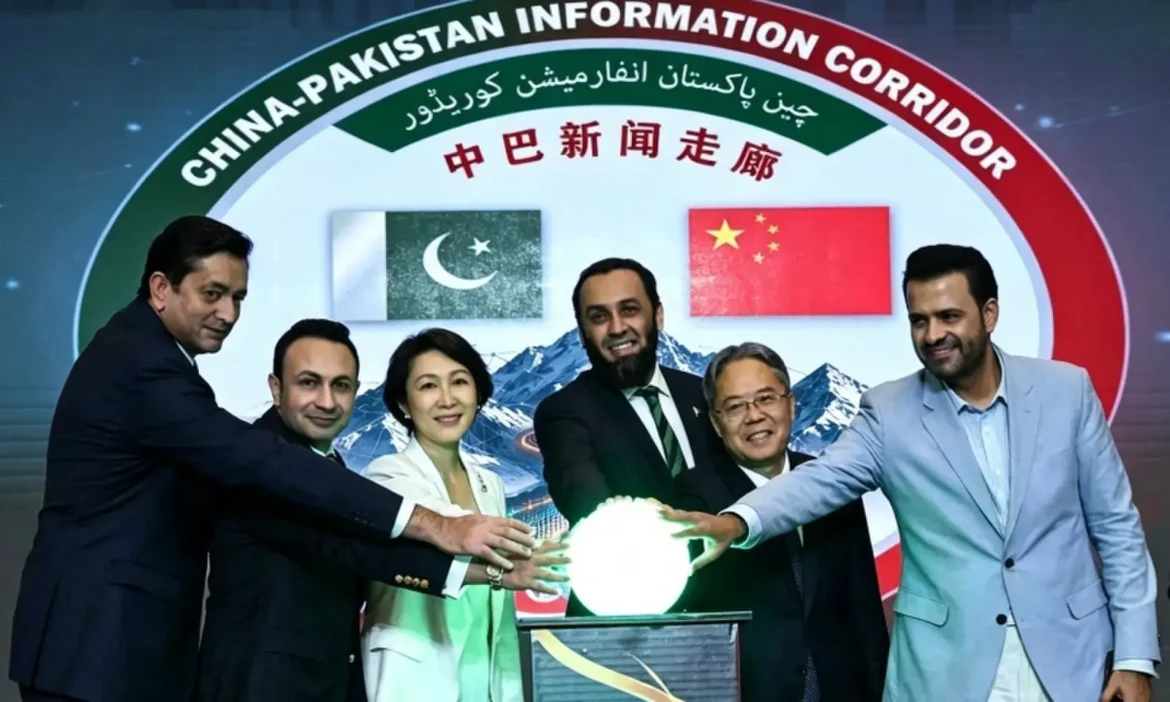
The China-Pakistan Information Corridor (CPIC) was inaugurated at the Pakistan-China Friendship Centre in Islamabad on Monday evening, and the ceremony was broadcast on Tuesday. Attaullah Tarar, Pakistan’s information minister, presented it as the successor to the China-Pakistan Economic Corridor (CPEC), the multibillion-dollar programme of power plants, roads and port projects that has anchored Beijing’s investment in the country for more than a decade.
Mao Ning, spokesperson for China’s foreign ministry, travelled to the capital for the launch, and Jiang Zaidong, Beijing’s ambassador to Pakistan, also attended. Tarar said the first phase of CPEC had linked territory and the second would link minds. He likened CPEC to the body of a shared future and CPIC to its voice.
The corridor rests on four pillars. The first is a news-exchange working group of 18 Pakistani and Chinese media organisations, drawing in Pakistani state broadcasters and private channels alongside Xinhua, China Media Group and People’s Daily. All three Chinese outlets are controlled by the state or the Communist Party. Tarar said the group now shares verified news about bilateral cooperation, while a separate fact-checking mechanism will track misleading narratives and answer them with evidence.
The second pillar, covering business, will draw on leading commercial groups in both countries and has opened its first regional office in Karachi, he said. A portal to track trade, investment and foreign direct investment is being built, along with a podcast series on Chinese entrepreneurs in Pakistan and Pakistani entrepreneurs in China.
Think tanks form the third. The Pakistan-China Institute will lead Pakistani research bodies in joint dialogue, research and publications with Chinese counterparts.
Tarar called the fourth pillar, covering culture, tourism and youth, the “heart of the corridor”. Work has begun on a Xinjiang-Gilgit-Baltistan tourism corridor intended to carry Chinese travellers into the valleys of northern Pakistan, and a Pakistan-China friendship rally is planned. The first cohort of CPEC Youth Ambassadors has been nominated from 13 Pakistani universities.
The minister said the corridor would meet “falsehoods with fact, isolation with exchange, and suspicion with trust”. A student in Lahore, he said, would come to know the China of today rather than the caricatures of the past, and a family in Chengdu would see Pakistan as warm, resilient and full of potential. He credited President Xi Jinping with the vision of a shared future and Prime Minister Shehbaz Sharif with giving Pakistan the means to pursue it.
Tarar described CPIC as a digital corridor at heart, and said more than 68 per cent of Pakistan’s population was under 30, with the country’s place in the global digital economy resting on that generation. He invited Chinese media houses, think tanks, universities, enterprises and youth ambassadors to join each pillar. He ended by saying the Karakoram Highway had been carved through mountains, whereas the new road was built of truth and would be carried by voices rather than trucks.
Mao said the two countries still faced misinformation, fake news and lies, and called the launch “necessary, important, and right on time”. She compared the corridor to the Karakoram Highway, describing it as a digital highway between the two nations. Jiang said it would help create a more favourable public opinion environment for practical cooperation, particularly in the next phase of CPEC. Tarar said a formal secretariat had been set up to support exchanges of information and ideas.
Tarar first raised the idea of an information corridor with Jiang in March 2024, shortly after taking over the ministry, when he called for a mechanism at government and media level to counter fake news about CPEC. The two also discussed a film production agreement and a memorandum between the Associated Press of Pakistan and Xinhua.
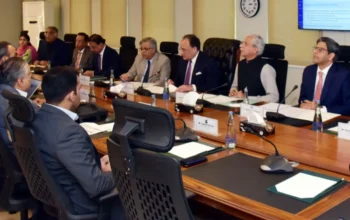
Mao was in Islamabad for the third round of the Pakistan-China Spokespersons’ Dialogue, led on the Pakistani side by Foreign Office spokesperson Sajjad Haider Khan. The previous round was held virtually in 2022, between Asim Iftikhar Ahmad and Mao’s predecessor, Hua Chunying. Both sides stressed closer coordination and regular consultations, according to the Foreign Office.
The launch falls in the 75th year of diplomatic relations between the two countries, which were established in 1951. It also comes as CPEC enters its second phase, which shifts the emphasis from large infrastructure towards industrial cooperation and Pakistan’s mineral resources, and adds five new corridors.
Copyright © 2021 Independent Pakistan | All rights reserved