By Staff Reporter
ISLAMABAD: The Lahore Bar Association on Thursday petitioned Pakistan’s Supreme Court to declare the 27th Constitutional Amendment unconstitutional, arguing that the measure — which enabled the abrupt transfer of three Islamabad High Court judges and stripped the Supreme Court of key powers — violates the nation’s basic constitutional framework and undermines judicial independence.
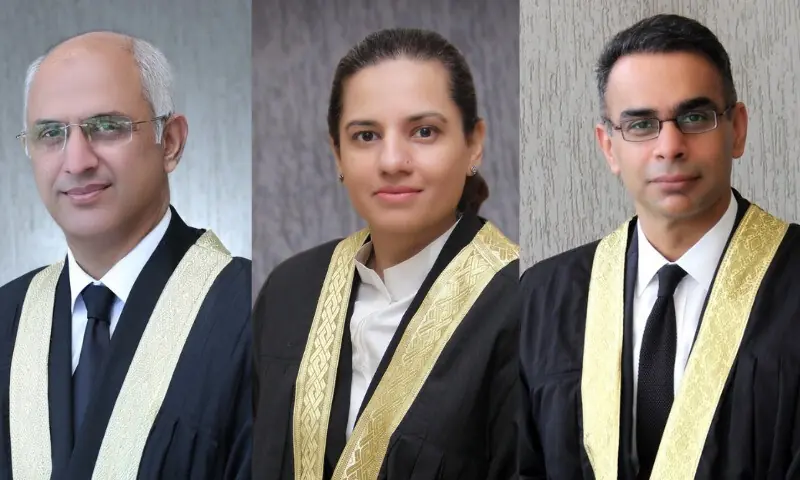
The filing came just a day after the government formally notified the transfers, approved Tuesday by the Judicial Commission of Pakistan. The move, which reassigned Justices Mohsin Akhtar Kayani, Babar Sattar and Saman Rafat Imtiaz to other provincial high courts, has drawn sharp criticism from lawyers’ groups for what they described as a lack of transparency and uniform criteria.
Senior counsel Hamid Khan, appearing for Lahore Bar Association President Irfan Hayat Bajwa, asked the Supreme Court to rule that the transfers were “unconstitutional and of no legal effect.” The petition goes further, seeking declarations that two core changes introduced by the amendment are void: the repeal of Article 184(3), which had given the Supreme Court original jurisdiction to enforce fundamental rights, and the insertion of a new Article 175(2) establishing a Federal Constitutional Court.
The bar association contended that Parliament lacked the authority to alter these provisions because they touch on the Constitution’s “basic/salient features.” Removing the Supreme Court’s power to directly protect fundamental rights, the petition argued, “undermines the Constitution and destroys the independence of the judiciary.”
The challenge also highlighted the transfers themselves. “In the absence of any substantive and disclosed reasons, criteria, or demonstrable institutional necessity, the transfers of IHC judges are unlawful and liable to be declared arbitrary, mala fide in law, and based on extraneous considerations,” the petition stated. It added that the Constitution “does not contemplate an unstructured or ad hoc exercise of transfer powers” and that the action had been taken “without any disclosed reasons, criteria, or demonstrable public interest,” rendering it “arbitrary, opaque and liable to be set aside.”
A separate section of the petition argued that the newly created Federal Constitutional Court could not hear the case. Its judges, the lawyers said, would be deciding a matter in which they are beneficiaries, and the court itself is a product of the very amendment under challenge. The transfer powers exercised under the amended Article 200, the petition maintained, similarly fall outside the new court’s purview.
In a related development Thursday, the names of two of the transferred judges appeared on the working rosters of their new courts. Justice Kayani is scheduled to begin hearing cases as a single-bench judge at the Lahore High Court’s principal seat under a revised roster covering May 4 to July 4. Justice Sattar will sit on a division bench at the Peshawar High Court on Monday, May 4, according to a roster approved by Chief Justice SM Attique Shah. No immediate roster details were released for Justice Imtiaz.
The 27th Amendment, passed earlier this year, significantly restructured Pakistan’s judicial architecture. It created the Federal Constitutional Court to handle constitutional matters previously reserved for the Supreme Court and altered the process for transferring high court judges. Lawyers and opposition figures have warned that the changes concentrate power in ways that could erode the judiciary’s ability to check the executive and Parliament.
The Lahore Bar Association’s petition frames the amendment as an existential threat to the separation of powers. By stripping the Supreme Court of its Article 184(3) jurisdiction, the lawyers argued, Parliament effectively revoked the apex court’s “inherent jurisdiction” to enforce fundamental rights — a power they described as unassailable.
The Supreme Court has not yet indicated when it will take up the petition. Legal observers said the case could test the limits of parliamentary authority over the judiciary and determine whether the 27th Amendment survives its first major constitutional challenge.
The developments come amid long-standing tensions between Pakistan’s legal fraternity, the judiciary and the political establishment over the balance of institutional power. Bar associations have historically played an active role in defending judicial autonomy, most notably during the lawyers’ movement of 2007-09 that helped restore deposed Chief Justice Iftikhar Muhammad Chaudhry.
Copyright © 2021 Independent Pakistan | All rights reserved