By Staff Reporter
ISLAMABAD: For a fixture that nobody particularly wants to play and even fewer particularly want to watch, England and France contrived something that will be remembered long after the World Cup final has faded from view. The third-place play-off, that unloved coda to the tournament, produced 10 goals, two contrasting halves and a finish so breathless that both benches seemed almost relieved when the referee finally blew for time.
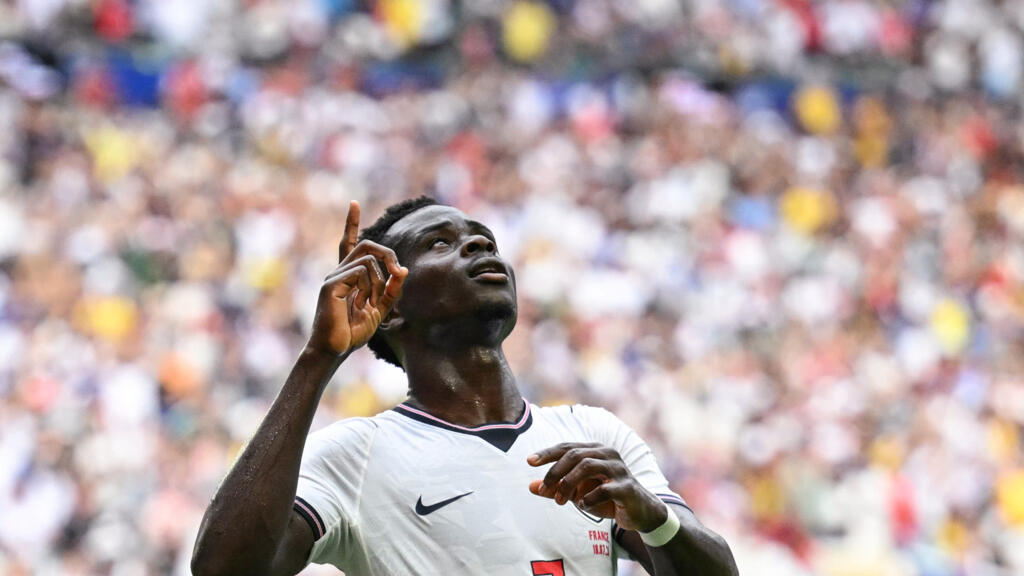
England won 6-4, and it could easily have been more emphatic still. Bukayo Saka scored a hat-trick to become only the second England player to do so in a World Cup knockout match, following Geoff Hurst’s treble in the 1966 final, and the first to manage it against France since Pelé achieved the feat for Brazil in 1958. It secured England’s best World Cup finish since that triumph 60 years ago, and their finest result on foreign soil in the competition’s history.
There was barely time to draw breath. Declan Rice, captaining the side with Harry Kane among the substitutes, opened the scoring inside three minutes with a driving run and finish from the edge of the box after intercepting a stray Désiré Doué pass. Ezri Konsa headed in a second from Rice’s corner shortly after, and by half-time England led 4-0, Saka having added two of his own — the second arriving in first-half stoppage time from an Eberechi Eze pass.
France had never trailed by four goals at half-time in any match since April 1930. Didier Deschamps, in the final game of his 14-year reign, was seen remonstrating with his players as they left the pitch, and later described the first-half performance to French broadcaster M6 as “catastrophic.”
Whatever he said worked, briefly and thrillingly. Kylian Mbappé pulled one back three minutes after the restart, Bradley Barcola — introduced as one of four half-time substitutes — added a second, and when Mbappé struck again in the 66th minute, guided in by Michael Olise, England’s four-goal cushion had shrunk to a single goal. The finish also took Mbappé above Lionel Messi as the all-time leading scorer in World Cup history, with 22 goals, and opened up a two-goal lead over the Argentinian in the race for this tournament’s Golden Boot.
England held on. Olise spurned two clear chances to complete the turnaround, and Dean Henderson, deputising in goal, produced a string of saves to deny Rayan Cherki, Mbappé and Ousmane Dembélé at various points in the second half. When Djed Spence was felled by Malo Gusto in the area, Saka stepped up to convert the penalty and complete his hat-trick in the 87th minute, restoring some breathing room.
Even that was not the final word. Dembélé pulled one back in the sixth minute of stoppage time, finishing off Dayot Upamecano’s pass to make it 5-4 and set up a nervous finish. But Jude Bellingham, on as a substitute, settled matters in the 98th minute, driving from inside his own half, beating Maxence Lacroix and finishing calmly for England’s sixth. It was his seventh goal of the tournament, the most by any England player at a single World Cup, and the perfect send-off for a player who had endured a difficult night against Argentina three days earlier.
France had never before conceded six goals in a single World Cup match, and had not shipped six goals in any fixture, of any kind, in 66 years.
Analysis in the studio was unequivocal. “It was brilliant,” the former England defender Stephen Warnock said on Match of the Day. “Some of the best free-flowing football we have seen all tournament.” His fellow pundit Danny Murphy agreed: “So much talent on show. Some of the football I have seen today is the best I have seen. It had everything.”
For Thomas Tuchel, the timing of such an eye-catching display invites an obvious question. Under pressure after his substitutions and shape were criticised following England’s galling semi-final defeat to Argentina, the head coach made seven changes here, recalling Saka — who has battled fitness issues throughout the tournament — and omitting both Kane and Bellingham from his starting XI. The rewards were immediate, if not without their nerves. Saka, who also had a goal ruled out for offside, was outstanding throughout, and his display will only sharpen scrutiny of why such attacking intent was not on show against Argentina, when the game demanded it most.
There is context, of course. This was a dead rubber, shorn of the tension that gripped Wednesday’s semi-final, and England’s off-the-ball discipline was porous where it had previously been disciplined. Still, a first half of such attacking fluency, followed by a second that demanded resilience under pressure, will have offered Tuchel something to build towards ahead of the next major tournament.
For Deschamps, this was a definitive full stop. His 187th and final match in charge extended his own World Cup finals record to 27 appearances, but ended in his side’s first competitive defeat to England since 1982, despite the improvement after the break. He leaves having delivered the 2018 World Cup and reached the final four years later — a reign bookended, fittingly, by two matches that swung wildly in either direction.
The match finished level with France’s 7-3 win over Paraguay in 1958 for the joint fifth-highest goal tally in World Cup history, and was the highest-scoring game at the tournament since Hungary’s 10-1 win over El Salvador in 1982. In total there were 38 shots, 20 of them on target — more than in any other England match at a World Cup.
Argentina face Spain in Sunday’s final in East Rutherford, New Jersey, with the world champions bidding for a fourth star and Spain chasing a first World Cup since 2010.
Copyright © 2021 Independent Pakistan | All rights reserved