By Staff Reporter
ISLAMABAD: The health minister told lawmakers on Friday that “no one will be spared” in the aftermath of a nursery fire that killed 14 infants at a government hospital here, as members of parliament from across the political spectrum demanded an independent accounting of how flames were able to sweep through a neonatal ward at the country’s most prominent medical facility.
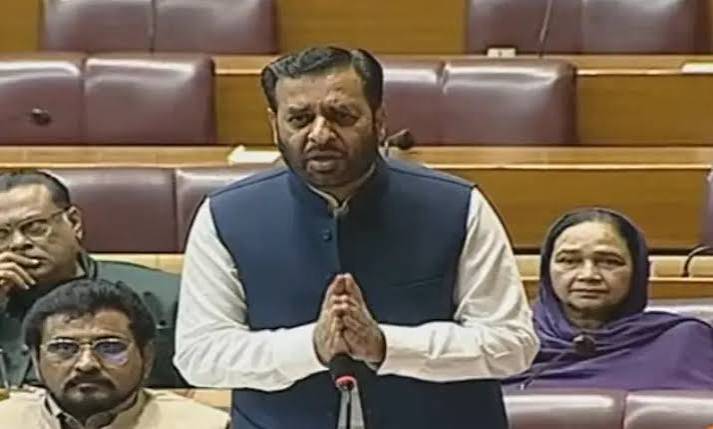
The minister, Mustafa Kamal, delivered his remarks in an emotional address to the Senate, three days after the blaze tore through the Mother and Child Healthcare Centre at the Pakistan Institute of Medical Sciences, known widely as Pims. He spoke not merely as a government official defending his ministry, but as a man visibly shaken by the scale of the loss — and by what he suggested was a far deeper failure within the health system he now oversees.
“No one intends to spare or save anyone,” Kamal told the Senate. “I am saying this on behalf of the prime minister and the entire government that not a single person will be spared.”
The fire broke out shortly before 7 a.m. Wednesday, according to a statement from Pims, when a spark ignited inside the nursery. Because oxygen lines ran to each incubator in the unit, the flames spread within seconds into what hospital officials described as a “massive fire.” Two doctors and two nurses on duty that morning called for security assistance and attempted to reach the infants, the hospital said, but a blast tore through the space and the ceiling came down before rescue efforts could succeed.
Family members and witnesses who gathered outside the ward that morning offered a starkly different account. Several said they waited for more than an hour for emergency crews to arrive, and that some resorted to breaking windows in a desperate bid to reach their children. Others alleged that doors leading into the unit had been locked. Hospital administrators and government officials have since disputed those claims, insisting there were no delays and no barred exits — an early fault line in a controversy that has only widened since.
By Friday, that dispute had migrated from the hospital’s gates to the floor of the Senate, where Kamal offered no defense of the institution he leads, choosing instead to indict it.
“There can be no explanation for this,” he said, opening his remarks. “I am holding myself responsible, and I have presented myself to be held accountable.”
A minister’s confession
What followed was less a policy address than something closer to a public reckoning. Kamal told senators the health sector he inherited was, in his word, “rotten” — a system so degraded, he said, that replacing any single official accused of incompetence offered little guarantee of improvement.
“Where do I find a better person after removing an incompetent one?” he asked the chamber.
He returned repeatedly to the scale of preventable death in Pakistan’s health system, invoking a statistic meant to frame Wednesday’s tragedy not as an aberration but as an extreme, sudden expression of a chronic failure. Four hundred thousand children between the ages of one and five die in the country every year, he said — roughly 1,300 each day, deaths he characterized as preventable. By the time the Senate’s session ended Friday evening, he noted grimly, that toll would again have been reached elsewhere in the country, unrelated to the Pims fire.
“It is not possible to bring back the infants who died at Pims,” Kamal said, “but let us look at it as a test from God and prevent the next kid from dying.”
He rejected the notion that the tragedy could be allowed to fade from public attention, as he suggested past disasters had. “This cannot be an episode lasting merely a few days,” he said, calling instead for sustained accountability and structural reform.
Kamal disclosed that an inquiry committee’s initial report on the fire was expected to be presented Friday night, but he moved quickly to lower expectations of finality, telling senators that if they distrusted its conclusions, the government would not resist further scrutiny. “If you don’t trust it, fair enough,” he said. “We will listen to you.”
He went further, agreeing on the floor of the Senate to the formation of a parliamentary committee, with opposition members among its ranks, to conduct its own investigation — and urging that the panel not be constrained by a deadline. “When you go investigate this incident,” he told lawmakers, “you will find so many things associated with it.”
The minister also sought to preempt the political interference that has long shadowed staffing decisions inside Pakistan’s public hospitals, telling the Senate that if real reform were to take hold, elected officials would need to relinquish a familiar habit. “No MNA should call and ask why a certain doctor was removed,” he said, a remark that drew directly on his own experience navigating the ministry’s politics.
He closed by invoking the stakes in explicitly moral, rather than administrative, terms. “This is a matter of children’s lives, and we are answerable to God for it,” Kamal said. “The ministry is nothing; we cannot ruin our afterlife for these ministries.”
Asked directly by lawmakers whether he intended to resign, Kamal declined, telling the chamber he would await the outcome of the investigation. “Let the investigation be completed,” he said. “I have already taken action beyond what they are thinking.”
Opposition lays out a blueprint for reform
Barrister Ali Zafar, a senior leader of the opposition Pakistan Tehreek-e-Insaf party, used the debate to lay out a detailed proposal for how such a committee should function — one designed, he said, to avoid the fate of past inquiries that produced reports and little else.
Zafar proposed a panel with equal representation from the government and opposition, led by a member of the opposition, tasked with examining hospital safety and emergency preparedness broadly and developing standard operating procedures for foreseeable hazards across the country’s hospitals, beginning in the capital. “Let us start with Islamabad,” he said.
He asked that the committee be granted authority to inspect hospitals directly, demand records, question hospital administrations, and bring in outside experts in medicine, fire safety, engineering and disaster management as needed. Hospital administrations, he said, should be compelled to cooperate fully.
“This should not be another committee that merely produces a report which sits on a shelf,” Zafar told the chamber, arguing that its mandate should extend to identifying specific failures, correcting them, and enforcing compliance with new safety protocols going forward.
“We owe this not only to those who lost their lives in this tragedy,” he said, “but to every patient and every family who will have to depend on our hospitals in the future.”
National Assembly adopts its own resolution
Across the parliamentary complex, the National Assembly took up the same tragedy Friday, unanimously passing a resolution demanding an impartial inquiry and formally extending condolences to grieving families. A copy of the resolution, reviewed by the Pakistani newspaper Dawn, expressed lawmakers’ “profound grief and sorrow” and condemned the fire in unambiguous terms, attributing the circumstances surrounding it to “sheer negligence.”
The resolution called on the government to pursue strict legal action against anyone found responsible for negligence or safety failures, and urged that fire-safety and emergency-preparedness standards be rigorously enforced across federal hospitals, with particular attention to neonatal and pediatric units.
“The House extends its heartfelt condolences to the bereaved families,” the resolution stated, “and prays for strength and fortitude for them in this hour of profound grief.”
Law Minister Azam Nazeer Tarar briefed the Assembly on the government’s response, telling lawmakers that Prime Minister Shehbaz Sharif had already formed two separate committees — one led by Dr. Azhar Kiani, tasked with identifying what improvements Pims requires, and a second led by former secretary Shahid Khan. Tarar urged lawmakers to bring concrete proposals to the House rather than allow the tragedy to become a vehicle for political point-scoring.
Former prime minister Raja Pervez Ashraf, a senior PPP leader, offered a more skeptical view of the process now underway, telling colleagues that Pakistan had developed a habit of forming commissions to address disasters only to abandon the effort within weeks. “We need to have a change of approach towards hazards and the health sector,” he said, calling for a cross-party parliamentary committee to determine, at minimum, the fire’s cause — a question he said remained unresolved days later.
PTI leader Asad Qaiser drew attention to an added layer of scrutiny surrounding the hospital, noting that Pims was the same facility the government had held out as offering superior care when it arranged for a medical checkup last week for Imran Khan, the imprisoned former prime minister and PTI founder. That examination took place at Pims rather than Islamabad’s private Shifa International Hospital, as had been directed by the Supreme Court, before Khan was returned to Adiala jail.
Compensation announced, and questions about the dead
Earlier Friday, Parliamentary Affairs Minister Tariq Fazal Chaudhry traveled to Pims to announce that the government would provide 5 million rupees in compensation to each family that lost a child in the fire, funds he said would be deposited directly into accounts held by the children’s mothers.
Speaking to reporters at the hospital, Chaudhry described the deaths of the 14 infants as the result of “someone’s criminal negligence,” and said the inquiry committee formed by the prime minister was expected to deliver its findings later that day. He said any on-duty staff found responsible for negligence would face “exemplary punishment.”
He acknowledged the limits of the government’s gesture. “Neither can their children be brought back, nor can their grief be reduced,” Chaudhry said. “But to provide some relief, the prime minister has announced that five million rupees will be given to all the affected families. This is a small effort to share their sorrow.”
Asked about calls from some families for DNA testing to confirm the identities of the deceased infants, Chaudhry said such measures were unnecessary. Most of the children, he said, died from smoke inhalation rather than burns, and each had been fitted with identification tags bearing their mothers’ names shortly after birth — allowing hospital staff to identify them without difficulty.
A secretary removed, an investigation pending
In the days since the fire, Prime Minister Sharif has moved to remove Muhammad Aslam Ghauri, the federal health secretary, and established a high-level committee to investigate the blaze. The National Assembly’s Standing Committee on National Health Services has separately pressed Pims administrators for answers about possible negligence and lapses in safety protocol.
What remains unresolved, three days after the fire, is a clear public accounting of precisely how it started, why oxygen lines meant to sustain critically ill infants instead fueled the flames that killed them, and whether the emergency exits meant to save them were, as families allege, locked shut. That accounting, lawmakers across party lines said Friday, cannot wait.
Copyright © 2021 Independent Pakistan | All rights reserved