By Staff Reporter
ISLAMABAD: A relentless monsoon and a powerful westerly wave are bearing down on Pakistan, threatening torrential rains, flash floods, and landslides from July 6 to 10.
The National Disaster Management Authority’s National Emergencies Operation Centre (NEOC) has sounded the alarm, predicting severe impacts, especially in the rugged north, where flash flood risks could linger until July 12.
The NDMA’s alerts pinpoint a sprawling weather event that will span Punjab, Khyber Pakhtunkhwa, Gilgit-Baltistan, Azad Jammu and Kashmir, Sindh, and Balochistan.
A second monsoon spell, colliding with a westerly wave, is expected to unleash isolated to widespread thunderstorms and moderate to heavy rainfall. The potential fallout includes flash floods in streams and nullahs, landslides in hilly terrain, and disruptions to roads, power, and communication networks.
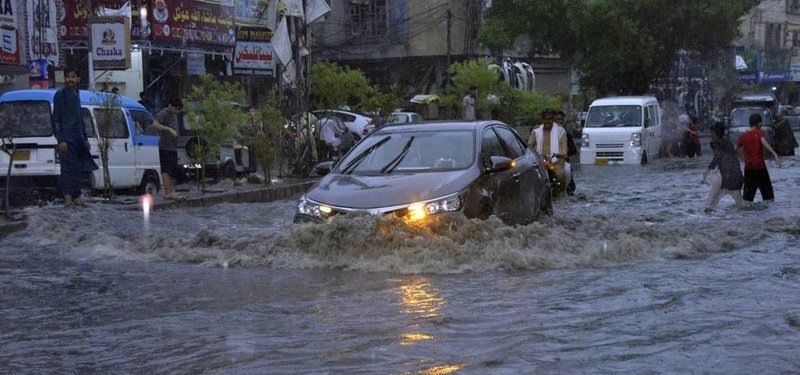
In Punjab, the Provincial Disaster Management Authority (PDMA) has put the province on high alert, bracing for monsoon rains from July 5 to 10 that could trigger urban flooding and swell rivers. PDMA Director General Irfan Ali Kathia said the second monsoon spell is expected to affect most districts, with heavy downpours predicted in areas like Rawalpindi, Lahore, and Faisalabad. “We are particularly concerned about potential flooding in hill torrents and rain drains from July 7 onwards.”
Recent rainfall data from PDMA Punjab shows Jhelum leading with 31 millimeters in the past 24 hours, followed by Mangla at 29 millimeters and Attock at 14 millimeters. The NDMA forecasts isolated rain and thunderstorms across Islamabad and Punjab cities like Rawalpindi, Attock, Jhelum, Chakwal, Mianwali, Sargodha, Khushab, Gujranwala, Gujrat, Faisalabad, Lahore, Kasur, and Okara from July 6 to 10.
Northern and central Punjab are slated for widespread moderate to heavy rain, while southern districts, Multan, Khanewal, Bahawalpur, Bahawalnagar, Rahim Yar Khan, and Dera Ghazi Khan, may see lighter showers. Urban flooding, traffic snarls, and damage to infrastructure loom as major concerns.
Khyber Pakhtunkhwa is gearing up for heavy rain and thunderstorms in districts including Dir, Swat, Chitral, Kohistan, Shangla, Buner, Battagram, Swabi, Nowshera, Charsadda, Malakand, Mansehra, Abbottabad, Peshawar, Mardan, Haripur, Bannu, and Kohat.
The NDMA warns of flash floods, landslides, and road closures that could knock out power and communication lines.
Gilgit-Baltistan and Azad Jammu and Kashmir face similar threats, with moderate to heavy rainfall expected, especially at night, in areas like Gilgit, Skardu, Hunza, Astore, Diamer, Ghanche, Shigar, Muzaffarabad, Neelum Valley, Rawalakot, Haveli, and Bagh.
In Sindh, isolated to moderate rainfall is forecast for Sukkur, Nawabshah, Kashmore, Hyderabad, Karachi, Tharparkar, Mirpurkhas, Umerkot, Sanghar, Jamshoro, Tando Allahyar, Thatta, Badin, and Mithi, with heavier bursts likely in Ghotki, Khairpur, Shikarpur, Larkana, Jacobabad, and Dadu.
The NDMA cautions that urban flooding and traffic chaos could follow. Balochistan is set for scattered to heavy rainfall in Quetta, Zhob, Ziarat, Kalat, Khuzdar, Awaran, Barkhan, Jaffarabad, Kohlu, Sibi, Dera Bugti, Loralai, Lasbela, and Naseerabad, with risks of waterlogging, wind damage, and lightning strikes.
The PDMA Balochistan has issued its own alert for a monsoon spell from July 4 to 8, targeting 20 districts including Sherani, Musakhail, Duki, Loralai, Harnai, Sibi, Usta Muhammad, and Surab. Heavy rain could spark flash floods in seasonal streams and rivers, prompting warnings for tourists to steer clear and residents to avoid dams and picnic areas.
The NDMA is calling on the public to batten down the hatches: avoid unnecessary travel, stay indoors during storms, and secure loose items and vehicles. Tourists are urged to skip high-altitude or flood-prone zones.
Local officials are tasked with readying response teams, clearing drainage systems, and raising awareness. Motorists face stern warnings against navigating flooded roads, while emergency services stand poised for rescues or evacuations.
In Punjab, agencies like the Water and Sanitation Agency, Rescue 1122, and local government are on high alert, with citizens advised to keep kids clear of waterlogged areas and electrical hazards. Balochistan’s deputy commissioners are monitoring conditions and deploying heavy machinery to keep roads open. The NDMA is pushing its ‘Pak NDMA Disaster Alert’ app for real-time updates, urging vigilance as the nation steels itself for the storm.
Copyright © 2021 Independent Pakistan | All rights reserved