By Staff Reporter
Colombo did its best to stage the spectacle. Grey skies, armed security, the familiar inflation in fake jerseys. For a week, the cricket world held its breath over whether Pakistan would even turn up. In the end, they did – not out of sporting spirit, but because the money spoke louder than solidarity with Bangladesh. And what followed was less a contest than a public execution, dressed up as the greatest rivalry in the game. India won by 61 runs. It was their eighth victory in nine T20 World Cup meetings, their 13th in the last 17 white-ball encounters overall. Ishan Kishan’s 77 off 40 balls was the highlight of a one-sided batting display; Pakistan’s reply was a procession, slumping to 13 for 3 inside three overs and folding for 114. Usman Khan’s 44 offered the only flicker of resistance. The rest was surrender.
But the real story was not on the field. It was in the faces of the Pakistani fans who streamed out of the R Premadasa Stadium midway through the chase, in the viral videos of supporters smashing televisions back home, in the raw, bitter posts calling for the entire team to be sacked. “Boycott could’ve saved us,” one fan wrote. Another: “This is not a team, just a gathering of some players here and there.” A third, more savage: “If the public thinks of Babar Azam as a king, he should act like one.” The frustration is visceral because humiliation is now routine. This is what happens when politics colonises sport so completely that the contest itself becomes secondary. Pakistan’s initial threat to boycott was framed as a principle – solidarity with Bangladesh after the ICC refused neutral venues. The change of heart came under intense pressure from the wider cricket ecosystem, from Sri Lanka, the UAE, and the ICC itself. The subtext was clear: the show must go on, because this fixture alone is worth $250 million to the global game, and the Indian broadcasting deal is worth billions. Cricket’s administrators did not save the match; they saved the balance sheet. And so the players were sent out to perform a ritual of discomfort.
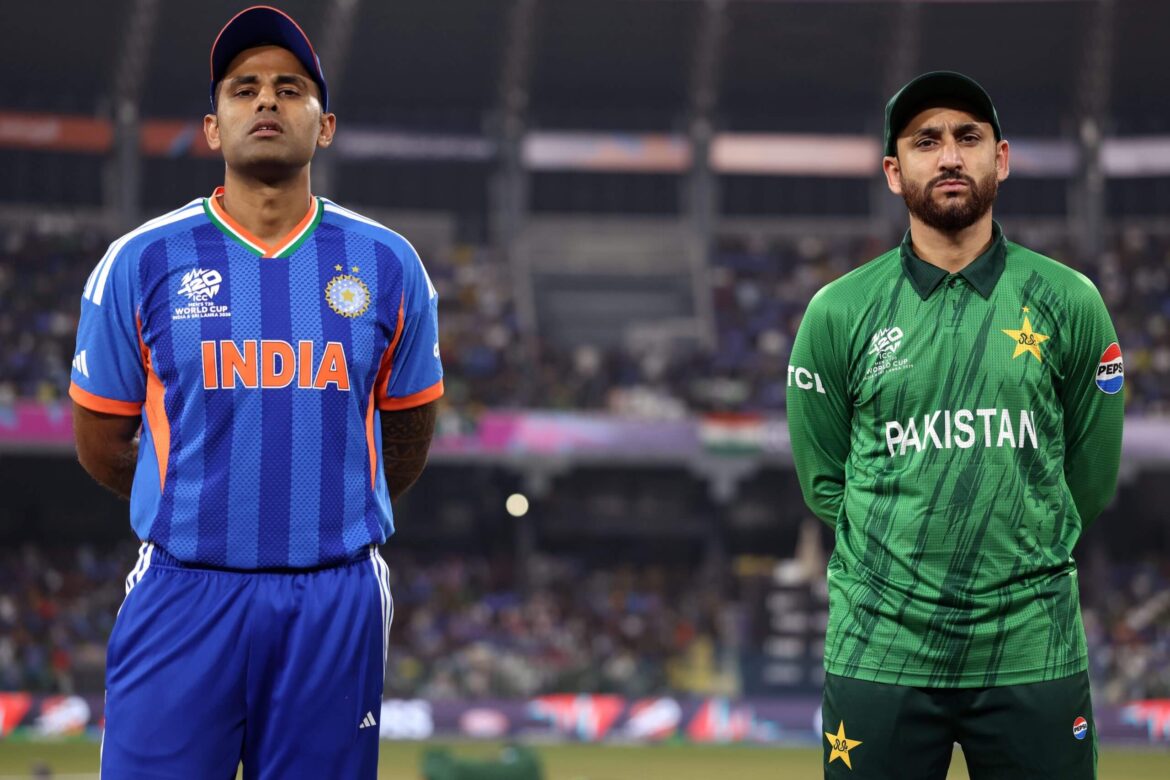
Suryakumar Yadav and Salman Ali Agha stood metres apart at the toss, refusing even the courtesy of a handshake – a policy dictated by the Indian government since the Pulwama attack and rigidly enforced ever since. The cameras lingered on the silence. Later, the ICC helpfully replayed footage of Rohit Sharma and Wasim Akram exchanging warm greetings, as if to say: see, the grown-ups are fine. The players, meanwhile, were left to embody the frostiness of state policy. Harsha Bhogle, one of the most measured voices in Indian cricket, captured the unease better than most. “I’m not excited about this India v Pakistan game,” he said before the match. “This time I fear our beloved sport is being held hostage to larger economic and political ends… We exploit it. And that is the reality of India against Pakistan today.” Sanjay Manjrekar was blunter: the no-handshake policy is “silly” and “unbecoming”. Even Anil Kumble and Irfan Pathan, hardly radicals, described the contest as a “no contest” – on the field because India is simply better; off it because the narrative has been hijacked.
The asymmetry is now structural. India’s economy, the IPL’s talent factory, the sheer scale of its infrastructure – these are not temporary advantages. They are permanent. Pakistan, for all its flashes of brilliance, remains a team playing catch-up in a game that has been financially and culturally colonised by its neighbour. The result is a rivalry that has ceased to be sporting and become almost entirely political. The crowds mix amicably enough in the stands. The old players – Harbhajan, Misbah, Ramiz – chat cordially in the media box. But the current generation is instructed to maintain the chill. The optics are toxic by design.
For Pakistani cricket, the damage runs deeper than one bad day. This was supposed to be a side rediscovering itself under Mike Hesson: spin rediscovered, joy in power-hitting, a coherent plan. Instead, the top order threw the game away in the powerplay with reckless abandon. Shaheen Afridi and the spinners went through the motions. The execution was hapless, but the deeper problem was mental. When you arrive at such a fixture having already performed a diplomatic retreat, how do you summon the belief required to compete? The fans know it. They have seen too many of these collapses, too many false dawns. Their anger is not just at the players; it is at a system that treats them as props in a larger geopolitical drama. The PCB chairman, Mohsin Naqvi, was spotted leaving early. One wonders what message he took back to Lahore.
South Asian cricket has always been political. But never has the imbalance been so stark, nor the hypocrisy so glaring. India and Pakistan have not played a bilateral series in 18 years, yet the ICC rigs the draw to ensure they meet in every global tournament because the television rights demand it. The sport’s governing body wrings its hands about “the spirit of cricket” while quietly enabling the very forces that corrode it. In Colombo, cricket did not win. Pakistan lost more than a match; they lost another layer of dignity. India marched on to the Super Eights, declaring the victory “for India”. But the bigger victory belonged to the accountants and the politicians who have turned the greatest rivalry in the game into a lucrative, joyless sideshow. The fans, as ever, are left to pick up the pieces – smashing televisions, walking out early, wondering what happened to the sport they loved.
Copyright © 2021 Independent Pakistan | All rights reserved