By Staff Reporter
ISLAMABAD: One year after a brief but intense military confrontation with India that Pakistan calls “Marka-i-Haq,” or Battle of Truth, the Pakistani armed forces’ chief spokesman declared Thursday that the country’s military had not only prevailed against a far larger adversary but remained fully prepared for any future conflict.
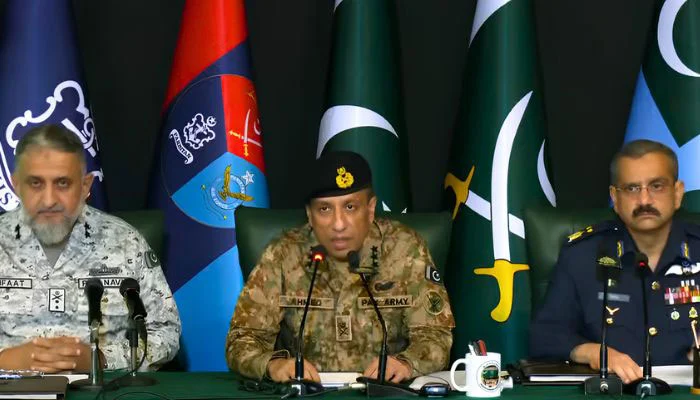
Lt. Gen. Ahmed Sharif Chaudhry, director general of the Inter-Services Public Relations directorate, flanked by the deputy chief of naval staff for operations, Rear Adm. Shifaat Ali, and the deputy chief of air staff for projects, Air Vice Marshal Tariq Ghazi held a high-profile news conference in Islamabad. The event was timed to the anniversary of the 19-day escalation that began with a deadly attack on tourists in Indian-occupied Kashmir and ended with a US-brokered ceasefire on May 10, 2025.
“We welcome you to ISPR on this happy day,” Chaudhry told reporters at the outset, offering congratulations to the nation on a decisive victory. He said the armed forces had “risen to the nation’s expectations and defeated a much larger enemy with multi-domain operations.”
Chaudhry made clear that the military intended to shift its public focus forward. “Today, we are not going to dwell a lot on what happened,” he said. “We are going to spend more time from May 2025 to May 2026,” expanding on the “strategic consequences” of the conflict. Those consequences, he said, number 10. The first, he asserted, was the collapse of India’s attempt to portray Pakistan as the source of terrorism. One year after the April 22, 2025, attack in Pahalgam that killed 26 people, most of them tourists, Pakistan’s questions about evidence remain unanswered, he said. “Where is the evidence?” Chaudhry asked. “Nobody buys this … you are the biggest terrorist. Nobody listens to them, nobody believes them.”
The second consequence, he continued, was Pakistan’s emergence as the region’s “net security stabiliser,” demonstrating control over escalation while India acted on what he called a fabricated premise. The third, Chaudhry said, was the politicisation of India’s military leadership and the militarisation of its political class — a development he described as dangerous. He cited an Indian air chief marshal’s remarks months after the conflict, in which the officer appeared to suggest he had only recently learned that Indian forces had downed aircraft.
“That is politicisation of the military leadership,” Chaudhry said. “Why are you trying to make jokers out of your admirals, and generals and marshal? Don’t do that.” In contrast, he said, Pakistan had presented facts plainly. The fourth consequence, according to Chaudhry, was global recognition of India’s pattern of externalising its internal problems — including the repression of minorities and Kashmiris — while using terrorism allegations as a state tool. “Kashmir is an internationally recognised dispute,” he said. “It’s not your internal problem for you to make demographic changes there … you cannot do that.”
The fifth was the exposure of what he called the “true face of the Indian media and its discredited information operations,” including India’s ongoing restrictions on Pakistani media. “The only thing that can survive in today’s information domain is the truth,” he said. “Tell people the truth.” The sixth consequence, he said, was the transformation of modern warfare into multi-domain operations spanning land, sea, air, cyberspace and the cognitive realm. Pakistan’s forces were ready across all those domains in 2025, he said, “and we are prepared today as well.”
The seventh was Pakistan’s proven resilience against multifaceted challenges. The eighth was the unambiguous reestablishment of deterrence between two nuclear neighbours. “Anyone who thinks there is space for war between two nuclear neighbours is crazy,” Chaudhry said. “That is madness.” The ninth was Pakistan’s recognition as a “geopolitically significant and responsible middle power.” The tenth and most important, he said, was the unbreakable synergy among the Pakistani people, government and armed forces — what he termed the “Bunyanum Marsoos effect.”
Chaudhry also presented data showing a surge in terrorist incidents inside Pakistan after the conflict, which he attributed to Indian proxies operating from Afghan soil. Pakistan responded with strikes on terrorist infrastructure in Afghanistan in October, after which attacks declined, he said. He played clips of Indian media commentary, remarking dryly that “the field marshal and Pakistan … feature in their dreams day and night. They need to grow up.”
The news conference featured videos showcasing Pakistan’s “homegrown” military capabilities, including surface-to-air and cruise missiles, the Army Rocket Force Command, main battle tanks, long-range artillery, ship-launched anti-ship missiles, UAVs, loitering munitions, anti-drone systems, electro-optical satellites and an integrated artillery fire control system. Chaudhry recalled telling reporters a year earlier that the capabilities displayed during the conflict represented only 10 percent of the armed forces’ potential. “We are prepared,” he said. “If anyone wishes to test us, they are more than welcome.”
Rear Adm. Ali described Marka-i-Haq as a “historic and memorable” conflict in which India’s navy, despite heavy investment and claims of being a blue-water force, failed to challenge Pakistan effectively. Indian vessels moved into the northern Arabian Sea aiming to threaten Pakistani assets and disrupt trade, he said, but Pakistani naval strategy kept ports and sea lanes fully operational. Pakistan and its air force were prepared to strike the Indian aircraft carrier Vikrant, he added, but the Indian navy stayed within its sanctuaries.
Air Vice Marshal Ghazi provided the most detailed operational summary, saying the Pakistan Air Force shifted from a strong defensive posture to an offensive one after India’s initial attacks. He said that the air battle’s tally was “eight-zero,” with confirmed kills of four French-made Rafale jets, one Su-30, one MiG-29, one Mirage 2000 and one high-value multi-role unmanned aerial system. Additional Indian aircraft were damaged, some unrecoverable, he added.
Pakistani forces struck 16 Indian air bases, BrahMos sites, command centers and two prized S-400 air-defense batteries using indigenously produced JF-17 Block III fighters, Ghazi said. The Indian Air Force “was not to be seen in the air for the rest of the conflict.” The operation, he said, represented the first full-spectrum, multi-domain air campaign in the history of warfare and offered a “classical case study for air warfare experts.”
In response to questions, Chaudhry attributed Pakistan’s success to India’s “hubristic mindset” and strategic miscalculations, including the belief that vastly higher defense spending would guarantee victory and that a rift existed between Pakistan’s military and its people. “There is nobody who has the power to come between the people and the armed forces,” he said. “We are together.”
He also reaffirmed Pakistan’s commitment under its mutual defense pact with Saudi Arabia, stating that any threat to the kingdom — custodian of Islam’s two holiest sites — was a threat to Pakistan. On Afghanistan, he said Operation Ghazab lil-Haq remained active, describing the Afghan Taliban regime as “not a rational player” and insisting that Islamabad would not tolerate its soil being used for attacks on Pakistan.
On Kashmir, Chaudhry repeated the long-standing Pakistani position that the region’s future must be decided by its people through self-determination as called for in U.N. Security Council resolutions. “Kashmir is and always will be Pakistan’s jugular vein,” he said.
Separately, in a statement released shortly after midnight by the Inter-Services Public Relations, the military’s media wing, the armed forces — and particularly the Pakistan Air Force — commemorated a defining chapter in the nation’s military history. The ISPR statement, issued to coincide with the anniversary of the initial Indian strikes, said the conflict had validated the Pakistan Air Force’s years-long modernization and its shift toward advanced technologies and multi-domain operations. “The successful execution of these operations, unprecedented in scope and novel in the history of aerial warfare, not only underscored the professional excellence of Pakistan Air Force but also renewed the pride, confidence and spirit of the resilient Pakistani nation,” it said.
Pakistan remained committed to regional peace and stability, the statement added, but warned that its forces were fully prepared for evolving threats. “Any hostile design against Pakistan will be countered with even greater strength, precision and resolve far stronger than what was witnessed by the adversary during Marka-e-Haq,” it said.
In a separate address at a commemorative ceremony, Air Chief Marshal Zaheer Ahmed Babar Sidhu, the Pakistan Air Force chief, offered the most detailed Pakistani account yet of the fighting. He said that after the Pahalgam incident, India had blamed Pakistan without evidence and taken “immature and hasty measures” that escalated tensions. Pakistan’s government condemned the attack and offered cooperation, he said, but prepared defensive measures as Indian activity increased.
When India struck in the early hours of May 7, Sidhu said, Pakistani jets mobilized immediately. “Despite being outnumbered, PAF fought aggressively, denying the enemy the opportunity to enter our airspace,” he told the gathering. “The enemy was compelled to stay at a distance from our borders.”
He described a rapid shift to offensive action once Indian forces fired from their own territory. “Within minutes, multiple jets … were shot down,” he said. “This devastating blow shocked the enemy and IAF was not seen in the air for the remainder of the conflict.” Sidhu said dozens of Indian drones were launched but none returned, and that Pakistani forces conducted the first full-spectrum multi-domain operation in air warfare history, integrating cyber, electronic warfare and conventional strikes.
The air chief said Pakistan’s cyber forces targeted Indian communication hubs, power grids and transport infrastructure, causing “massive power disruption in different Indian states and key military installation.” He also said that Pakistani long-range systems and “killer drones” struck 16 Indian air bases in eight to 10 hours, neutralizing a BrahMos missile site, command centers and two S-400 air-defense batteries. Pakistani aircraft, including J-10 and F-16 fighters, engaged Indian formations in the largest and longest beyond-visual-range aerial battle in history, downing multiple Rafale, Su-30MKI, Mirage 2000 and MiG-29 jets along with advanced unmanned systems. “PAF could have gone further but we exercised maturity,” Sidhu said.
The successes, he added, were not achieved overnight but resulted from “transformative modernisation undertaken within the past four to five years,” including the rapid induction of locally developed technologies at the National Aerospace Science and Technology Park.
Copyright © 2021 Independent Pakistan | All rights reserved