By Staff Reporter
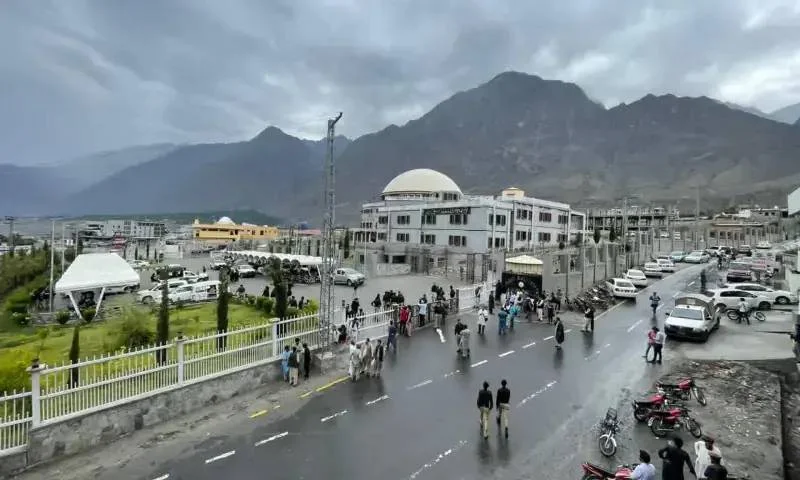
ISLAMABAD: In the days before a closely watched regional election in Pakistan’s mountainous north, the government has dispatched 6,000 police officers from Punjab province to Gilgit-Baltistan — a deployment the opposition says is less about security than about silencing dissent.
Punjab authorities initially approved the transfer of 5,000 officers and subsequently authorized 1,000 more, according to official memoranda issued by the province’s assistant inspector general of operations. The documents, which issued on Sunday, describe a mobilization that reads like a military logistics operation: anti-riot gear issued to each officer, armed escorts assigned to every transport bus, and a specific requirement that drivers be familiar with the rugged mountain terrain between Punjab and Gilgit-Baltistan.
The motor transport department’s senior superintendent of police was directed to arrange buses in certified working condition for the journey, with the fitness of the vehicles formally verified before departure.
To the ruling Pakistan Muslim League-Nawaz, the deployment is a matter of routine election security. To former prime minister Imran Khan’s Pakistan Tehreek-e-Insaf, it is something else entirely.
“By converting GB into a virtual police state, deploying Punjab police, and imposing unconstitutional barriers, they have openly admitted their inability to face the people in a free and fair election,” the PTI said in a statement on Sunday, the latest in a series of increasingly urgent accusations against the federal government as the June 7 vote approaches.
A Campaign Season Marked by Confrontation
The election for Gilgit-Baltistan’s legislative assembly has unfolded against a backdrop of unusual tension, with multiple opposition leaders reporting being blocked, detained, or expelled from the region while attempting to campaign.
On Friday, PTI president in Khyber Pakhtunkhwa, MNA Junaid Akbar, and several party colleagues were removed from Gilgit-Baltistan by authorities while on the campaign trail. Party accounts suggested that Akbar and his companions were briefly held before their expulsion. The GB government disputed that characterization, saying in an official statement that no arrests had been made and that the leaders had been removed for violating the election code of conduct.
A day later, PTI senior leader Asad Qaiser said he was unable to board a flight to Skardu after finding the roads leading to Islamabad’s airport blocked, forcing him to miss a planned campaign stop. Videos he posted on social media showed a long line of vehicles stalled near the airport entrance; in another clip, Qaiser can be seen speaking with men he identifies as Punjab police officials, asking that other passengers be allowed to pass.
The incidents have drawn the attention of Khyber Pakhtunkhwa’s chief minister, Sohail Afridi, who wrote to the chief judge of the Gilgit-Baltistan Supreme Appellate Court this week expressing concern over what he described as a systematic pattern of restrictions and harassment targeting PTI workers and leaders.
Allegations Against the Election Commission
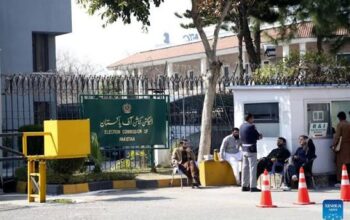
The PTI’s broadside extended on Sunday to the GB Election Commission itself, which the party accused of applying its authority selectively — going after opposition figures while ignoring violations by the ruling party.
As one example, the PTI pointed to a notice the commission allegedly sent to the mother of former Gilgit-Baltistan chief minister Khalid Khursheed, questioning why she had displayed a photograph of her son on campaign materials. The party also claimed that commission officials had contacted candidates directly to pressure them into abandoning the PTI and running instead under government-allied party banners, though those allegations could not be independently verified.
PTI Information Secretary Sheikh Waqas Akram accused federal ministers from the PML-N — including Amir Muqam, the minister for Kashmir Affairs and Gilgit-Baltistan, and Information Minister Attaullah Tarar — of stationing themselves in the region to sway local administration. At the same time, the party said, its own parliamentarians were being prevented from entering GB at all.
“The Election Commission remains inexplicably silent on blatant violations by the ruling party while selectively targeting PTI candidates and their families,” the party’s statement read. “The selective approach means the commission is being used as a tool of the regime.”
The commission and the federal government had not publicly responded to the specific allegations as of Sunday evening.
A Region With High Stakes
Gilgit-Baltistan occupies a strategically sensitive position at the intersection of Pakistan, China, Afghanistan, and India, and sits astride the China-Pakistan Economic Corridor, a vast infrastructure project linking the Chinese interior to the Arabian Sea. Elections there tend to draw scrutiny beyond what regional polls typically attract.
The PTI warned on Sunday that the conduct of this campaign — if left unchecked — could leave a wound that outlasts the election itself.
“GB is a highly sensitive region,” the party’s statement said. “The brazen pre-poll rigging and repression will destroy the peaceful atmosphere and create deep, lasting resentment in the hearts of the people whose democratic rights are being denied. Such grievances will endure for generations.”
The party called on civil society groups and human rights organizations to take note of what it described as “undemocratic and unconstitutional measures,” and demanded a level playing field, an end to what it characterized as political persecution, and the restoration of democratic rights in the territory.
“The regime’s fear-mongering actions,” it said, “will only hasten its own downfall.”
Copyright © 2021 Independent Pakistan | All rights reserved