By Staff Reporter
ISLAMABAD: Pakistan’s opposition parties united on Friday to demand a Truth and Reconciliation Commission (TRC) to investigate decades of constitutional breaches and hold accountable judges, generals, and politicians who have eroded democracy.
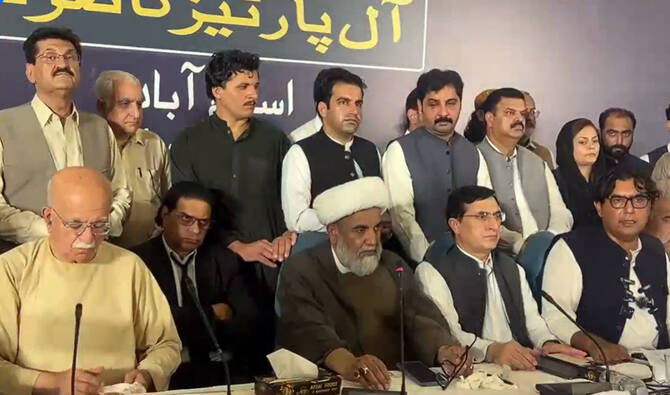
The proposal emerged from a multiparty conference (MPC) hosted by the Tehreek-e-Tahafuz-e-Ayeen-e-Pakistan (TTAP) alliance, which also called for a grand political dialogue, a new democratic charter, and an end to the country’s “hybrid” governance system. Drawing inspiration from South Africa’s post-apartheid model, the TRC would aim to uncover past abuses and promote justice.
The alliance demanded a new charter of democracy to restore the nation’s Constitution and democratic institutions, capping a two-day multi-party conference with a resolution that laid bare their grievances.
“The opposition [of this country] is being deliberately cornered and denied political space,” senior politician Mustafa Nawaz Khokhar told reporters at a press conference on the second day of the conference, held at his private farmhouse. The event’s relocation from its original venue, Tulip Banquet Hall in Islamabad, came after authorities erected barriers to block access on Thursday, a move the TTAP condemned as a direct assault on citizens’ rights.
The TTAP, a six-party coalition formed last year and formalised just last month, has emerged as a vocal critic of the government, pledging unwavering support for anti-government protests. Its conference, which began Thursday, was forced to shift to Khokhar’s farmhouse, underscoring the alliance’s claim that the government is intent on silencing dissent.
“We want the formation of a TRC on the pattern of South Africa, and those judges, generals, and politicians who have ever violated the constitution, harmed democracy, and usurped the rights of people should present themselves voluntarily before the commission,” Khokhar said. He urged those responsible to step forward willingly.
Khokhar criticised the government for backtracking on its earlier support for such a body. “The rulers were in favor of the TRC when they were in the opposition but are doing nothing in this regard after coming into power,” he said, pointing to a broader erosion of democratic principles. Beyond the TRC, the opposition outlined sweeping reforms. They demanded the release of missing persons, fair resource allocation across provinces, and adherence to the 1991 water accord. “No new canal project should be started without national consensus,” Khokhar said, calling for an immediate halt to any unilateral initiatives.
The TTAP listed key priorities for political consensus: constitutional supremacy, judicial independence, a reformed Election Commission, fair elections, border security, and solutions to crises in Balochistan, Khyber Pakhtunkhwa, and former tribal regions.
They also addressed inter-provincial tensions, media freedom, and rights for women and minorities. Opposition leaders targeted recent government moves, demanding the dissolution of the Special Investment Facilitation Council (SIFC)—deemed “unconstitutional”—and the cancellation of a 4.8-million-acre land lease to the Green Initiative Company, citing violations of provincial rights under the 18th Amendment.
The parties called for repealing the 26th Amendment, curbing judicial overreach, and restructuring the Election Commission to meet international standards. They labeled last year’s elections a “disgrace to democracy,” signaling deep distrust in the current system.
The crisis in Balochistan drew sharp focus, with the opposition calling it a “national wound.” They demanded local control over resources, court appearances for missing persons, an end to extrajudicial killings, and the release of political prisoners, including activist Dr. Mahrang Baloch.
They also sought to disband private militias, lift travel bans for religious pilgrims, and reopen historic trade routes. In a nod to grassroots activism, the opposition backed the Pashtun Tahafuz Movement (PTM) and urged the government to drop its appeal against a court ruling striking down a controversial security regulation.
Copyright © 2021 Independent Pakistan | All rights reserved