By Staff Reporter
ISLAMABAD: Pakistan on Friday accused India of orchestrating a deadly attack on a school bus in the restive province of Balochistan, an assault that left six children and one adult dead.
Officials described the bombing as part of a broader pattern of violence sponsored by New Delhi, aimed at destabilizing the region and undermining Pakistan’s development efforts. India swiftly dismissed the allegations, attributing the violence to Pakistan’s internal failures.
The attack, which occurred on Wednesday in the Khuzdar district of Balochistan, targeted a bus carrying students to an army-run school. A vehicle-borne improvised explosive device detonated near the bus, killing seven people and injuring several others. The incident has drawn widespread condemnation, with Pakistan’s military calling it a “cowardly act of terrorism” and an assault on the nation’s future.
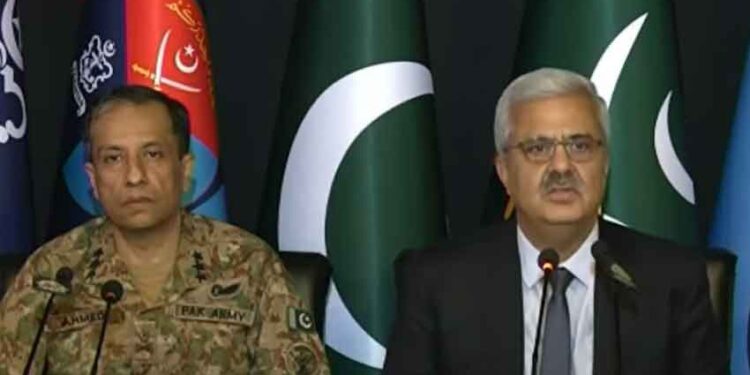
Speaking at a press conference alongside a senior military spokesman, Interior Secretary Khurram Muhammad Agha said the attack was not an isolated incident but part of a larger campaign of violence.
“Initial findings confirm that this attack is in continuity of a broader pattern of violence sponsored by India through Fitna Al-Hindustan (FAH), operating under the tutelage and patronage of the Indian intelligence agency R&AW,” Agha said.
“The attack on school bus in Khuzdar was an attack on our values, our education system and the very fabric of our society.”
The term ‘Fitna al Hindustan’ is a new phrase coined by Pakistan’s military, aimed at framing India’s role in terrorism as a deliberate destabilisation strategy, potentially to galvanise domestic support.
The FAH, according to officials, is a coalition of separatist groups and independent cells that have been active in Balochistan, a province long plagued by insurgency.
“The state has the wherewithal and will to dismantle these networks and bring their handlers and perpetrators of these acts of terrorism to justice. Such actions will have consequences… Our resolve is firm and response will be decisive,” Agha added.
Balochistan, Pakistan’s largest but least developed province, has been the site of a decades-long conflict, with groups like the Baloch Liberation Army (BLA) demanding greater autonomy or outright independence. These groups have frequently targeted civilians, security forces, and infrastructure projects, but the recent attack on schoolchildren marks a grim escalation.
“These Indian-sponsored terrorists have no place in Pakistan,” Agha said, vowing to dismantle the networks responsible. “We have the wherewithal and the commitment to bring an end to this violence. Our resolve is firm, and our response will be decisive.”
The military spokesman Lt. Gen. Ahmed Sharif Chaudhry, who also spoke at the press conference, detailed several past incidents of violence that he said were linked to India-backed groups.
“Self-given confessions and acknowledgements of multiple surrendered terrorists of this Fitna Al-Hindustan who told that how Hindustan is funding, planning and carrying out terrorist acts in Balochistan.”
Chaudhry accused India of attempting to “sabotage development in the region, incite fear among the population and derail the journey of peace and development in an attempt to repeat their playbook of 1971,” a reference to the war that led to Bangladesh’s independence.
He said it would persist with intelligence-based operations (IBOs) to counter terrorism in Balochistan, opting against a large-scale kinetic military campaign at this stage.
“The intelligence-based operations would continue,” Chaudhry said. “Intelligence-based operations are very effective way of dealing with terrorists. We are hunting them down and eliminating them,” he added. “The number of terrorists killed in these intelligence-based operations are much higher as compared to the large-scale operations.”
According to the military spokesman, the armed forces are currently conducting approximately 150 IBOs daily without disrupting civilian life. “The terrorist groups after suffering heavily at the hands of law-enforcement agencies are now attacking soft targets. This shows the effectiveness of our operations,” he added.
Lt Gen Chaudhry pointed to synchronized attacks on the night of May 9-10, involving 33 terrorist incidents in Balochistan, as evidence of collaboration between India and proxy groups in the region.
“At a time when India was firing projectiles and missiles into Pakistan, it had also activated these proxies,” he said. “This synchronisation of attacks proved the collaboration between Fitna al Hindustan and India.”
He linked India’s alleged targeting of Balochistan to the province’s recent economic progress. “Balochistan has reached its take-off phase with improvements in the socio-economic sector… the inauguration of the airport in Gwadar and expansion of road network,” he said.
Balochistan’s terrorism issue is being addressed through a rational approach, with the military effort as one component. The problem is being tackled collectively by all elements of national power.
This holistic approach acknowledges that military solutions alone cannot resolve the complex issues in Balochistan.
Addressing recent tensions with India, the DG ISPR warned of dire consequences if provocations persist. “India is using terrorism as a tool against Pakistan through Fitna al Hindustan and Fitna al Khawarij,” he said. “Pakistan is on the other hand maintaining peace as a rational actor through the resolve of the people and the capabilities of the armed forces.”
The accusation comes at a time of heightened tensions between the two nuclear-armed neighbors. Last month, a deadly attack in occupied Kashmir left 26 people dead, an incident India blamed on Pakistan-based militants. Islamabad denied any involvement, and Lt. Gen. Chaudhry reiterated that India had yet to provide evidence to support its claims.
The Kashmir attack triggered a series of military confrontations, including air strikes by India in Pakistan’s Punjab and Azad Kashmir regions on May 6-7, which resulted in civilian casualties. Pakistan responded by downing six Indian jets, and the situation only de-escalated after American diplomatic intervention on May 10.
Despite the ceasefire, rhetoric from both sides remains heated. On Thursday, Indian Prime Minister Narendra Modi delivered a fiery speech in Rajasthan, accusing Pakistan of sponsoring terrorism and vowing to cut off Pakistan’s access to rivers under Indian control. “Pakistan will not get water from rivers over which India has rights,” Modi declared, escalating the stakes in the long-standing dispute over water resources.
Pakistan’s Foreign Office responded sharply on Friday, rejecting Modi’s “baseless, provocative, and irresponsible allegations.”
In a statement posted on X, the ministry accused India of using inflammatory rhetoric to “stoke regional tensions for narrow political gains.” The Foreign Office described Modi’s remarks as a “grave breach of the United Nations Charter” and warned that such “belligerent posturing” could undermine regional stability.
“Any insinuation seeking to associate Pakistan with acts of terrorism is factually incorrect and patently misleading,” the statement read. It also accused India of attempting to deflect attention from its own “serious human rights violations” in Kashmir, where a decades-long insurgency has been met with a heavy-handed military response.
Pakistan’s top diplomat at the United Nations, Ambassador Asim Iftikhar Ahmad, told Arab News that Islamabad plans to raise the school bus attack at the UN and present evidence of Indian involvement. “This was a heinous terrorist act directed against children, against students, [which is] totally unacceptable and condemnable,” Ahmad said.
Copyright © 2021 Independent Pakistan | All rights reserved