By Staff Reporter
ISLAMABAD: Deputy Prime Minister and Foreign Minister Ishaq Dar accused India on Monday of waging ‘water terrorism’ against its neighbor, alleging that New Delhi is weaponizing the Indus River system in violation of a decades-old treaty.
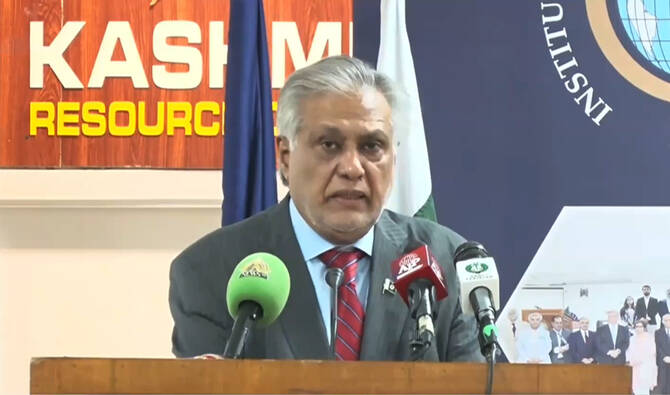
Addressing an audience at the Institute of Strategic Studies Islamabad (ISSI) during its 52nd anniversary event, Dar said India seeks to endanger Pakistan’s 240 million citizens through what he termed “water terrorism.”
The accusation centers on the Indus Waters Treaty, a 1960 pact brokered by the World Bank that allocates the Indus River system’s waters between the two nations, three eastern rivers to India and three western ones to Pakistan.
“India cannot impose its will on Pakistan and must reconsider its policies,” Dar said, delivering a stern warning that any unilateral attempt by India to suspend the treaty would be “unacceptable and counterproductive.” “India wants to use water as a weapon, but Pakistan stands firm in protecting its interests.”
The treaty, brokered by the World Bank in 1960, governs the use of the Indus River and its tributaries, a lifeline for agriculture across Pakistan and a persistent flashpoint in the fraught relationship between New Delhi and Islamabad.
Tensions flared in April when India announced it was placing the treaty in abeyance after a deadly attack in occupied Kashmir’s Pahalgam killed 26 people, an assault New Delhi blamed on Pakistan without presenting evidence. Pakistan swiftly denounced the move as an “act of war,” arguing that the treaty offers no mechanism for unilateral suspension.
Dar pressed New Delhi to reconsider its approach, saying, “New Delhi must, therefore, rethink its present hubristic and misguided policies that threaten peace and undermine security in South Asia.”
“Pakistan is charting a forward-looking course as a confident and self-assured nation – resolutely safeguarding its sovereignty and territorial integrity and shouldering its obligations as a responsible member of the international community”.
The diplomatic rift deepened after the April attack in Kashmir, which sparked a four-day military clash in May, the most intense skirmish between the two since their last major confrontation. Tit-for-tat measures followed, with India’s treaty suspension marking a sharp escalation.
“The outcome of this four-day war has once again underscored the reality that India can neither intimidate nor coerce Pakistan,” the minister said.
The violence subsided when US President Donald Trump announced a ceasefire on May 10. The United States reported that both India and Pakistan had agreed to meet at a neutral venue to address their differences, though New Delhi has publicly dismissed the prospect of bilateral talks with Islamabad.
Dar praised the diplomatic efforts of friendly nations, including the United States, Saudi Arabia, the United Arab Emirates, and Türkiye, crediting them with helping to prevent further escalation between India and Pakistan and securing a ceasefire along their volatile border.
“Going forward, it is essential to consolidate the ceasefire, institute a reliable crisis management mechanism, and develop confidence-building measures that would help stabilize the regional security situation,” Dar said.
Dar also reaffirmed Pakistan’s position on Kashmir, labeling it a “recognized international dispute” and accusing India of violating global norms in the region. “Resolving Kashmir peacefully is vital for lasting stability,” he said.
Geo-Economics in Foreign Policy
Dar said Pakistan is reorienting its foreign policy toward geo-economics, emphasizing economic priorities and a renewed push for regional cooperation in South Asia.
The minister stressed that enhancing trade, prompting foreign investment, attracting remittances and technology flows, and forging development partnerships are among the highest priorities of the foreign ministry.
He pointed to a recent trilateral cooperation mechanism launched on June 19 with China and Bangladesh as a model, pledging “win-win cooperation” that he said could extend to other South Asian nations. “Such interventions can be envisaged with other South Asian nations as well, based on principles of common interest, mutual benefit, and win-win mutual cooperation.”
Relations with Afghanistan, another critical neighbor, are also under focus. Dar highlighted efforts to reset ties, including a trilateral mechanism with China and the extension of the China-Pakistan Economic Corridor (CPEC) to Afghanistan.
“Our visit to Kabul on April 19 and Pakistan, China and Afghanistan’s trilateral meeting in Beijing paved the way for a qualitative change,” he said. “Having made sincere efforts in Afghanistan’s interest, it is our legitimate expectation that the Afghan interim government would take all steps necessary to ensure that Afghanistan’s soil is not used for terrorism against any state, particularly Pakistan.”
On Palestine war, Dar condemned Israel’s military operations in Gaza, where its campaign against civilians has killed at least 56,412 people since October 2023. “The international community must mobilize to stop Israel from its murderous course and persuade it to pursue a path of reason,” he said, decrying the “wanton killing of women and children” and the use of starvation as “an instrument of war.”
The minister reiterated Pakistan’s support for an independent Palestinian state and condemned Israel and the United States for attacking Iranian nuclear facilities earlier this month, calling it a violation of the United Nations Charter and international law.
Copyright © 2021 Independent Pakistan | All rights reserved