By Staff Reporter
ISLAMABAD: Pakistan and Afghanistan have agreed to extend a fragile 48-hour ceasefire until the conclusion of high-level talks set to begin in Doha on Saturday, senior officials said on Friday, in an effort to halt a recent surge of border clashes that left dozens dead and heightened longstanding frictions over terrorism and sovereignty.
The extension was initiated at the Afghan Taliban government’s request. A delegation from Pakistan had already reached the Qatari capital, with an Afghan team anticipated to join on Saturday. Afghan reports indicate the Taliban team may feature Defence Minister Mullah Yaqub Mujahid and intelligence chief Mullah Wasiq. Pakistan’s Foreign Office remained mum, but a late-evening huddle between National Security Adviser and ISI chief Lt. Gen. Asim Malik and Foreign Minister Ishaq Dar hinted that General Malik might head to Doha.
The truce temporarily halts intense fighting that broke out on the night of Oct. 11, when Pakistani authorities said Afghan forces initiated an unprovoked assault on border posts. The confrontations persisted through Wednesday, killing 23 Pakistani soldiers and more than 200 Taliban fighters.
The flare-up was ignited by Islamabad’s demands that Kabul curb militants launching increased attacks into Pakistan from alleged safe havens in Afghanistan. In retaliation, Pakistan’s military executed what it termed “precision strikes” in Afghanistan’s Kandahar Province and the capital, Kabul, demolishing several militant bases, officials said.
The hostilities have unfolded amid a volley of recriminations between the two neighbors. Pakistan has long accused Afghanistan of sheltering terrorist organizations, including the outlawed Tehreek-i-Taliban Pakistan — which Islamabad labels Fitna al Khawarij — and Balochistan separatist groups it dubs Fitna al Hindustan, while alleging Indian meddling in efforts to destabilize the region. Afghan leaders have countered by charging Pakistan with breaching their sovereignty, pointing to airstrikes on a civilian market in Paktika Province near the border and unauthorized incursions into Kabul’s airspace.
Kabul has directed its forces to uphold the cease-fire provided Pakistan abstains from further aggression, Zabihullah Mujahid, the Afghan Taliban spokesman, told Ariana News, a Pashto-language local television news channel. The rise in militant activity within Pakistan has long strained ties with the Afghan Taliban, who reclaimed control of Kabul following the withdrawal of US-led forces in 2021.
In Islamabad, the Foreign Office stressed on Friday that the two nations were “sincerely working towards resolving the ‘complex but solvable’ issue of border clashes” amid the provisional truce. During a weekly press briefing, the office’s spokesman, Shafqat Ali Khan, noted that throughout the 48-hour armistice — due to end at 6 p.m. local time — both governments were undertaking “sincere efforts to find a positive resolution to this complex but solvable issue through constructive dialogue.”
“Pakistan greatly values dialogue and diplomacy and a mutually beneficial relationship with Afghanistan,” Khan said. “At the same time, the Government of Pakistan continues to closely monitor the situation and would take all possible measures to safeguard its territory and the lives of its people.”
Khan voiced profound alarm over what he called the Taliban’s “provocative attacks” along the frontier from Oct. 11 to 15, which Pakistan repulsed in self-defense. He reported substantial casualties among Taliban troops and the terrorist sanctuaries they utilized. “Our retaliatory action was against terrorist elements, not civilians,” he stated.
Bilateral relations have worsened in recent years, with Pakistan alleging that Kabul provides refuge to combatants from the banned Tehreek-e-Taliban Pakistan (TTP) and the separatist Baloch Liberation Army (BLA), enabling them to mount raids across the border from Afghan territory. Kabul rejects these claims, insisting it does not allow its land to be exploited against other nations.
Khan said Pakistan had repeatedly notified Kabul of Fitna al-Khawarij’s presence in Afghanistan and anticipates the Taliban administration to enact tangible measures against such groups, ensuring Afghan soil is not a launchpad for terrorism, consistent with its pledges. He emphasized that Pakistan honors Afghanistan’s sovereignty and pursues dialogue and collaboration to tackle the common threat of terrorism. “The recent contacts between the two countries reflect mutual trust and understanding,” the spokesman added.
As envoys from both nations prepared for Qatari-mediated discussions in Doha, a pointed remark from Pakistan’s defence minister signaled a hardening stance, coinciding with renewed strikes on terrorist hideouts in Afghanistan on Friday.
These operations followed a bold gun-and-bomb assault on a military outpost in North Waziristan, occurring mere hours after the cease-fire extension between Islamabad and Kabul. Fresh clashes were noted in the Angoor Adda area and Afghanistan’s Urgun and Barmal districts in Paktika Province, where security sources reported precision attacks on strongholds of the prohibited Hafiz Gul Bahadur group, resulting in dozens of militant deaths.
“If someone attacks Afghanistan, our forces are ready to respond,” Mujahid told Ariana News. Yet Pakistani security officials clarified that the truce with the Afghan government did not bar actions against terrorist entities and their bases.
Pakistan’s military issued no formal statement, but militants affiliated with the Hafiz Gul Bahadur group claimed the assault on Khaddi Fort in Mir Ali, where a suicide attacker drove an explosives-packed vehicle into the camp’s main entrance before others tried to breach it earlier that day. While the Inter-Services Public Relations (ISPR) provided no official tally of casualties, security sources said the incursion was thwarted with all assailants eliminated.
The assault commenced on Friday morning, local accounts described, featuring an enormous blast succeeded by intense gunfire as militants sought entry to the camp. Sources indicated that “all four” attackers perished.
In a revealing post on X, Defence Minister Khawaja Asif declared that ties with Kabul would diverge from previous patterns. “There will no longer be protest notes or appeals for peace; no delegations will go to Kabul. Wherever the source of terrorism lies, it will have to pay a heavy price,” he wrote.
Asif charged Afghanistan with “sitting in India’s lap and plotting conspiracies against Pakistan,” asserting that Islamabad “can no longer afford to have relations with Kabul like in the past.” “All Afghans on Pakistani soil will have to go back to their homeland,” he wrote. “Now they have their own government [or] caliphate in Kabul. It has been five years since the Islamic revolution… they must live with Pakistan as neighbours.”
In the post, the defence minister detailed Pakistani delegations’ trips to Kabul and cited statistics on terrorism originating from Afghanistan and resultant losses. Since the Taliban’s 2021 ascent, Pakistani foreign ministers traveled to Kabul four times; defence ministers and ISI chiefs twice each; the special representative and foreign secretaries five times apiece; the national security adviser once; and the Joint Coordination Committee convened eight sessions in the Afghan capital.
He listed 225 border flag meetings, 836 protest notes, and 13 demarches. “From 2021 to date: 3,844 martyred (civilians, military, and law enforcement agencies combined). Terrorist incidents: 10,347,” the defence minister listed.
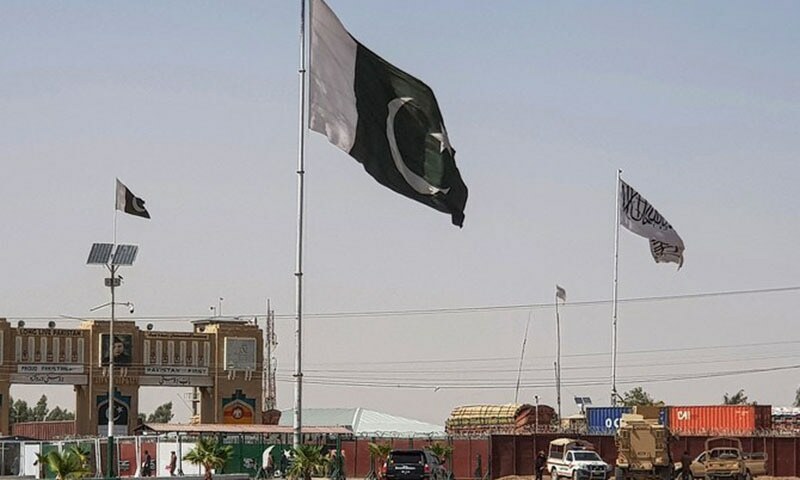
Earlier Friday, Afghan officials transferred the remains of seven Pakistanis — two of them security personnel — to Pakistani authorities at the border after Tuesday’s lethal Taliban strike in the Chaman sector. “The Taliban authorities handed over all the seven bodies to Pakistan through Hilal-e-Ahmar Pakistan (Red Crescent),” confirmed Abdul Wali Khan Ghabizai of the organization’s Balochistan chapter.
He said Taliban representatives at the Vesh Mandi border crossing declared they were repatriating the bodies of Pakistanis who perished “in the armed clash between two countries.” The remains were transported to Chaman’s District Hospital for identification and legal procedures. “Five bodies were brought to the district hospital Chaman,” said Dr. Muhammad Awais, the hospital’s medical superintendent. “Four out of five martyrs have been identified as residents of the border town, while the fifth could not be identified so far.” Two victims were confirmed as security personnel — Naik Suleman and Sepoy Sabir — whose bodies were moved to the Combined Military Hospital in Quetta. Officials reported that four of the five civilians died from mortar shell fragments, with one struck in the forehead. The identified civilians — Syed Ali Adozai, Muhammad Asghar Ashaizai, Rozi Khan Salehzai and Nasibullah Salehzai — were daily-wage laborers buried in their home villages that evening.
Copyright © 2021 Independent Pakistan | All rights reserved