By Staff Reporter
ISLAMABAD: Pakistan and Afghanistan traded accusations on Friday over reported airstrikes in Kabul, escalating tensions between the neighbours as Islamabad defended its right to counter terrorism from Afghan soil while denying direct involvement in the blasts that shook the Afghan capital.
The exchanges came a day after twin explosions in Kabul on Thursday night, which local Afghan media described as precision airstrikes targeting a vehicle and a compound linked to the Tehreek-i-Taliban Pakistan, or TTP, a militant group that has long plagued Pakistan. Witnesses reported fighter jet overflights and bursts of automatic gunfire, with speculation centering on an attempt to kill Noor Wali Mehsud, the TTP’s chief.
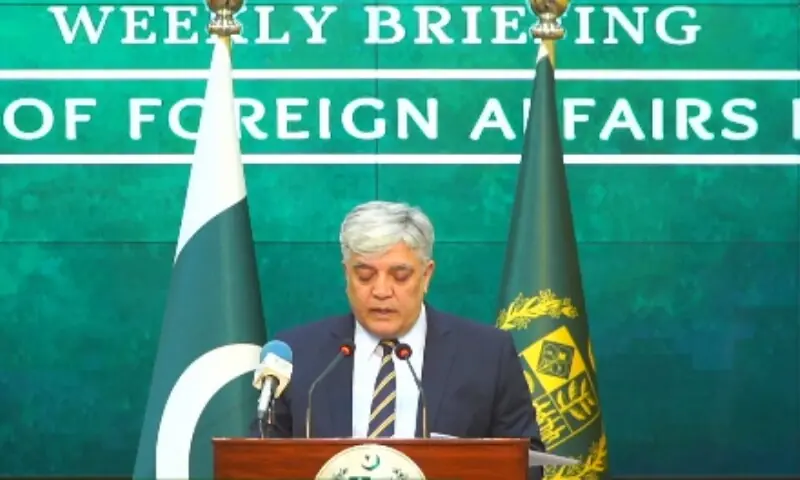
Pakistan’s Foreign Office, in a weekly briefing, avoided acknowledging the strikes but framed its counterterrorism efforts as legitimate self-defence. “Pakistan reaffirms its unwavering commitment to the security and well-being of its people,” said Shafqat Ali Khan, the spokesperson.
He added that Pakistan “respects the sovereignty of Afghanistan, and remains steadfast in its commitment to fostering dialogue and cooperation with our neighbours to address the shared challenges of terrorism.”
Khan described the operations as intelligence-driven and aimed at protecting citizens from groups like the TTP The statement underscored Islamabad’s growing frustration with what it sees as Kabul’s failure to curb militants operating from Afghan territory.
Conflicting reports emerged about Mehsud’s fate. Some social media accounts linked to Pakistan’s establishment hailed the strike as a potential blow to the TTP leadership, while pro-TTP and Indian channels released an audio message purportedly from the chief denying his death and dismissing the reports as “enemy propaganda.”
The incident represents one of the most serious escalations since the Taliban regained power in Afghanistan in 2021. Analysts noted that if confirmed, a Pakistani strike in Kabul would mark the first such action in the capital, though Pakistan has previously targeted TTP sites elsewhere in Afghanistan.
In Peshawar, a city in northwestern Pakistan near the border, Lt. Gen. Ahmed Sharif Chaudhry, the military spokesperson, held a news conference almost simultaneously with the Foreign Office briefing. He declined to confirm or deny the Kabul strikes but emphasised Pakistan’s resolve. “Afghanistan is being used as a base of operations for carrying out terrorism in Pakistan. There is also evidence of this,” he said.
General Chaudhry cited recent violence, including the killing of at least a dozen Pakistani soldiers, among them three officers, in Khyber Pakhtunkhwa Province, which borders Afghanistan. “We just ask them [the Afghan authorities] for an extremely fair, just thing that, ‘do not let your soil become a haven for non-state actors and terrorist groups,’” he said. “For the safety of the life and property of the people of Pakistan, for the territorial integrity of Pakistan, we are doing and we will continue to do whatever is necessary.”
Afghan officials, in turn, publicly blamed Pakistan. The Afghan defence ministry accused Pakistani forces of violating Afghan airspace and bombing a civilian market in the Margha area of Paktika Province near the Durand Line, the disputed border, as well as targeting Kabul. “Once again, Pakistan violated Afghan airspace, bombed a civilian market in the Paktika airspace near the Durand Line, and also violated the territory of the capital Kabul,” the ministry said in a statement.
The ministry described the strikes as “unprecedented, violent, and reprehensible,” warning that “regardless of how critical the situation becomes, the consequences will fall on the Pakistani army.” Kabul has consistently denied providing safe havens to militants, rejecting Islamabad’s allegations.
The flare-up follows a surge in militancy in Pakistan’s northwest since a truce with the TTP collapsed in November 2022. The group, seen by Pakistani officials as allied with the Afghan Taliban despite being separate, has claimed responsibility for deadly attacks since the late 2000s. Islamabad has conducted multiple operations over two decades to combat the militants, but officials say they have regrouped in the rugged border regions.
A day earlier, in Pakistan’s National Assembly, Defence Minister Khawaja Asif had signalled impatience. “Enough is enough, Pakistan government and armed forces’ patience has worn out,” he said. Pakistan has long accused Afghanistan of allowing its soil to be used by militants, with some allegations extending to Indian backing—a charge denied by both Kabul and New Delhi.
Separately, the Foreign Office refrained from commenting on an agreement between India and Afghanistan to reopen their embassies, which had been shuttered since the Taliban’s takeover. The deal was reached during talks in New Delhi between India’s external affairs minister, S. Jaishankar, and Afghanistan’s acting foreign minister, Amir Khan Muttaqi, marking India’s first high-level engagement with the Taliban government.
“Our position on Afghanistan’s bilateral relations with any other country remains that it is a matter between those two countries,” Khan said. “Afghanistan is a sovereign, independent country, and we do not have any particular comment to offer on it.”
He added that Pakistan’s consistent request, while respecting Afghanistan’s sovereign foreign policy, is that Afghan territory not be used against Pakistan.
Copyright © 2021 Independent Pakistan | All rights reserved