By Staff Reporter
ISLAMABAD: Pakistan has created a new military command dedicated to long-range conventional missiles, aiming to bolster its strike capabilities against arch-rival India, Prime Minister Shehbaz Sharif said.
Sharif announced the establishment of the Army Rocket Force Command during a ceremony on the eve of Pakistan’s 78th Independence Day in Islamabad. Experts said the creation of the new command is marking a shift in the country’s approach to conventional warfare.
“On this occasion, I announce the establishment of the Army Rocket Force Command,” he told the audience, calling it “equipped with modern technology and having the capability to strike at the enemy from different directions… another milestone in strengthening our conventional warfare capacity.”
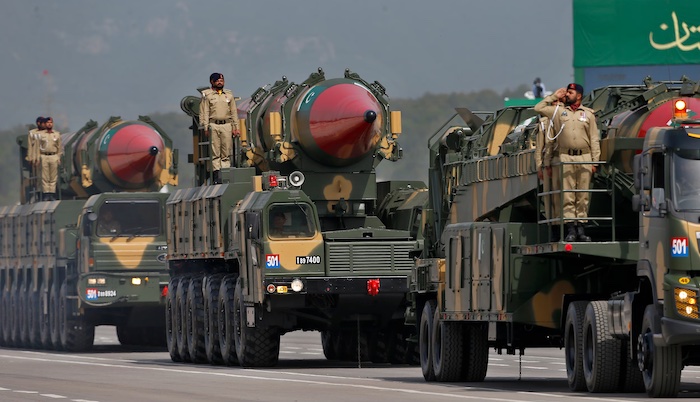
The new force will manage an array of conventional missiles—ballistic, cruise, and possibly hypersonic—designed to hit targets deep inside enemy territory without resorting to nuclear weapons.
The move comes just months after a fierce four-day war with India in May, the most intense fighting between the two neighbors in years, which laid bare Pakistan’s need for longer-range strike options. In that conflict, Pakistan’s air force scored early wins, helping to tilt the battlefield in its favor.
But military planners were frustrated by the lack of conventional rockets capable of striking far beyond the front lines, a gap that left Pakistan vulnerable against India’s deeper defences.
A senior security official, speaking to Reuters, said the new command “would have its own command in the military, which would be dedicated to handling and deployment of missiles in the event of a conventional war.” The official was clear about its target: “It is obvious that it is meant for India.”
The decision to establish the Army Rocket Force Command stems directly from the lessons of the May war, where Pakistan’s reliance on fighter jets and artillery proved insufficient for targeting strategic assets at long range.
“Crucially, it is a lesson of the May war. Pakistan didn’t have much in the way of longer-range conventional rockets, which could be employed for deep targeting,” said Muhammad Faisal, a South Asia security analyst at the University of Technology Sydney.
Pakistan’s new command draws inspiration from a handful of countries with dedicated missile forces. China has long relied on its People’s Liberation Army Rocket Force to project power through advanced missile systems. Iran, during its 12-day clash with Israel in June, fired waves of missiles to overwhelm defences, causing significant damage but failing to shift the broader strategic balance.
In Ukraine, Russia’s massive missile barrages have pounded cities but haven’t delivered victory, with drones often proving more effective in recent fighting. These examples raise a critical question: Will Pakistan’s rocket force prove a decisive tool in its standoff with India, or will it become an expensive project with uncertain benefits?
Building and maintaining long-range precision missiles is a costly endeavor, requiring heavy investment in technology, training, and infrastructure. How the new command fits into Pakistan’s overall military strategy also remains unclear, leaving room for debate about its role and impact. “It is a significant development and could lead to changes in our military doctrine and force posture. Since not much is available in the public domain about the role of this new entity and the employment concept, it may be premature to speculate about its effectiveness against the Indian threat,” said Dr Adil Sultan, dean of the Faculty of Aerospace and Strategic Studies at Air University in Islamabad.
The launch of the Army Rocket Force Command is likely to draw sharp attention from India, potentially fuelling tensions in a region already marked by mistrust and frequent military flare-ups.
Copyright © 2021 Independent Pakistan | All rights reserved