By Staff Reporter
ISLAMABAD: Pakistan will host foreign ministers from the Economic Cooperation Organisation (ECO) in Islamabad on Sunday, using its chairmanship of the 10-nation bloc to press for closer trade and transport links across Central Asia.
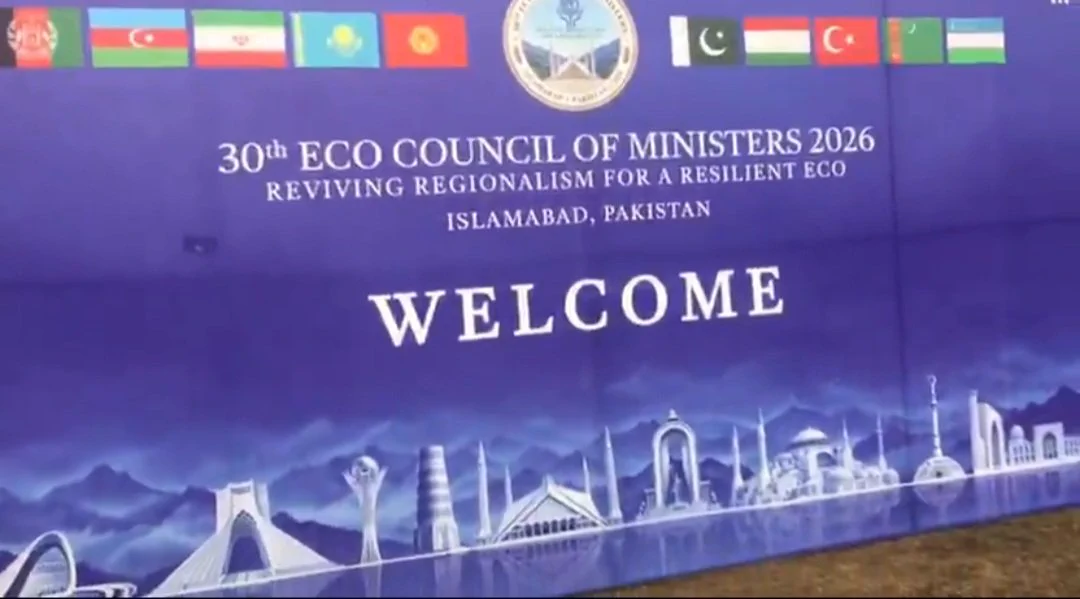
The 30th meeting of the ECO Council of Ministers will run for two days, from 15 to 16 November, the Foreign Office said on Saturday. It will be chaired by Deputy Prime Minister and Foreign Minister Ishaq Dar and attended by foreign ministers and heads of delegation from member states, along with representatives of the ECO secretariat and its subsidiary bodies.
Senior officials from member states will meet first to review the organisation’s activities and programmes, assess the work of its subsidiary bodies and finalise the agenda and draft outcome documents for the ministers to consider.
Pakistan holds the ECO chairmanship for 2026-27 and has framed its term around the theme “Reviving Regionalism for a Resilient ECO”. The Foreign Office said the chairmanship would focus on strengthening regional connectivity and integration, deepening partnerships and promoting collective efforts towards prosperity and sustainable development. It would also give the ECO a chance to reinforce its role as a platform for cooperation, dialogue and economic collaboration, the ministry added.
Islamabad also wants to position itself as a regional connectivity hub, a facilitator of logistics supply chains and an agenda-setter for regional trade, according to the Foreign Office.
“These efforts will contribute toward unlocking the region’s considerable economic potential and ensuring that the benefits of regional cooperation are translated into tangible improvements in the lives of the people of ECO member states,” the ministry said in its statement.
Dar welcomed arriving delegates in a post on X. “I look forward to productive deliberations as we work together to strengthen regional cooperation and advance our shared priorities,” he wrote. “Wishing all delegates a productive and memorable stay in Islamabad.”
Tahsin Ertuğruloğlu, foreign minister of the Turkish Republic of Northern Cyprus, was among those to land in the capital. He was received at the airport by officials of Pakistan’s Ministry of Foreign Affairs. The territory takes part in ECO events as an observer, and only Turkey recognises it as a state.
Pakistani media reported, citing unnamed diplomatic sources, that Islamabad has not invited the Afghan Taliban government, although Afghanistan is a member of the bloc. The Foreign Office has not addressed the reports in the statements issued so far. A separate ECO interior ministers’ meeting, due to be held in Islamabad in late October, was postponed because of the prevailing regional situation.
Security has featured in Dar’s recent ECO diplomacy. Addressing an informal meeting of the council in New York on 26 September, he warned that the terrorist threat from Afghanistan remained a major obstacle to regional peace and development.
Dar chaired a meeting in Islamabad on 6 November to finalise preparations for the council, and expressed satisfaction with progress and directed officials to ensure close coordination. His directive underlined the importance Pakistan attaches to the regional bloc.
Pakistan was elected chair of the council at its 29th meeting, held virtually, where Mr Dar said Islamabad would work with members to finalise the ECO Vision 2026-2035 during its term. The current framework, ECO Vision 2025, is due to expire this year.
The 17th ECO Summit was held in Khankendi, Azerbaijan, on 3 and 4 July 2025, with Prime Minister Shehbaz Sharif leading Pakistan’s delegation. Heads of state and government discussed regional cooperation and economic integration. Pakistan called for stronger intra-regional trade, transport connectivity, energy cooperation and sustainable development, and reaffirmed its commitment to ECO Vision 2025.
Iran, Turkey and Pakistan founded the organisation as the Regional Cooperation for Development in 1964, and it was renamed the ECO in 1985. It expanded in the 1990s to take in Afghanistan, Azerbaijan, Kazakhstan, Kyrgyzstan, Tajikistan, Turkmenistan and Uzbekistan. Its stated aim is to create conditions for sustainable economic development and the joint welfare of its members.
Pakistan has been working to strengthen its position as a trade and transit hub, offering landlocked Central Asian states a route to global markets. Visits, investment discussions and economic activity between Pakistan and Central Asian and Gulf countries surged in 2024 for that purpose. The push comes as Islamabad seeks to reduce its reliance on bilateral and multilateral creditors in favour of trade and connectivity partnerships with regional allies.
Copyright © 2021 Independent Pakistan | All rights reserved