By Staff Reporter
ISLAMABAD: Pakistan and China pledged to bolster their strategic partnership and advance the China-Pakistan Economic Corridor (CPEC) during high-level talks in Islamabad on Thursday, with both sides expressing optimism about expanding cooperation in trade, infrastructure, and regional stability.
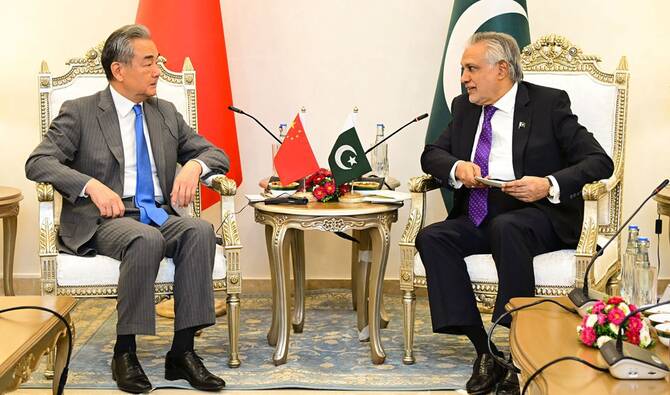
Deputy Prime Minister and Foreign Minister Ishaq Dar hosted Chinese Foreign Minister Wang Yi for the sixth round of the Pakistan-China Strategic Dialogue, following Wang’s arrival in the Pakistani capital on Wednesday evening. The talks, held at the Ministry of Foreign Affairs, focused on strengthening bilateral ties across multiple sectors, including trade, energy, defence, and people-to-people cooperation.
“We held fruitful and substantive discussions today covering diverse areas of mutual interest,” Dar told reporters at a joint press conference with Wang. “We took stock of progress achieved since the last round of Strategic Dialogue. We also exchanged views on the entire gamut of Pakistan-China relations, including CPEC, trade and investment, science and technology, and people-to-people cooperation.”
Dar highlighted the “complete unanimity of views and consensus on all important matters” between the two nations, underscoring the depth of their longstanding strategic partnership. He also referenced a recent trilateral meeting involving Pakistan, China, and Afghanistan, noting that such mechanisms reflect a shared commitment to fostering regional peace and prosperity.
“These mechanisms signify our joint resolve to promote regional peace, stability, and prosperity, and to share the dividends of Pak-China friendship with other countries in the region and beyond,” Dar said.
Wang echoed Dar’s sentiments, describing CPEC as the “cornerstone” of the Pakistan-China strategic partnership. He outlined plans to transform the corridor into “a growth corridor, livelihood-enhancing corridor, green corridor, and open corridor” to better align with Pakistan’s development priorities.
“We will work hard to deepen our industrial, agriculture, and mining cooperation to improve the Pakistani people’s welfare, accelerate Pakistan’s capability for self-sustained development, and increase Pakistan’s economic resilience,” Wang said.
The Chinese minister reaffirmed Beijing’s support for key CPEC projects, including the development and operation of Gwadar Port and the realignment of the Karakoram Highway, a critical road link connecting Pakistan and China through the Himalayas. He also welcomed third-party participation in the Main Line-1 (ML-1) railway project, a major initiative to upgrade Pakistan’s Karachi-Peshawar railway line.
Wang extended condolences for lives lost in recent floods in Pakistan, assuring that China would “immediately provide emergency humanitarian assistance.” He also praised Pakistan’s efforts in combating terrorism, stating that Islamabad was “effectively protecting the safety of Chinese personnel and institutions” in the country.
“China highly commends Pakistan’s tireless efforts in combatting terrorism, as it firmly believes that Pakistan’s counter-terrorism operation will secure victory,” Wang said.
The talks also touched on preparations for Pakistani Prime Minister Shehbaz Sharif’s upcoming visit to China, where he will attend the Shanghai Cooperation Organisation (SCO) Council of Heads of State summit in Tianjin from August 31 to September 1. APakistan-China business-to-business investment conference would be held during the visit, which will also include meetings with Chinese President Xi Jinping and Premier Li Qiang.
“The two sides will jointly prepare and ensure the success of the series of activities for the 75th anniversary of China-Pakistan diplomatic relations next year,” Wang added.
The discussions come on the heels of the Sixth Trilateral Foreign Ministers Dialogue held in Kabul earlier this week, where Dar, Wang, and Afghan Foreign Minister Amir Khan Muttaqi committed to strengthening cooperation in political, economic, and security domains. A statement from Pakistan’s Foreign Office said the three sides reaffirmed their resolve to combat terrorism and deepen collaboration in trade, transit, and regional development, including the potential extension of CPEC to Afghanistan.
Launched in 2015, CPEC is a flagship project of China’s Belt and Road Initiative, encompassing energy projects, highways, railways, and the development of Gwadar Port on the Arabian Sea. The upcoming launch of CPEC-II, expected during Sharif’s visit to China, will focus on industrial cooperation, green energy, and agricultural modernization, following a delay of nearly five years.
Dar welcomed China’s vision for “CPEC 2.0,” emphasizing its potential to enhance industrial zones and promote sustainable development. Both sides expressed confidence that the upgraded corridor would align with Pakistan’s development goals and foster greater economic resilience.
In response to a question about China’s relations with India, Wang clarified that the partnership between Beijing and Islamabad would “not affect any third party,” underscoring the independent nature of the Pakistan-China relationship.
Copyright © 2021 Independent Pakistan | All rights reserved