By Staff Reporter
ISLAMABAD: Pakistan’s Army Chief Field Marshal Asim Munir met with senior Chinese political and military leaders in Beijing to discuss defence modernisation and cooperation, focusing on counterterrorism, joint training, and combating transnational threats, the Pakistani military said on Friday, amid escalating tensions in South Asia following a recent clash with India.
The meetings follow a four-day military standoff in May between Pakistan and India, marking the worst fighting between the nuclear-armed neighbors in over two decades. Pakistan air force used Chinese-supplied J-10C aircraft to shoot down six Indian fighter jets, including three French Rafales, while its army struck several Indian military installations. The conflict was sparked by an attack on tourists in occupied Kashmir.
“These engagements featured comprehensive exchanges on defense and security cooperation, including counterterrorism collaboration, joint training, defense modernization, and enhanced institutional linkages,” the Inter-Services Public Relations (ISPR), the Pakistani military’s media wing, said in a statement.
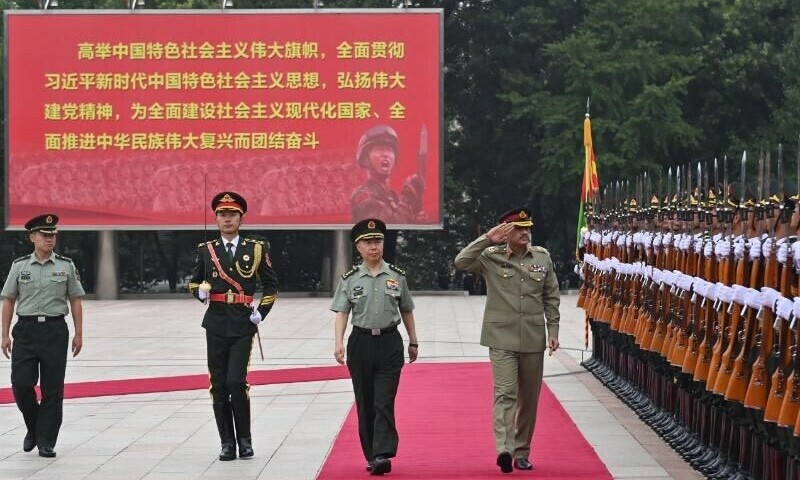
Munir held talks with Chinese Vice President Han Zheng, Foreign Minister Wang Yi, and top military figures, including General Zhang Youxia, Vice Chairman of the Central Military Commission, General Chen Hui, Political Commissar of the PLA Army, and Lt. Gen. Cai Zhai Jun, Chief of Staff of the PLA Army. Upon arrival at the People’s Liberation Army Headquarters, he was presented with a guard of honor, a gesture underscoring the longstanding ties between the two militaries.
The discussions emphasised “improving operational interoperability and strategic coordination to confront hybrid and transnational threats,” the ISPR said. “The Chinese military leadership reiterated full confidence in the strength of the bilateral defense partnership and acknowledged Pakistan’s pivotal role in promoting regional peace.”
The Chinese leadership praised the Pakistan Armed Forces as a “cornerstone of resilience and a vital contributor to peace in South Asia,” according to the ISPR. Munir, in turn, appreciated China’s “consistent support” and reaffirmed Pakistan’s commitment to “further expanding military-to-military cooperation across all domains,” the statement added.
The visit comes as India plans to launch a $234 million incentive program for civil and military drone makers to reduce reliance on imported components, a move seen as a response to Pakistan’s drone program, which has been bolstered by support from China and Turkey, Reuters reported earlier this month.
The standoff offered a rare glimpse into the performance of advanced Chinese military technology against Western hardware, with Chinese defence stocks surging after Pakistan’s claimed success. China, a rising military superpower that has not fought a major war in over four decades, has accelerated its armed forces’ modernization under President Xi Jinping, extending that expertise to Pakistan, its long-standing ally often described by Beijing as its “ironclad brother.”
Over the past five years, China has supplied 81% of Pakistan’s imported weapons, including fighter jets, missiles, radars, and air-defence systems, according to the Stockholm International Peace Research Institute. Some Pakistani weapons have also been co-developed with Chinese firms or built using Chinese technology. Beyond defence, China is investing over $60 billion in Pakistan through the China-Pakistan Economic Corridor (CPEC), a flagship project under Beijing’s Belt and Road Initiative.
“Discussions focused on the evolving regional and global political landscape, connectivity initiatives under the CPEC, and the need for coordinated responses to shared geopolitical challenges,” the ISPR said. “Both sides expressed satisfaction over the depth of bilateral engagement and reiterated their shared commitment to sovereign equality, multilateral cooperation, and long-term regional stability.”
The military talks build on recent engagements between the two nations. A day earlier, the Pakistan National Shipping Corporation signed a memorandum of understanding with Chinese shipping giant Shandong Xinxu Group, a deal expected to transform Pakistan’s shipping sector. Last week, Foreign Minister Mohammad Ishaq Dar met with Wang Yi, with both sides reaffirming their commitment to strengthening bilateral cooperation and promoting regional peace, stability, and development.
“The visit reflects the growing depth of politico-military ties between the two brotherly nations and underscores their shared resolve to advance regional security through sustained high-level dialogue and engagements,” the ISPR said.
Pakistan and China’s partnership, rooted in decades of mutual trust, spans trade, energy, infrastructure, and defence. The CPEC, in particular, symbolises their shared vision for economic development and regional connectivity, even as India and China remain strategic rivals, competing over a disputed 3,800-km Himalayan border that triggered a war in 1962.
Copyright © 2021 Independent Pakistan | All rights reserved