By Staff Reporter
ISLAMABAD: Pakistan has condemned the assassination of Iran’s supreme leader as a flagrant violation of international norms that have long shielded heads of state from targeted killing, as the country finds itself caught between grief at home, missile exchanges across the Middle East and active combat on its Afghan frontier.
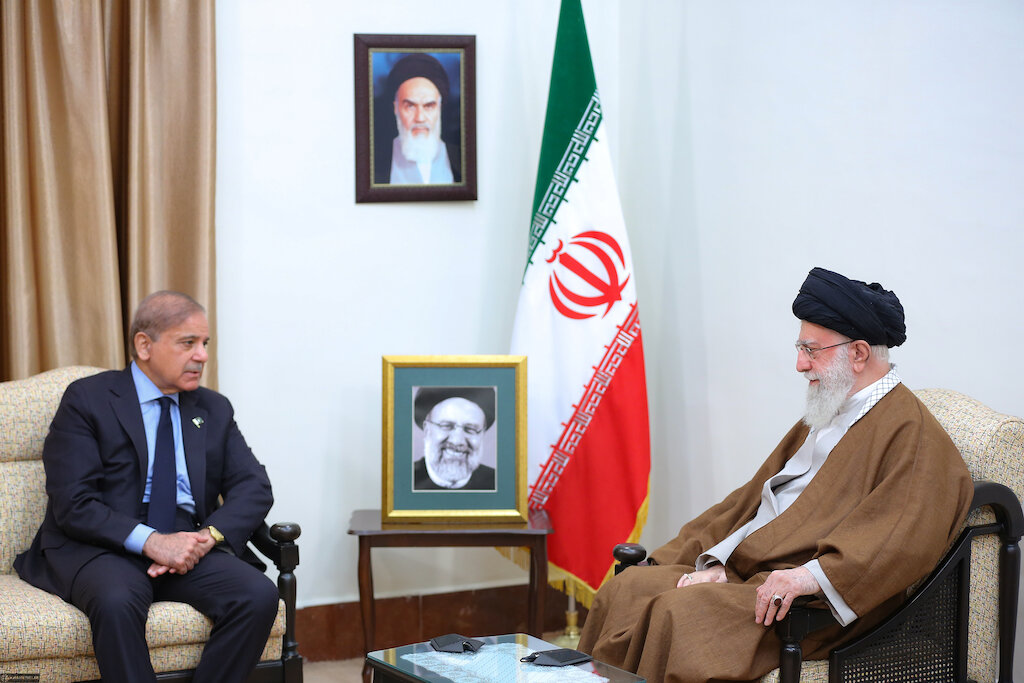
Prime Minister Shehbaz Sharif described the killing of Ayatollah Ali Khamenei as an “irreparable loss” and said both the government and people of Pakistan stood with Iran in its hour of sorrow. “The government and the people of Pakistan join the people of Iran in their hour of grief and sorrow and extend the most sincere condolences on the martyrdom of His Eminence Ayatollah Seyyed Ali Khamenei,” Sharif wrote in a post on X on Sunday. “Pakistan also expresses concern over the violation of the norms of international law. It is an age-old convention that the heads of state/government should not be targeted.”
President Asif Ali Zardari struck a similar note, saying the loss of a leader “of such stature”, along with other senior Iranian figures, would be felt across the Muslim world. Pakistan, he said, shared fully in the Iranian people’s grief.
The assassination, carried out in US and Israeli strikes on Saturday, prompted an immediate and wide-ranging Iranian response: missiles fired at Israel and at least seven other countries, including Gulf states that host American bases. Tehran denounced the operation as unprovoked and illegal.
The crisis has thrust Pakistan into one of its most delicate diplomatic balancing acts in years. With a long, sensitive border with Iran, deep economic and security ties to the Gulf monarchies, and now renewed hostilities with the Taliban government in Kabul, Islamabad is trying to defend its interests on multiple fronts without alienating any neighbour.
At an emergency session of the UN Security Council on Saturday, Pakistan’s permanent representative, Ambassador Asim Iftikhar Ahmad, set out that position with characteristic precision. He condemned the “initiation of unwarranted attacks against the Islamic Republic of Iran, in violation of international law”, but also denounced the subsequent strikes on Saudi Arabia, Bahrain, Jordan, Kuwait, Qatar and the United Arab Emirates, and expressed solidarity with those “brotherly countries”.
Ahmad warned that such actions risked undermining ongoing diplomatic efforts and could have “far-reaching consequences” for the stability of the entire Gulf region, home to millions of Pakistani expatriates. He praised Oman’s mediating role between Iran and the United States and noted that the strikes had derailed negotiations “right in the middle of” talks that were already fragile. Citing the UN charter, he reminded the council that its principles “are inviolable and sacrosanct” and prohibit the threat or use of force against the territorial integrity or political independence of states.
The ambassador offered condolences to civilians caught in the violence, singling out schoolchildren in Iran and the family of a Pakistani national killed in the UAE. “We are deeply alarmed at the risk of regional conflagration,” he said, adding that the safety of Pakistani citizens across the region remained a top priority. Pakistan, he said, called on all sides to “immediately halt escalation and urgently resume diplomacy”.
The domestic fallout was swift and bloody. Protests erupted in several major Pakistani cities on Sunday after news of Khamenei’s death. Clashes with law enforcement left at least 11 people dead and dozens injured. Interior Minister Mohsin Naqvi appealed for calm.
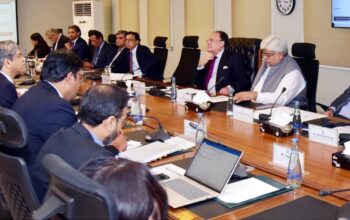
Sharif convened a high-level security meeting the same day to assess both the internal situation and the wider regional picture. Officials briefed him on security arrangements at home, Pakistan’s own peace initiatives, the situation in Afghanistan and the evacuation of Pakistani citizens from Iran, which is being arranged through Azerbaijan. The meeting took place against the backdrop of Pakistan’s military operation, launched earlier this week and named Ghazab lil-Haq, after tit-for-tat border strikes that began when Islamabad targeted Tehreek-e-Taliban Pakistan and Islamic State camps inside Afghanistan on 21-22 February.
Information Minister Attaullah Tarar said 415 Afghan Taliban fighters had been killed and more than 580 wounded since the latest phase of fighting intensified on Thursday. Gunshots and explosions were reported over Kabul on Sunday; an Afghan government spokesperson said they were air-defence actions against Pakistani aircraft and told residents not to be alarmed.
In another sign of the strain on Pakistan’s diplomatic calendar, Sharif postponed his official visit to Russia, due to take place from 3 to 5 March. The prime minister’s office described the trip as one of “great significance” for bilateral relations but said it was being delayed because of the “regional and internal situation”. A new date will be set through mutual consultations.
Sharif also spoke by telephone with Jordan’s King Abdullah II. Both leaders emphasised the urgent need for restraint, de-escalation and dialogue. Pakistan reaffirmed its solidarity with Jordan and other countries in the region and reiterated its readiness to support efforts to restore calm.
With millions of its citizens working in the Gulf, the foreign ministry moved quickly to protect them. It activated a 24/7 crisis management unit and issued a strong advisory urging Pakistanis in the region to remain indoors where possible, avoid unnecessary travel and follow instructions from host governments. Emergency contact numbers were published for missions in Iran, Saudi Arabia, the UAE, Qatar, Bahrain and Kuwait. The Pakistani embassy in Abu Dhabi added that flight operations from the UAE had not yet been restored and advised nationals to check with airlines before heading to the airport.
Copyright © 2021 Independent Pakistan | All rights reserved