By Staff Reporter
ISLAMABAD: Pakistan has expressed grave concern over a long-term uranium supply agreement concluded between Canada and India, describing the arrangement as yet another selective carve-out that weakens the international nuclear non-proliferation framework and threatens the strategic balance in South Asia.
The deal was announced on Monday as part of a broader package of bilateral agreements that also covered cooperation on critical minerals. Indian prime minister Narendra Modi hailed the nuclear component as a significant breakthrough. “In civil nuclear energy, we have struck a landmark deal for long-term uranium supply,” he said, adding that the two countries would also collaborate on small modular reactors and advanced reactor technologies.
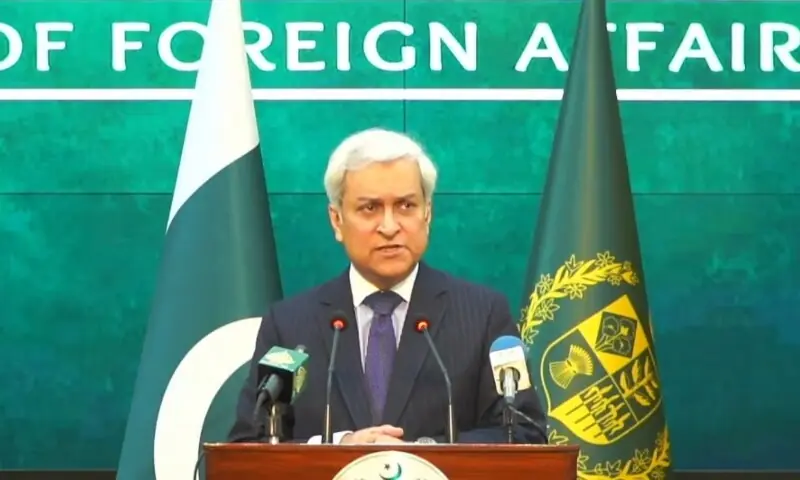
Responding on Thursday, Pakistan’s foreign ministry spokesman Tahir Andrabi said Islamabad had noted the development “with concern”, particularly the potential for joint work on small modular reactors and advanced reactor technologies. The arrangement, he said, represented “yet another country-specific exception in the field of civil nuclear cooperation”.
Andrabi pointed to the historical irony of the deal. India’s 1974 nuclear test, he recalled, had been conducted using plutonium produced in a reactor supplied by Canada for ostensibly peaceful purposes – an event that directly prompted the creation of the Nuclear Suppliers Group. “A state whose actions necessitated the establishment of global export controls is now being granted preferential access under selective arrangements,” he added.
The spokesman highlighted what he described as serious gaps in oversight. India has not placed all its civilian nuclear facilities under International Atomic Energy Agency safeguards, nor has it made any binding commitment to do so under the new agreement, Andrabi said. “Several facilities remain outside international inspection,” he noted, adding that it remained unclear what concrete non-proliferation assurances, if any, accompanied the uranium supply pact.
The strategic implications, he argued, were equally troubling. Assured access to external uranium supplies would effectively free up India’s domestic reserves for military purposes, enabling an expansion of its fissile material stockpiles, accelerating the growth of its nuclear arsenal and deepening existing asymmetries in South Asia’s strategic balance. In this context, the arrangement also undermined Canada’s own commitments to the international non-proliferation regime and its obligations under that framework, Andrabi said.
Pakistan, he reiterated, believes civil nuclear cooperation must be governed by a non-discriminatory, criteria-based approach that applies equally to all states that are not parties to the Nuclear Non-Proliferation Treaty. “Selective exceptions diminish the credibility of the global non-proliferation framework and risk further destabilising regional and global peace and security,” he added.
Copyright © 2021 Independent Pakistan | All rights reserved