By Staff Reporter
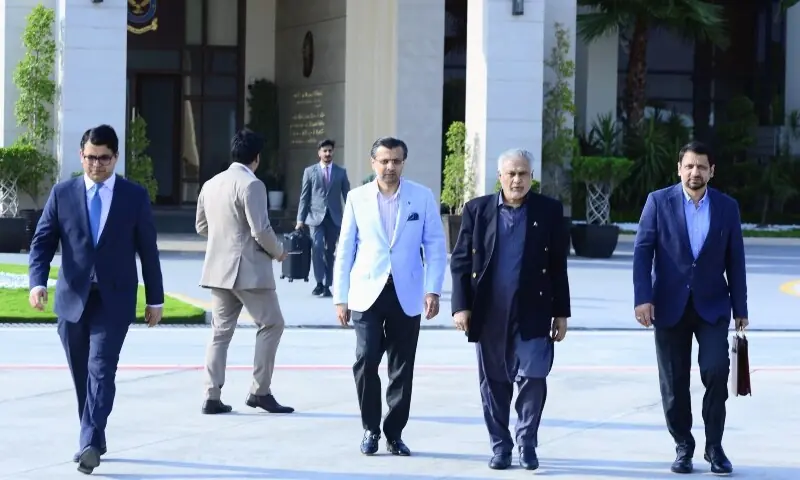
ISLAMABAD: Deputy Prime Minister and Foreign Minister Ishaq Dar left Islamabad on Thursday for a two-day visit to Shanghai, where he is expected to sign Pakistan into a newly formed international body aimed at coordinating global cooperation on artificial intelligence, according to a statement from the Foreign Office.
The trip, undertaken at the invitation of Chinese Foreign Minister Wang Yi, positions Pakistan among the founding members of the World Artificial Intelligence Cooperation Organisation, a group China first proposed last year as a vehicle for shaping how nations govern and share AI technology. Dar is also slated to take part in the opening of the 2026 World Artificial Intelligence Conference and a related high-level meeting on global AI governance, both scheduled for Friday in Shanghai.
The Foreign Office said Dar’s presence at the gathering reflects Islamabad’s effort to position itself within international conversations on AI policy at a moment when the technology’s governance has become a subject of intense diplomatic maneuvering between Washington and Beijing.
“During his engagements, the Deputy Prime Minister/Foreign Minister will share Pakistan’s perspective on strengthening international cooperation in artificial intelligence, with particular emphasis on the priorities and development needs of the Global South,” the Foreign Office said in its statement, adding that Dar intends to press for “bridging the global AI divide, promoting equitable access to AI technologies, enhancing capacity-building, and ensuring that the benefits of AI contribute to sustainable development and shared prosperity for all.”
Beyond the signing ceremony, Dar is expected to hold a bilateral meeting with Wang Yi and separate sessions with other officials to discuss what the Foreign Office described as “matters of mutual interest.”
A Beijing-led initiative years in the making
China’s push to establish the organisation dates to last year’s AI conference in Shanghai, where Premier Li Qiang used his opening remarks to call for stronger AI governance frameworks and greater support for open-source development, while announcing plans for a Chinese-led international cooperation body. That announcement has since evolved into the organisation Dar is set to help formally launch.
Pakistan’s support for the initiative was first signalled publicly in May, during a four-day visit to China by Prime Minister Shehbaz Sharif. At the time, Islamabad voiced backing for what it called “China’s initiative of establishing the World Artificial Intelligence Cooperation Organisation, believing that this represents a concrete step toward promoting the development of artificial intelligence for good and for all,” and committed to working with Beijing to advance international cooperation and governance frameworks around the technology.
Thursday’s departure moves that commitment from rhetoric to formal participation, with Pakistan set to become one of the organisation’s charter members rather than a later addition.
A conference shadowed by great-power competition
Dar’s visit lands amid a broader contest over who will set the rules for artificial intelligence on the world stage. Chinese President Xi Jinping is scheduled to address the conference Friday, marking his first appearance at the annual event and signalling, according to officials and analysts tracking the summit, the degree to which Beijing now regards AI as central to both its economic strategy and its standing in global technology competition.
The conference is also expected to serve as a showcase for China’s efforts to build advanced computing infrastructure independent of American technology. Huawei is scheduled to unveil its Atlas 950 SuperPoD, a large-scale AI computing system that links thousands of the company’s Ascend processors into a single high-speed cluster, in what industry observers describe as one of the most visible efforts yet by a Chinese firm to assemble cutting-edge AI infrastructure without relying on advanced chips from the American firm Nvidia. Domestic reports also indicate that DeepSeek’s latest V4 model has been adapted to run on Huawei’s Ascend-based clusters, and that additional Chinese chipmakers, including Biren and MetaX, plan to introduce their own large-scale computing systems at the conference.
The Shanghai gathering also arrives just ahead of the first government-level talks on artificial intelligence between Washington and Beijing since President Trump returned to office, a dynamic that has heightened the stakes of this year’s conference well beyond its usual role as a technology trade show. At a United Nations dialogue on AI last week, the two governments staked out sharply different positions: American officials argued that extensive regulation would slow technological progress, while Chinese representatives promoted their country’s low-cost, open-source AI models as a public good capable of narrowing AI disparities between wealthy and developing nations.
George Chen, chair of digital practice at the Asia Group, described the shift in the conference’s significance in stark terms, writing that against this backdrop, WAIC has become more than a technology showcase and is now a geopolitical stage where Beijing seeks to articulate its vision of AI as both a national priority and a diplomatic instrument.
A commentary published this week in People’s Daily, the Chinese Communist Party’s official newspaper, struck a similar note, arguing that AI development “must never move toward a technological monopoly that walls itself in” and should remain “anchored to the fundamental goal of serving humanity” — language widely read as a rebuke of Western efforts to restrict Chinese access to advanced computing technology.
A broader guest list, but limited American presence
The conference’s attendee list underscores both its growing international profile and the absence of major American technology firms. Confirmed attendees include United Nations Secretary General António Guterres, Kazakh President Kassym-Jomart Tokayev and Thai Prime Minister Anutin Charnvirakul, alongside nine Turing Award and Nobel laureates, among them artificial intelligence pioneers Yoshua Bengio and Richard Sutton. Organizers have also flagged product unveilings from Chinese firms including ZTE-owned Nubia and the AI startup StepFun, which are expected to introduce AI-integrated smartphones during the event.
The conference is scheduled to run alongside a separate high-level meeting on global AI governance, where officials are expected to detail further progress on the new cooperation organization and on implementing what China calls its Global AI Governance Initiative.
Pakistan’s own AI ambitions
For Islamabad, the Shanghai trip represents the latest step in a broader push to position Pakistan within the global artificial intelligence economy — an effort officials describe as central to the country’s plans for economic diversification and digital modernization.
Pakistan’s domestic AI sector, though still emerging, has drawn growing attention for its expanding role in health care, education and agriculture, sectors where officials say the technology is beginning to reshape service delivery and productivity. The government has pointed to a rising pool of AI-focused talent and a growing startup ecosystem as evidence that the country is positioning itself for further growth in the field.
That effort was formalised last year when Pakistan approved its National Artificial Intelligence Policy, a framework centered on innovation, public education, secure systems and international collaboration. The policy set out an investment target of roughly 278 billion rupees, or about $1 billion, through 2030, and established a nationwide training initiative known as “AI Seekho 2026,” intended to train one million people in AI-related skills. The plan also called for expanded AI infrastructure and a national framework governing data use, which officials said was designed to align the country’s approach to AI ethics with international standards.
Pakistan has already taken initial steps under that framework. In October of last year, the country launched what officials described as a sovereign AI cloud, along with a dedicated fund to support AI-focused startups — moves that officials have characterized as foundational to the country’s broader digital transformation strategy.
Copyright © 2021 Independent Pakistan | All rights reserved