By Staff Reporter
ISLAMABAD: Pakistan’s leading capital-market institutions on Wednesday formally established the Capital Market Development Fund, a new industry-backed vehicle designed to lift financial literacy, broaden retail investor access and deepen domestic capital mobilization as the country seeks greater economic independence amid regional tensions.
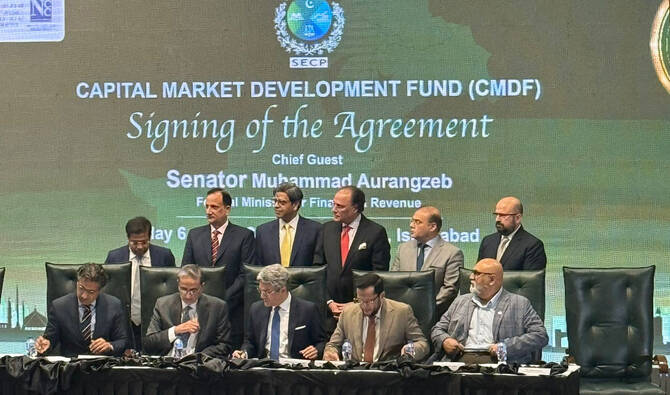
The fund was created under the oversight of the Securities and Exchange Commission of Pakistan and brings together the Pakistan Stock Exchange, Central Depository Company, National Clearing Company of Pakistan, Pakistan Mercantile Exchange and Institute of Financial Markets of Pakistan. Chief executives of the five entities — Farrukh H. Sabzwari of PSX, Badiuddin Akber of CDC, Naveed Qazi of NCCPL, Khurram Zafar of PMEX and Dr. Mobashar Sadik of IFMP — signed the agreement at a ceremony hosted by the SECP in Islamabad.
Finance Minister Muhammad Aurangzeb, addressing the event, said the initiative was part of a broader push to harness domestic resources after recent disruptions in the Strait of Hormuz underscored Pakistan’s vulnerability to imported energy shocks. “We must rely on our own resources and strengthen self-sufficiency,” he said. “Capital markets can play a vital role in providing the financing needed for economic independence.”
Aurangzeb said the government remains committed to economic stability, sustainable growth and financial-sector reforms, while focusing on strengthening the current-account balance, narrowing the fiscal deficit and maintaining macroeconomic stability. Despite regional uncertainties and global pressures, he noted, Pakistan’s economic indicators continue to show improvement and the stock market has demonstrated resilience, reflecting rising investor confidence.
He highlighted recent investor inflows — more than 220,000 new participants over the past two years, largely young people using digital platforms — and pointed to April’s record 24,000 additions as evidence of momentum on the equity side. The debt-capital market, by contrast, has slowed, prompting a call for regulatory improvements to corporate-bond issuance, ease of doing business and taxation in coordination with the Ministry of Finance and the Federal Board of Revenue.
SECP Chairman Dr. Kabir Ahmed Sidhu said retail investor participation still stands below 1 percent of the population, even after recent growth. The regulator’s target is to expand the investor base to 2.5 million through streamlined onboarding, simplified know-your-customer and anti-money-laundering procedures, and coordinated national efforts on financial literacy. “Investor awareness efforts have remained fragmented and retail outreach limited,” Sidhu said, adding that the CMDF would help address these structural gaps.
Sadik, whose institute will help steer the fund, described the CMDF as a “ring-fenced institutional mechanism” for long-term market development. It will be seeded with an initial Rs120 million contribution and sustained by annual payments equal to 1 percent of each participating institution’s revenue, creating a self-reinforcing funding model. The fund will operate along four pillars: financial literacy and investor awareness, expanded retail participation, financial inclusion focused on women, youth and underserved segments, and enhanced institutional capacity and market infrastructure.
Aurangzeb tied the fund’s launch directly to national priorities. Recent conflict-related volatility around the Strait of Hormuz — which carries roughly one-fifth of global oil and liquefied-natural-gas trade — has reinforced the need for strategic petroleum reserves, accelerated renewable-energy financing and reduced dependence on imported fuels, he said. “National security is energy security and therefore economic security,” the minister told the gathering. Pakistan is conducting scenario analysis on the economic impact of the Iran-related disruptions while keeping its focus on fiscal targets, balance-of-payments commitments and foreign-exchange reserves.
He also cited the impending privatization of Pakistan International Airlines as proof of substantial domestic capital. A consortium led by Arif Habib Corp. is set to assume management control of the loss-making national carrier on or before May 25, following a transaction now valued at roughly Rs180 billion ($645 million), including Rs55 billion payable to the government and Rs125 billion for recapitalization, fleet expansion and operational improvements. Initial collective bids reached about $1.2 billion, Aurangzeb noted. “We received collective bids of around $1.2 billion, demonstrating the capacity of local investors.”
The minister said further privatization moves in power distribution and financial institutions, alongside streamlined public-private partnerships, will make deeper capital markets even more critical. While foreign investment remains welcome, he emphasized that domestic resources must play the central role in financing infrastructure, renewables and private-sector growth.
Copyright © 2021 Independent Pakistan | All rights reserved