By Staff Reporter
ISLAMABAD: Pakistan’s top civil and military leaders on Tuesday condemned India’s continued control of Jammu and Kashmir, marking the sixth anniversary of New Delhi’s move to revoke the region’s autonomy.
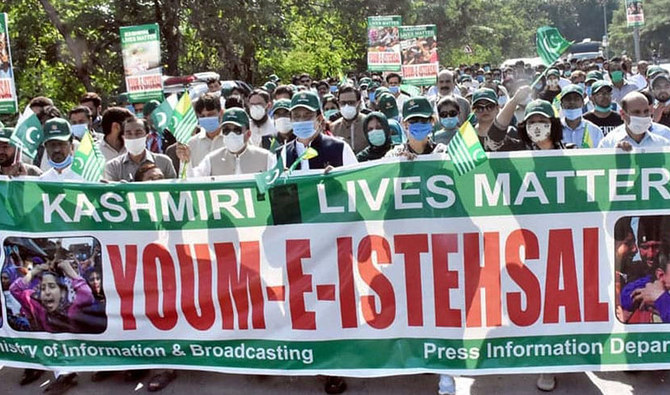
The country observed Youm-e-Istehsal (Day of Exploitation) to protest the August 5, 2019 decision by Prime Minister Narendra Modi’s government to scrap Article 370 of India’s constitution, ending the special status of Jammu and Kashmir and dividing it into two union territories.
Prime Minister Shehbaz Sharif, President Asif Ali Zardari, and the nation’s armed forces denounced India’s actions as a threat to regional stability and a violation of international law, while calling on the global community to intervene.
The commemoration reflects Pakistan’s unrelenting stance on the Kashmir dispute, a decades-long conflict that has defined tensions in South Asia since the partition of India and Pakistan in 1947. On August 5, 2019, India’s government, led by Prime Minister Narendra Modi, scrapped Article 370 of its constitution, stripping Jammu and Kashmir of its autonomy and splitting it into two union territories.
Pakistan and Kashmiris view the move as an illegal annexation aimed at altering the region’s demographic and political character. Sharif described India’s occupation as “the defining conflict of the South Asia region” and a “recipe for regional instability.”
The premier accused New Delhi of denying Kashmiris “basic human rights, dignity, and identity” under a regime sustained by “state terrorism and oppression.” “The continued denial of these rights to Kashmiris living under illegal occupation is a driver of rogue behaviour in the region,” Sharif said, urging the international community to press India to reverse its “unilateral and illegal actions” and implement United Nations Security Council resolutions that call for a plebiscite in Kashmir.
Sharif also lambasted India’s efforts to “silence genuine Kashmiri leaders” as part of a “wider hegemonic and extremist agenda.” He singled out the imprisonment of prominent figures such as Shabbir Ahmed Shah, Muhammad Yasin Malik, and Masarrat Alam Bhatt, saying that their detention “will never dim the resolve of our Kashmiri sisters and brothers.” “The brave Kashmiri people have endured this brutality with incredible dignity,” Sharif added.
Sharif framed the issue as a test for the international community, urging global powers to “play a role to halt Indian human rights crimes in IIOJK” and repeal what he called “draconian laws.” “The just resolution of the Jammu and Kashmir dispute is a key pillar of Pakistan’s foreign policy,” he said.
In a statement released by the Inter-Services Public Relations (ISPR), the armed forces also reaffirmed their “unwavering solidarity” with the people of Indian Illegally Occupied Jammu and Kashmir (IIOJK). “The continued illegal occupation of IIOJK by Indian security forces, characterized by an unrelenting military siege, systemic human rights violations, and demographic engineering, constitutes a grave breach of international norms,” the statement read. The military accused India of “repressive actions, coupled with its belligerent posture and incendiary rhetoric,” that “serve only to exacerbate regional instability and perpetuate human suffering.”
The ISPR emphasised that Pakistan’s armed forces “fully support the legitimate and ongoing struggle of the Kashmiri people for their inalienable right to self-determination,” as enshrined in international law and UN resolutions. “The Pakistan Armed Forces pay solemn tribute to the martyrs of IIOJK and reiterate their enduring commitment to stand shoulder to shoulder with the Kashmiri people in their just and rightful struggle for freedom,” the statement concluded.
President Zardari, in a separate message, underscored the urgency of resolving the Kashmir dispute in line with UN resolutions and the aspirations of the Kashmiri people. “The day underscores the need for a settlement of the Jammu and Kashmir dispute for a lasting peace in South Asia,” he said, noting that India’s actions since 2019 have deepened the crisis.
Zardari pointed to measures such as the “gerrymandering of electoral constituencies,” the issuance of domicile certificates to non-Kashmiris, and the expansion of the Lieutenant Governor’s administrative powers as evidence of India’s intent to reshape the region’s identity and undermine its people’s right to self-determination. The criticism extended beyond the top leadership.
The Kashmir conflict has been a persistent source of enmity between India and Pakistan, sparking two of their three wars and countless skirmishes along the Line of Control that divides the region. India insists that Kashmir is an integral part of its territory and has accused Pakistan of fuelling militancy there, a charge Islamabad rejects. Pakistan, in turn, maintains that it offers only moral, political, and diplomatic support to the Kashmiri struggle.
Copyright © 2021 Independent Pakistan | All rights reserved