By Staff Reporter
ISLAMABAD: Pakistan’s power sector regulator is being asked to approve mandatory battery storage requirements for a landmark competitive electricity auction, as the government moves to address grid instability caused by the rapid growth of solar power, Dawn newspaper reported on Tuesday.
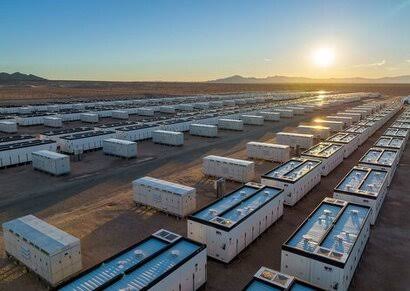
The Independent System and Market Operator (ISMO), the state-run body that oversees Pakistan’s power grid, has proposed to the National Electric Power Regulatory Authority (Nepra) that participants in an forthcoming 800MW capacity auction be required to pair their solar or wind projects with battery energy storage systems (BESS) equal to at least 10 per cent of firm capacity.
The auction, covering notional surplus capacity to be sold via wheeling arrangements, marks the first attempt by Pakistan to introduce competitive bidding into a power market that has operated under centrally negotiated contracts for more than three decades. The government is currently in discussions with private sector participants to finalise the bidding timetable.
The push for mandatory storage reflects mounting concern within the power division over the so-called duck curve — the pattern in which solar generation floods the grid during daylight hours before falling away sharply in the evening, just as demand from returning consumers peaks. Pakistan’s rapid uptake of rooftop and utility-scale solar has intensified the phenomenon, with large numbers of consumers effectively exiting the grid during the day and returning suddenly at dusk.
In its submission to Nepra, ISMO said the battery mandate was designed to address curtailment and duck curve pressures on the grid while also improving financial returns for auction participants. The regulator has given stakeholders seven days to comment before deciding on approval.
ISMO said the proposal followed extensive consultation, including multiple stakeholder meetings and a public session, at which most participants backed a minimum mandatory storage requirement, provided it remained financially viable. The operator’s own modelling found that returns for auction participants improved as battery capacity increased, up to a certain threshold, though the 10 per cent floor was ultimately set with input from prospective bidders. Auction participants remain free to install storage capacity above the mandated minimum, which the modelling suggests would yield further improvements in returns.
ISMO noted that international practice on integrating battery storage into grid systems fell broadly into two camps: markets with more developed regulatory frameworks generally opted to publish relevant technical information and allow market participants to make their own investment decisions, while developing markets tended to introduce mandatory requirements instead. It cited India, the Philippines, China and the Dominican Republic as developing markets that have taken the mandatory route.
Beyond the storage requirement, ISMO has proposed two further amendments to the auction framework. The first would give the operator discretion to extend the deadline for proposal submissions by prospective bidders by roughly a month. Under the auction process as currently approved, that deadline is fixed at one month with no scope for extension — a rigidity ISMO said could prove problematic given the likelihood that a significant number of participants seek more time during the first auction.
The second would establish a Grievance Redressal Committee, comprising two independent members of ISMO’s board alongside the operator itself, to handle complaints from bidders. The change was requested by prospective auction participants. Under the existing mechanism, the auction committee is responsible both for evaluating bidder eligibility and for adjudicating any grievances arising from those evaluations — a structure that has drawn criticism for placing the same body in charge of both functions.
Nepra declared the Competitive Market Operation Date effective from January 22 2026, but the first auction under the new framework has yet to take place. ISMO is required under the rules to publish an annual auction calendar by June 15 each year, setting out auctions to be held in the following fiscal year.
Copyright © 2021 Independent Pakistan | All rights reserved