By Staff Reporter
ISLAMABAD: The Pakistan Navy has initiated a new maritime security operation to safeguard the country’s critical energy imports and commercial shipping amid escalating disruptions in the Strait of Hormuz, the military said Monday as the widening US-Israeli conflict with Iran sent global oil prices surging more than 25 percent.
The operation, dubbed “Operation Muhafiz-ul-Bahr,” was launched to counter “multidimensional threats” to national shipping and maritime trade in an increasingly volatile regional environment, the Inter-Services Public Relations (ISPR), the military’s media wing, said in a statement. It came just hours after Pakistani officials sought to reassure the public that the country holds “comfortable levels” of petroleum stocks and that supply chains remain intact despite the intensifying Middle East fighting.
Global fuel markets were thrown into turmoil after Tehran blocked the narrow Strait of Hormuz — the strategic chokepoint between Iran and Oman through which roughly one-fifth of the world’s oil trade normally passes — in response to US-Israeli strikes on Iranian targets and Iran’s retaliatory attacks on several Gulf states. Oil prices jumped to $119.50 a barrel on Monday, the highest level since mid-2022, as several major producers curtailed supplies and traders braced for prolonged shipping delays.
In Islamabad, the developments raised immediate concerns about fuel shortages and the broader economic fallout from skyrocketing energy costs. Petroleum Minister Ali Pervaiz Malik told state media that three oil shipments are scheduled to reach Pakistan this week, even as the government grapples with the dual challenge of securing those cargoes and cushioning the impact of the global price spike.
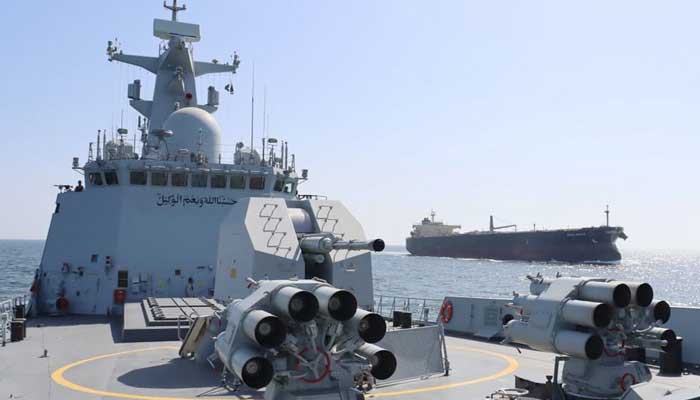
The navy’s response is focused on ensuring the uninterrupted flow of energy supplies and the protection of Pakistan’s sea lines of communication. Under the new operation, Pakistani warships are conducting escort missions in close coordination with the Pakistan National Shipping Corporation, the ISPR said. The navy is “fully cognizant of the prevailing maritime situation” and is actively monitoring and controlling the movement of merchant vessels to guarantee their safe transit through contested waters.
With approximately 90 percent of Pakistan’s trade carried by sea, military officials described the operation as essential to keeping vital sea routes open and secure. As of Monday, navy ships were escorting two merchant vessels, one of which was due to arrive in Karachi later in the day, the statement said. “Pakistan Navy remains fully prepared to respond to emerging maritime security challenges and is committed to ensuring the safety of national shipping and regional maritime security,” the ISPR added.
The measures show Pakistan’s delicate position in a region increasingly fractured by conflict. While Islamabad has sought to maintain a measured diplomatic stance, the direct threat to its energy lifelines has prompted swift military action. The navy’s deployment reflects long-standing concerns over the vulnerability of its maritime trade, which funnels the bulk of the country’s oil imports and commercial goods through routes now shadowed by the expanding war.
Officials have not detailed the exact scope or duration of the escort operations, but the ISPR’s statement suggested a proactive posture: continuous monitoring, coordinated escorts and readiness to adapt to “evolving regional maritime security environment.” The move also signals to international partners and adversaries alike that Pakistan intends to defend its economic arteries regardless of how the crisis in the Gulf deepens.
Copyright © 2021 Independent Pakistan | All rights reserved