By Staff Reporter
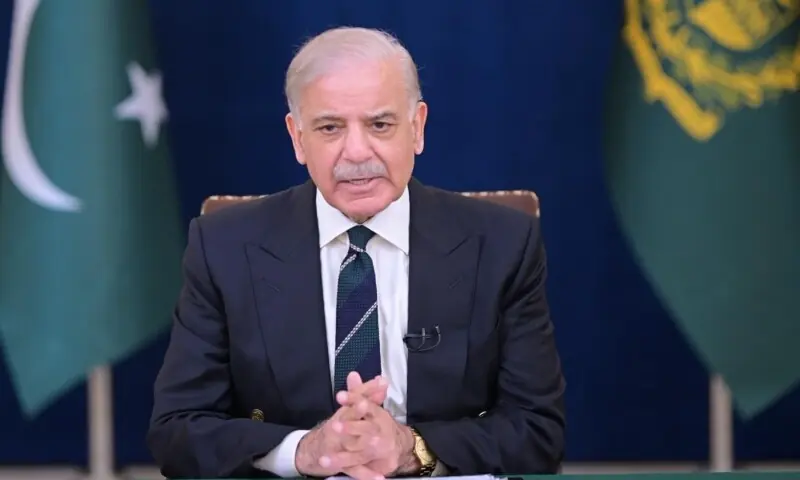
ISLAMABAD: Prime Minister Shehbaz Sharif announced a broad package of austerity measures on Monday to conserve fuel and reduce government spending as Pakistan grapples with the fallout from the US-Israel conflict with Iran, which has sent global oil prices surging past $100 per barrel and disrupted critical energy supplies to the region.
In a nationally televised address, Sharif detailed steps to slash official vehicle use, cut salaries for top officials and lawmakers, restrict foreign travel and shift to remote work and shorter office weeks — measures he described as necessary to shield the economy from a crisis largely beyond Pakistan’s control. The moves come days after the government raised petrol and diesel prices by as much as 55 rupees per liter, drawing criticism from opposition parties, allies and ordinary citizens.
The prime minister said the decisions were reached after consultations earlier on Monday with federal and provincial governments. He framed them as a collective response to “new challenges” facing the world, calling for national unity at a “delicate turn.”
The austerity plan targets government operations for the next two months. Fuel allowances for official vehicles will be halved, though ambulances and public buses are exempt. Sixty percent of vehicles used by government departments will be taken off the roads. The federal cabinet will forgo its salaries entirely during that period, while parliamentarians will see their pay reduced by 25 percent. Senior officials in grade BS-20 earning more than 300,000 rupees monthly will contribute two days’ salary toward public relief efforts.
Government departments face a 20 percent cut in overall expenses, along with a ban on purchasing new vehicles, furniture, air conditioners and other non-essential items. Foreign trips by ministers, advisers and officials have been prohibited except those deemed essential for national interests. Sharif urged the use of teleconferencing and online meetings to further save fuel. Official dinners and Iftar gatherings are banned, and seminars or conferences must now be held on government premises rather than in hotels.
The measures extend beyond the public sector. Except for essential services, 50 percent of staff in public and private offices will work from home. Government offices will operate only four days a week, though banks are exempt. All schools will observe a two-week break starting at the end of this week, while higher educational institutions will shift to online classes.
Sharif said directives had been issued to all provincial governments to implement the changes. The prime minister also warned against profiteering, telling oil traders and hoarders not to exploit the situation. “Otherwise, the law will come into effect and action will be taken,” he said.
The austerity drive stems from severe disruptions in global energy markets triggered by the conflict. The conflict has choked off key supply routes, including the Strait of Hormuz, through which much of the world’s oil passes. Pakistan, heavily dependent on oil and gas imports from the Gulf, has seen crude prices jump sharply from around $60 to more than $100 per barrel. Sharif acknowledged that the government faced a difficult choice on raising domestic fuel prices, saying his “head was at war with his heart” and that officials had opted for a middle path to lessen the burden on citizens, even as he warned that oil prices could rise again. “We tried to take the middle road so that the burden on you is less.”
Separately, three provinces also announced sweeping fuel-conservation measures on Monday, shuttering schools and universities, cutting official vehicle allowances and ordering work-from-home arrangement. The moves, unveiled separately by the governments of Khyber Pakhtunkhwa, Punjab and Balochistan, reflect mounting concern over petroleum shortages and rising prices that have already forced emergency steps across the region. Officials framed the initiatives as temporary but necessary precautions to protect public services and the economy without imposing new burdens on ordinary citizens.
In Khyber Pakhtunkhwa, the provincial cabinet approved a package of restrictions that will remain in place for two months under what it called the “Fuel Conservation and Responsible Governance Initiative.” The measures include a fresh 25 percent cut in fuel allowances for government vehicles — bringing the total reduction to 50 percent when combined with an earlier cut imposed during the Covid-19 pandemic. The reduction does not apply to police, rescue services or other law enforcement personnel.
Special Assistant to the Chief Minister on Information and Public Relations Shafi Jan said the provincial government will continue monitoring fuel availability at filling stations and has vowed strict action against hoarding. Supply of diesel to farmers for the wheat harvest will be protected. Additional measures include a 50 percent work-from-home policy for government departments, with all official meetings to be held virtually. Educational institutions will close on Fridays, with virtual learning prioritized. The use of VIP protocol vehicles and helicopters will be curtailed, and the government has banned unnecessary events and official dinners.
Jan said the province would remain vigilant. “We aim to implement these policies to protect the economy without burdening the people,” he said. The announcement came one day after the province unveiled a subsidy for registered motorcycle riders to offset recent petroleum price increases. Last week, the provincial finance department had already directed all offices to restrict fuel use to essential official duties, emergency responses and unavoidable field operations.
In Punjab, Chief Minister Maryam Nawaz ordered an even broader set of restrictions, according to a statement posted on the official X account of her party, the Pakistan Muslim League-Nawaz. Provincial ministers will receive no free petrol for the duration of the “petroleum crisis.” Fuel and diesel allowances for official vehicles are being reduced by 50 percent, and protocol vehicles for ministers and senior officials will be limited to one additional security vehicle during commutes.
Government offices will shift to a work-from-home model in which only essential staff report in person; the statement emphasized that core operations would continue uninterrupted. All schools, colleges and universities will close from Tuesday, March 10, through March 31, though online classes may be held and scheduled examinations will proceed as planned.
The province will also postpone the Horse and Cattle Show 2026, originally set to open March 28. Official outdoor activities are prohibited, and all government meetings will be conducted online or via teleconferencing. E-business services and the doorstep delivery program — which provides domicile certificates, FIR copies, birth certificates and other documents through a mobile app and web portal — will remain fully operational.
Punjab authorities have formed district-level petroleum monitoring committees and tasked the Punjab Information Technology Board with creating a track-and-trace system for fuel supplies. The system will include representatives from district administrations, police and the Punjab Enforcement and Regulatory Authority. The provincial government has also directed the private sector to adopt similar work-from-home policies, avoid unnecessary events and limit office attendance to essential staff only. The provincial authorities will also strictly monitore transport fares and food supplies, and take legal action against overcharging. In public appeals, the authorities urged citizens to forgo outdoor events and late-night shopping.
In Balochistan, the government issued two separate notifications closing all educational institutions as a precautionary measure. The College, Higher and Technical Education Department ordered intermediate, degree and technical colleges as well as public-sector universities to suspend all teaching, academic and administrative activities from March 10 through March 23.
A second notification from the School Education Department extended the closure to every public and private educational institution in the province, effective immediately on March 9 and lasting through March 23. The order cited “the prevailing regional situation arising out of recent war in the neighbouring region” and the need to prepare for potential mobility and transport constraints. The school closure notice made clear exceptions: the ongoing enrollment campaign, the digital census of schools and any scheduled examinations will continue without interruption. All concerned officers and staff were directed to ensure these activities proceed as planned.
Copyright © 2021 Independent Pakistan | All rights reserved