By Staff Reporter
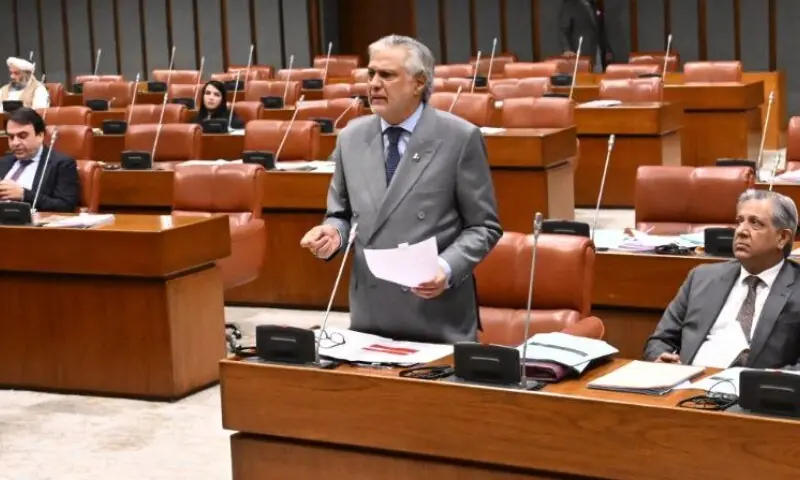
ISLAMABAD: Deputy prime minister and foreign minister, Ishaq Dar, told the Senate on Tuesday that Islamabad stood ready to mediate directly between Washington and Tehran, even as he expressed deep concern over a US-Israeli military strike on Iran that came despite what he described as promising diplomatic progress.
Dar said Pakistan was prepared to facilitate dialogue in Islamabad itself. Both Prime Minister Shehbaz Sharif and Chief of Army Staff Field Marshal Asim Munir had played “a very active and positive role” in diplomatic and defence-level efforts to ease tensions.
The minister’s address came amid a rapidly escalating Middle East conflict. Coordinated US-Israeli strikes on Iran over the weekend killed several senior Iranian figures, including Supreme Leader Ayatollah Ali Khamenei. Iran responded with missile and drone attacks on US bases and infrastructure across Gulf states, including airports.
Pakistani officials described the assault on Iran as “unprovoked and unwarranted”. Dar told senators that Iran had agreed not to develop nuclear weapons, but the United States was demanding the complete dismantling of Tehran’s nuclear programme. He insisted that Pakistan had consistently supported Iran’s right to the peaceful use of nuclear energy, describing it as a “legitimate right”.
The foreign minister recounted a series of recent diplomatic initiatives that had appeared to be gaining momentum. Prime Minister Sharif met the head of the International Atomic Energy Agency during a visit to Austria; the IAEA chief was said to be “optimistic that dialogue was heading in a positive direction”. Dar also spoke with Oman’s foreign minister, who reported that the latest round of US-Iran talks had ended “on a positive note” and had immediately briefed the US vice-president in Washington. “It was a repeat of what happened in June last year,” Dar said, referring to a 12-day war between Israel and Iran.
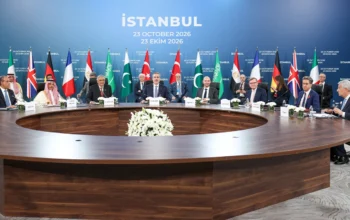
He recalled being in Istanbul with Iran’s then foreign minister, Abbas Araghchi, at a multilateral meeting when tensions were rising. Araghchi had asked him to divert Munir — then en route from the United States — to Istanbul. On 12 June the three men met and urged a diplomatic solution. Dar also cited his own meeting with US Secretary of State Marco Rubio in August last year, in which he had raised the Iran issue and received what he called a “positive response”. Pakistan had objected to any total ban on uranium enrichment, arguing instead for international surveillance involving two or three countries — an arrangement Tehran was said to have accepted. Locations for further talks were discussed; Islamabad featured in proposals from both sides. Despite these efforts, Dar said, the strikes had come “suddenly”. Iran had retaliated against what it called US bases and other infrastructure. Had those attacks not occurred, he suggested, Pakistan could have helped rally regional countries to speak with one voice against the US and Israel.
Pakistan was the only country to condemn the US-Israeli action within minutes, Dar said. “It took me 15 minutes to decide that we had to condemn.” He noted Pakistan’s strategic mutual defence agreement with Saudi Arabia and said he had reminded Tehran of that pact. Iran had sought assurances that Saudi soil would not be used against it; those assurances were conveyed, and the Iranian reaction towards both Saudi Arabia and Oman had remained minimal. Dar stressed that Pakistan’s position on Iran had not changed and urged political leaders to manage public sentiment. “Do not let people get swayed,” he said.
Dar told the Senate that Pakistan would continue its diplomatic engagement and that opposition leaders would receive a detailed briefing the following day. The government, he said, viewed the situation as highly challenging but remained fully committed to de-escalation and a return to talks.
The Senate session also heard strong criticism from the opposition. PTI parliamentary leader Ali Zafar described the US and Israeli actions as illegal under the UN charter, which permits the use of force only when authorised by the Security Council or in self-defence against an armed attack. There was, he said, no evidence of any imminent Iranian attack on the US or Israel — a point previously acknowledged even before the US Congress.
Zafar noted that negotiations between Washington and Tehran had been advancing before being abandoned for military action. He warned that normalising such strikes could set a dangerous precedent, potentially justifying the assassination of political leaders anywhere. He called on responsible nations to use every diplomatic and legal means to stop what he termed “an illegal war of choice, not necessity”, citing past conflicts in Vietnam, Iraq, Libya and Syria as cautionary examples.
PPP parliamentary leader Senator Sherry Rehman set out what she called the core principles of Pakistan’s foreign policy: first, the protection of Pakistani citizens; second, the safeguarding of national sovereignty and territorial integrity; and third, the pursuit of national interests in a balanced and impartial manner while condemning attacks wherever they occur.
Pakistan, she said, had expressed sorrow over the assassination of Ayatollah Khamenei and had been the only Muslim country to formally condemn it. Rehman reaffirmed Islamabad’s deep and constructive ties with Gulf states and its policy of brotherhood towards Afghanistan. Wars, she added, were never a solution; dialogue remained the only sustainable path. She cautioned against alarmist talk of a third world war and urged public representatives to speak responsibly, warning that inflammatory rhetoric could sway citizens. Pakistan’s territory must not be used against any other country, she said, and national unity must transcend political differences.
Copyright © 2021 Independent Pakistan | All rights reserved